Resources / Design ideas
Barndominium Exterior Colors: Real Schemes, Panel Names, Heat
Updated November 2026 · Barndo Finder research
Quick answer
The most common barndominium color schemes pair white, gray or tan walls with a darker roof and trim, often over a stone or dark wainscot. Color rarely changes the price on standard panel lines, but it changes heat: on one manufacturer's chart, white panels reflect 0.64 to 0.66 of sunlight and dark colors such as black, brown, forest green and burgundy 0.25 to 0.33.
The most common barndominium exterior colors are white, gray and tan walls with a darker roof and trim, often over a stone or dark wainscot. On standard panel lines, color rarely changes the price. It does change heat: on Metal Sales' 29 gauge chart, White panels reflect 0.66 of sunlight and Black 0.33, so a dark roof absorbs roughly twice the solar energy of a white one.
Below are 10 real builds from builders in our directory grouped by wall color, the actual color names three manufacturers use, trim and wainscot combinations that work, and the heat, fading and HOA facts to check before you order.
Key takeaways
- Light walls, darker roof and trim is the most common scheme in the builds we catalog. It hides dirt on the trim and keeps the roof visually heavy.
- Color names vary by manufacturer. "Burnished Slate," "Charcoal" and "Black" are three different colors. Order from a physical sample, not a screen.
- Color is rarely a price upgrade. On Metal Sales' 29 gauge chart, only Patriot Red and Native Copper carry an upcharge.
- The roof color matters most for heat. Solar reflectance on one chart runs from 0.66 (White) down to 0.25 (Burgundy).
- The paint system matters most for fading. PVDF and silicone-modified polyester (SMP) finishes carry different fade and chalk warranties.
- Get HOA or county approval in writing before the panels are ordered.
What are the most popular barndominium exterior colors?
Manufacturers do not publish sales rankings by color. What we can show is what builders in our directory actually build. Here are real examples in each color family.
White
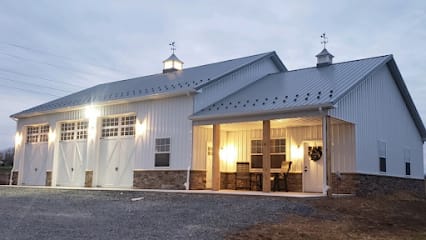 Photo: Fetterville Sales
White walls, a medium gray roof and a stone wainscot. The stone does the work that a dark wainscot panel does on simpler builds: it breaks up a tall white wall and hides mud splash at the base. White is also the most heat-reflective wall choice, at 0.64 to 0.66 solar reflectance on the Metal Sales chart.
Gray and charcoal
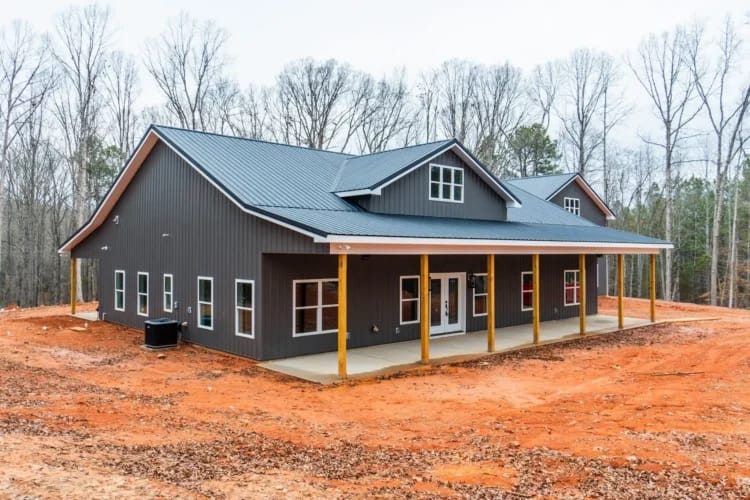 Photo: 757 Building Company
A near-monochrome scheme from Virginia: dark gray walls and roof, white window trim, and natural wood porch posts. The white trim and the wood keep a dark body from reading as one flat block. Dark grays are among the least reflective colors, so this scheme suits a well-insulated roof.
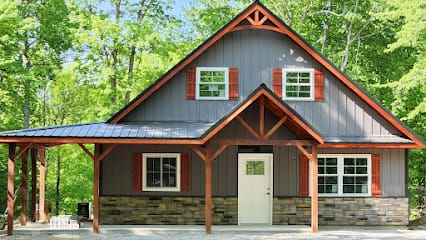 Photo: Dutchway Services
Gray with a strong accent. This Tennessee build uses light gray walls and roof, red trim and shutters, and a stone wainscot. The red is limited to trim and shutters, which is how most owners use a bright color without the whole building reading as a barn.
Tan, cream and beige
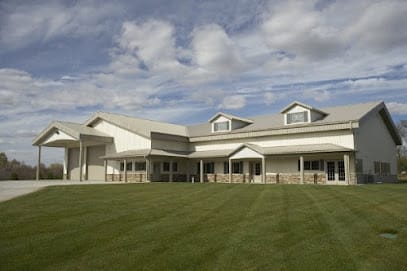 Photo: Structural Buildings
Cream walls, a light roof and a low stone wainscot, from Minnesota. Tans and creams are an easy sell to HOAs and neighbors because they blend into fields and dirt. They also reflect well: Light Stone is 0.58 and Mocha Tan 0.52 on the Metal Sales chart.
Red
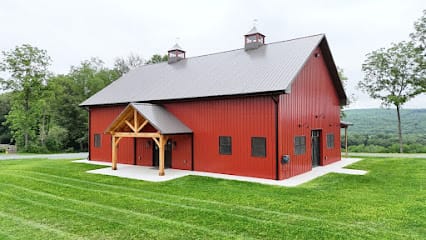 Photo: Fetterville Pole Buildings
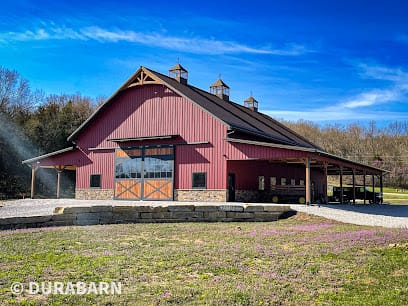
Classic barn red with a gray roof and a timber-framed gable entry. Red walls with a light or galvalume-colored roof is the most traditional scheme there is, and in farm country it reads as belonging there. Plain Red reflects 0.37 on the Metal Sales 29 gauge chart; the deeper Burgundy is 0.25. The featured photo at the top of this page, from Durabarn in Missouri, shows the dressed-up version: red walls over a stone wainscot, a dark roof, and cedar-look sliding doors under a timber gable accent.
Brown and bronze
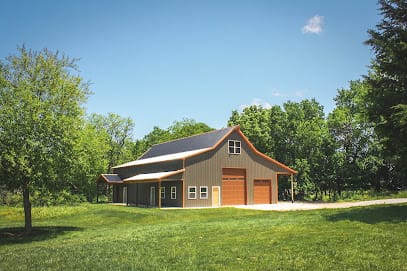 Photo: Yutzy Custom Structures
A brown body with copper-colored trim and matching garage doors under a charcoal roof, from Missouri. Browns and bronzes hide dust and pollen better than any other color, which is why they show up on gravel-road properties. They sit near the bottom of the reflectance chart, at about 0.30 to 0.32.
Blue
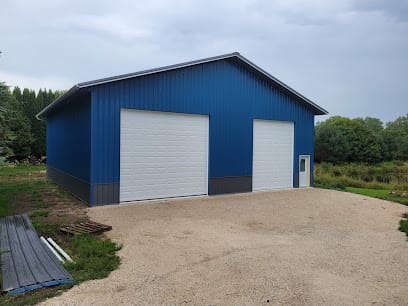 Photo: Jerry Duggan General Contractors
Bright blue walls with a charcoal wainscot and white doors on a Wisconsin building. Blue is a strong, deliberate choice. It shows up most as navy on houses and as brighter blues on shops. Ocean Blue reflects 0.34 on the Metal Sales chart.
Green
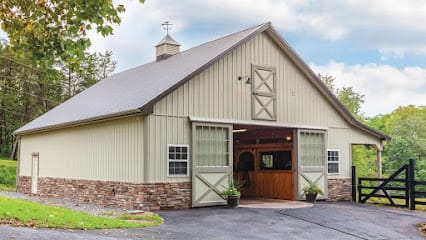 Photo: Conestoga Buildings
Sage green walls, a gray roof, white trim and stone wainscot on a New Jersey barn. Light greens like this read as a painted farmhouse. Deep greens (Forest Green is 0.27 on the Metal Sales chart) are among the hottest colors for a roof.
Black and near-black
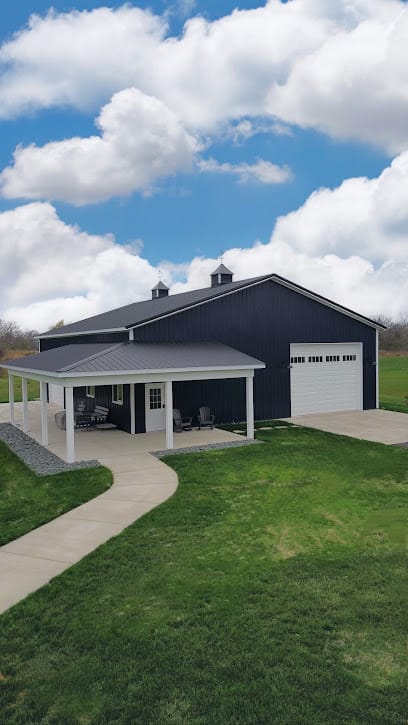 Photo: Everlast Structures
Dark walls and roof with white trim, white porch columns and a white overhead door, from Wisconsin. The white details keep a dark building crisp. Black is a big enough topic that it has its own page: see our black barndominium guide for the heat numbers and real builds.
What colors do manufacturers actually offer?
Names differ by company, and the same name does not always mean the same color. Here is what three suppliers list.
| Color family | Metal Sales (Colorfast45, 29 ga) | General Steel | Sheffield Metals (PVDF) |
|---|---|---|---|
| White | Bright White, White | Polar White, Snow White | Regal White, Stone White, Solar White |
| Tan and beige | Light Stone, Mocha Tan, Carlsbad Canyon | Almond | Sandstone, Sierra Tan, Surrey Beige |
| Gray | Ash Grey, Zinc Grey, Charcoal | Ash Gray, Charcoal Gray | Ash Gray, Dove Gray, Slate Gray, Charcoal Gray |
| Brown and bronze | Taupe, Brown, Burnished Slate | Koko Brown, Medium Bronze, Burnished Slate | Medium Bronze, Dark Bronze, Mansard Brown, Burnished Slate |
| Red | Red, Burgundy, Patriot Red | Crimson Red | Colonial Red, Regal Red, Burgundy, Terra Cotta |
| Blue | Ocean Blue | Cobalt Blue, Gallery Blue | Regal Blue, Slate Blue |
| Green | Forest Green | Fern Green | Hartford Green, Hemlock Green, Evergreen, Patina Green |
| Black | Black | (not in its featured list) | Matte Black |
Sources: Metal Sales color guide, General Steel color choices, Sheffield Metals colors. Availability varies by gauge, panel profile and branch, so confirm the exact color on the panel you are buying.
One name to watch: Burnished Slate appears on all three lists. It is a dark brown-gray that often reads as black in photos. If you want black, order a sample of both.
Which trim and wainscot combinations work?
Most barndominiums use three to four colors: walls, roof, trim, and sometimes a wainscot along the bottom 3 to 4 feet of wall. Here are combinations that show up in our directory photos and in General Steel's published examples.
| Walls | Roof | Trim | Wainscot | Example |
|---|---|---|---|---|
| White | Gray | White | Stone | Fetterville Sales, above |
| Polar White | Galvalume | Crimson Red | Crimson Red | General Steel example |
| Red | Dark | Wood accents | Stone | Durabarn, featured photo |
| Ash Gray | Not specified | Burnished Slate | None | General Steel example |
| Gray | Gray | Red | Stone | Dutchway Services, above |
| Almond | Medium Bronze | Medium Bronze | None | General Steel example |
| Cream | Light | Cream | Stone | Structural Buildings, above |
| Red | Gray | Red | None | Fetterville Pole Buildings, above |
| Koko Brown | Not specified | Snow White | None | General Steel example |
| Blue | Dark | Dark | Charcoal | Jerry Duggan, above |
| Charcoal or black | Dark | White | None | Everlast Structures, above |
Rules of thumb from these builds:
- Put the darkest color low or on top, as wainscot or roof, not in the middle of the wall.
- Match trim to the roof or the wainscot so the building reads as two or three colors, not four.
- Stone or wood counts as a color. If you add a stone wainscot or cedar posts, simplify the steel colors.
- White trim shows dirt; dark trim hides it. Choose accordingly for a gravel road.
Does exterior color affect heat?
Yes, mostly through the roof. Solar reflectance measures the share of sunlight a surface bounces back, from 0 to 1. Here is the full Metal Sales 29 gauge Colorfast45 chart, the most complete published set we found.
| Color | Solar reflectance | SRI |
|---|---|---|
| White | 0.66 | 79 |
| Bright White | 0.64 | 76 |
| Light Stone | 0.58 | 68 |
| Mocha Tan | 0.52 | 60 |
| Ash Grey | 0.49 | 56 |
| Carlsbad Canyon | 0.49 | 56 |
| Zinc Grey | 0.42 | 46 |
| Red | 0.37 | 39 |
| Charcoal | 0.35 | 37 |
| Ocean Blue | 0.34 | 35 |
| Taupe | 0.34 | 35 |
| Black | 0.33 | 34 |
| Brown | 0.32 | 33 |
| Burnished Slate | 0.32 | 33 |
| Forest Green | 0.27 | 26 |
| Burgundy | 0.25 | 24 |
Source: Metal Sales 29 gauge Eastern color guide, tested to ASTM C1549. Painted colors on that chart have a thermal emittance of 0.85 to 0.86.
What that means on a hot day: Lawrence Berkeley National Laboratory found that a clean white roof reflecting 80 percent of sunlight stays about 55°F cooler on a summer afternoon than a gray roof reflecting 20 percent, and a cool-colored roof reflecting 35 percent stays about 22°F cooler than one that looks the same but reflects 10 percent.
In cold climates the trade flips a little. The EPA notes that reflective roofs can raise heating use in winter, but that this heating penalty is typically offset by summer cooling savings. Practical takeaway: in the South, a light roof over any wall color is the cheapest energy decision on the exterior. In the North, choose on looks and insulate well. Either way, insulation decides how much roof heat reaches the rooms, which we cover in barndominium insulation.
Do barndominium colors fade?
All painted steel fades slowly. The warranty tells you how much the manufacturer will stand behind, and it depends on the paint system more than the color.
| Paint system (Metal Sales) | Film warranty | Fade limit | Chalk limit |
|---|---|---|---|
| PVDF (Kynar 500) | 45 years | 5 Hunter units for 35 years | No worse than a No. 8 rating for 35 years |
| MS Colorfast45 | 45 years | 5 NBS units on walls, 6 on roofs, for 30 years | No. 8 on walls, No. 7 on roofs, for 30 years |
Sources: Metal Sales PVDF warranty and Colorfast45 warranty. Both exclude sites too close to salt water: more than 1,500 feet for the PVDF warranty and more than 1,100 yards for Colorfast45. General Steel advertises a 40-year paint warranty on its color choices.
Two things stand out. Roofs get a looser fade limit than walls because they take more sun, so expect a roof to shift before the walls do. And coastal buyers should read the salt-water distance before choosing any paint system, because the warranty may not apply at all.
Can an HOA or county restrict barndominium colors?
Yes. An HOA with an architectural review committee can require approved colors, and some towns review exterior colors on new buildings. General Steel notes that depending on your municipality, the colors you select for a steel building may need approval before fabrication.
Steps that avoid a costly mistake:
- Read the HOA covenants for exterior materials and colors before you buy the lot.
- Submit the actual color names and a sample to the review board, not a rendering.
- Get approval in writing before the panels are ordered. Painted panels are cut to length for your building and cannot be returned.
- Check the county too if you are in a historic district or a planned development.
For the broader question of where a barndominium is allowed at all, see our barndominium zoning guide.
Our take
Pick the roof color for your climate first, then the walls, then the trim. In hot states, a light roof over any wall color is a real energy decision, and the chart above shows how much it matters. After that, the schemes that age best in our directory photos are the simple ones: a light or mid-tone body, one darker color for the roof and trim, and a stone or wood accent at the entry. Order physical samples, look at them outside at noon and at dusk, and choose the paint system before the color. For more finished builds, browse our barndominium pictures and the modern barndominium gallery.
Get quotes with your color scheme
When you request quotes, include the wall, roof, trim and wainscot colors and the paint system so every builder prices the same building. See what a finished barndo costs in your state on our cost table, or browse builders in Pennsylvania, Iowa and Texas.
Common questions
What is the most popular color for a barndominium?
White, gray and tan walls with a darker roof and trim are the most common schemes in the real builds we catalog. Manufacturers do not publish sales rankings by color, but General Steel lists its most popular picks as Crimson Red, Polar White, Snow White, Cobalt Blue, Gallery Blue, Almond, Medium Bronze, Charcoal Gray, Ash Gray, Fern Green, Koko Brown and Burnished Slate.
Does the color of a metal roof affect heat?
Yes. A light roof reflects more sunlight and stays cooler. Lawrence Berkeley National Laboratory found a clean white roof reflecting 80 percent of sunlight stays about 55 degrees Fahrenheit cooler on a summer afternoon than a gray roof reflecting 20 percent. On Metal Sales' chart, White reflects 0.66 and Black 0.33. Insulation reduces how much of that heat reaches the rooms.
Do metal building colors fade?
All painted steel fades slowly, and warranties spell out how much. Metal Sales warrants its PVDF finish not to fade more than 5 Hunter units for 35 years, and its Colorfast45 finish not more than 5 units on walls and 6 on roofs for 30 years. Both require the building to sit a set distance from salt water. Ask for the paint system, not just the color.
Do dark colors cost more on a barndominium?
Usually not. Most manufacturers price all standard colors the same, and the upcharge colors are specific named ones. On Metal Sales' 29 gauge chart, only Patriot Red and Native Copper carry an upcharge. Metal Sales offers its PVDF colors on heavier 24 gauge panels, so the paint system and gauge move the price more than the color does.
Can an HOA or county restrict barndominium colors?
Yes. HOAs with architectural review can require approved colors, and some towns review exterior colors for new buildings. General Steel notes that depending on your municipality, building colors may need approval before fabrication. Get written approval before the steel is ordered, because painted panels cannot be swapped once they are cut.
Ready to price your build?
Fill out one form. We send it to builders who work in your area. It costs nothing.
Request quotes