
Builders / North Carolina
Barndominium builders in North Carolina
Planning a build? Read our guide to building a barndominium in North Carolina.
Builders tracked
Barndominium-specific, deduplicated
Turnkey
Per sqft, directory estimate
Shell only
Per sqft, directory estimate
Permits and codes in North Carolina
The North Carolina State Building Code applies in every county, and residential work over $40,000 requires a licensed general contractor you can check against the NC Licensing Board database. Post-frame dwellings normally need engineered, sealed plans. Coastal counties add wind zone requirements east of I-95, and mountain counties add snow load. County inspections are consistent statewide, which makes NC one of the more predictable barndo states to permit in.
Financing a barndominium in North Carolina
NC has more barndo-experienced lenders than most states east of Texas. AgCarolina and AgSouth Farm Credit (which absorbed Carolina Farm Credit in 2023) write construction-to-permanent loans on metal homes with land, and several community banks in the Piedmont follow appraisals rather than construction type. Comparable sales now exist in most rural counties.
The list (7)
Sorted by review count. Featured listings are labeled.



Greensboro, NC


New London, NC
Ad space available
Your barndo business can be here
Builders, lenders, kit makers and suppliers: put your company in front of people planning a barndominium in North Carolina.
Get the deck and pricingBuilding a barndominium in North Carolina
A finished barndominium in North Carolina runs about $150 to $220 per square foot turnkey, or $45 to $75 per square foot for a shell, by our directory estimates. That puts a 2,400 square foot home at roughly $360,000 to $528,000 before land and site work. We list 7 North Carolina builders, most of them in the Piedmont.
North Carolina is the opposite of Texas or Tennessee on rules. One building code covers every county, inspections are routine, and general contractors need a state license on any real house. That predictability comes with two hard gates on rural land: the county health department's septic permits, which must be in hand before the building permit, and on the coast, wind engineering plus coastal permits and insurance.
Land, zoning and deed restrictions
Many North Carolina counties zone, and the barndo question is usually about the district, not the building type. In residential-agricultural districts a post-frame or steel home is a single-family dwelling like any other. In suburban residential districts, and especially in subdivisions, recorded covenants and HOA rules can ban metal siding, require a minimum heated square footage or require architectural approval. Have the closing attorney pull every recorded restriction before you sign, and read them for "metal," "exterior materials" and "accessory building."
Call the county planning department with the parcel number and ask what district it is in and whether anything in the local ordinance treats a metal-sided home differently. Around Raleigh, Charlotte and the Triad, you will also want to ask about minimum lot sizes and road frontage before you fall for a flag lot.
Codes, engineering and climate
The North Carolina State Building Code applies in every jurisdiction. The Office of State Fire Marshal lists the 2018 North Carolina Residential Code as the edition in effect since January 1, 2019, and it has posted notices about the effective date of the 2024 update. Ask your county inspections department which edition it will review your plans against when you apply.
Three things drive the engineering:
- Coastal wind and coastal permits. Design wind speeds climb toward the coast. Beyond the code, the state's 20 coastal counties fall under the Coastal Area Management Act, and building inside an Area of Environmental Concern (oceanfront or estuarine shoreline, for example) takes a CAMA permit. Local permit officers can issue some of them. Ask about it before you buy a waterfront lot.
- Mountain flooding. Hurricane Helene in 2024 showed how fast western North Carolina valleys flood. A flat creekside pad is the cheapest place to build and the riskiest. Check the parcel on FEMA's flood map and ask the engineer about elevation even outside a mapped zone.
- Humidity and termites. Condensation under a metal roof is the most common barndo complaint in the humid Southeast, and post-frame buildings put wood posts at or below grade. Ask what treatment rating the posts carry and whether the slab gets a termite pretreatment.
What a barndominium costs in North Carolina
Here is the math from our state table. These are Barndo Finder directory estimates, not transaction data, and they exclude land, well, septic, site work and the driveway.
| Size | Shell ($45 to $75/sqft) | Turnkey ($150 to $220/sqft) |
|---|---|---|
| 1,500 sq ft | $67,500 to $112,500 | $225,000 to $330,000 |
| 2,400 sq ft | $108,000 to $180,000 | $360,000 to $528,000 |
| 3,000 sq ft | $135,000 to $225,000 | $450,000 to $660,000 |
North Carolina matches the national median for shells and runs $5 per square foot above it for turnkey (national: shell $45 to $75, turnkey $145 to $215). It sits $10 per square foot above Tennessee and Georgia at each end of the turnkey range, which fits a state with full plan review, licensed contractors and coastal wind work. Our 2026 cost report has the national picture, the sizes guide shows how footprint moves the total, and every state is on the cost page.
Financing and insurance in North Carolina
Two Farm Credit associations cover the state. AgCarolina Farm Credit serves 46 counties in central, eastern and southeastern North Carolina and makes rural home and construction loans to non-farmers. AgSouth Farm Credit merged with Carolina Farm Credit on April 1, 2023, and now serves 147 counties across Georgia and the Carolinas. AgSouth publishes a barndominium financing guide listing what it needs before closing: plans, contractor bids, proof of utilities and local approvals. Community banks in the Piedmont round out the options. Our construction loan guide explains draws, and the financing page compares lender types.
Inland, insurance is a normal homeowners policy from an agent who writes post-frame and steel homes. On the coast, the Coastal Property Insurance Pool (NCIUA) is the market of last resort for property coverage in the beach and coastal areas. Get a wind and flood quote on the lot before you close, not after the slab is poured. Our barndominium insurance guide covers carrier types.
Utilities, well and septic
Septic sets the schedule on rural land. Under state law, the local health department must evaluate the soils and issue an improvement permit and a construction authorization before house construction begins, and you need the construction authorization before a building permit can be issued, per NC State Extension. An environmental health specialist does the soil and site evaluation. Order it before you close; a denial means the lot cannot hold the house you planned.
While you are at the health department, ask what it requires for a new private well on the same lot, since the well and the drainfield have to fit together on the site plan. For budgeting, published estimates run $3,500 to $8,500 and up for a septic system and $10,000 to $30,000 for a drilled well, per our build process guide. Mountain wells can run deep, so get a local driller's estimate early.
A realistic timeline in North Carolina
Plan on 12 to 18 months from design to move-in, the national range from our build timeline guide. North Carolina tends toward the middle of that range: nothing is skipped, but nothing is mysterious either.
- Before you buy: zoning, covenants, the septic soil evaluation, and on the coast, CAMA and flood questions.
- Pre-construction: 3 to 6 months. Stamped engineering, the loan, septic permits first, then the building permit and plan review.
- Construction: 6 to 12 months for a turnkey home, with county inspections at each stage. Mountain sites add grading and access time.
Builders we list in North Carolina
We list 7 barndominium builders in North Carolina. Here is all of them, by region, with what our data shows. Ratings are public Google reviews at the time we indexed them.
| Region | Builder | City | Build type | Rating |
|---|---|---|---|---|
| Mountains | Morton Buildings, Inc. | Fletcher | Turnkey (Morton) | 2.2 (21 reviews) |
| Foothills | Ridgeline Construction LLC | Hiddenite | Shell | 5.0 (17 reviews) |
| Piedmont | Ever Trust Construction, LLC | Mocksville | Shell and turnkey | 5.0 (13 reviews) |
| Piedmont | The Barndo Co. | Greensboro | Shell | 5.0 (3 reviews) |
| Piedmont | Knox & Associates LLC | New London | Shell and turnkey | 5.0 (1 review) |
| Piedmont | Tyro Structures | Linwood | Shell and turnkey, Red Iron kits | 5.0 (1 review) |
| Eastern NC | The Barndo Co. | Dunn | Turnkey | 5.0 (2 reviews) |
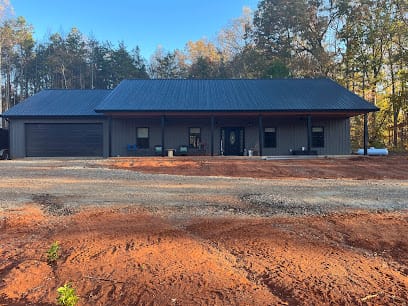
Photo: The Barndo Co.
Review counts in North Carolina are thin, so lean on completed builds you can visit and on the license lookup. If you are comparing kit steel, our red iron kit guide explains grades and pricing, and our Morton Buildings review covers that company. Buying a shell and finishing it yourself? Read shell vs turnkey first, then browse barndominium floor plans.
Ready to price your build? Request quotes from North Carolina builders who serve your county, and compare every number to our cost table.
Updated September 2026 · Barndo Finder research
Building in North Carolina: common questions
Do you need a permit to build a barndominium in North Carolina?
Yes, in every county. The North Carolina State Building Code applies statewide, so a barndominium gets a building permit and inspections like any other house. On rural land you also need an improvement permit and a construction authorization for the septic system from the county health department, and the building permit cannot be issued until you have them.
How much does a barndominium cost in North Carolina?
Our directory estimate for North Carolina is $150 to $220 per square foot turnkey and $45 to $75 per square foot for a shell. A 2,400 square foot turnkey build works out to about $360,000 to $528,000 before land, well, septic, driveway and site work. Those are estimates from our state table, not quotes.
Does a North Carolina barndominium builder need a license?
Yes, for any project valued at $40,000 or more, which covers essentially every barndominium. The general contractor must hold a license from the North Carolina Licensing Board for General Contractors, and you can search the board's database by name or license number before you sign.
Can you build a barndominium on the North Carolina coast?
Yes, but plan for more engineering and paperwork. Coastal counties sit in higher design wind zones, a lot inside an Area of Environmental Concern needs a CAMA permit from the Division of Coastal Management or a local permit officer, and wind coverage may have to come from the Coastal Property Insurance Pool if private carriers decline.
Which lenders finance barndominiums in North Carolina?
AgCarolina Farm Credit makes rural home and construction loans in 46 central, eastern and southeastern counties. AgSouth Farm Credit, which absorbed Carolina Farm Credit in 2023, covers much of the rest and publishes a barndominium financing guide. Community banks in the Piedmont also write construction-to-permanent loans.