Resources / Financing
Barndominium Construction Loans: Rates, Draw Schedules, Approval Odds
Updated July 2026 · Barndo Finder research
A barndominium construction loan works like any other home construction loan: the bank releases money in stages as the build passes inspections, you pay interest only on what you have drawn, and the loan converts to a normal mortgage when the house is done. The catch is approval. Plenty of lenders will finance a stick-built house and then hesitate on a metal building, so your real job is finding the right lender, not the perfect rate.
Key takeaways
- Expect construction loan rates around 6.5 to 8 percent in mid 2026, roughly 0.5 to 1 point above the 30-year mortgage average of about 6.6 percent.
- Most lenders want 20 percent down, 25 to 30 percent if you are buying land at the same time. Rural lenders like Rural 1st advertise as little as 15 percent down on barndos.
- Draws fund in 4 to 6 stages tied to inspections: foundation, framing, dry-in, rough-in, finishes. Each inspection runs about $300 to $600.
- The 2 things that kill barndo loans are weak appraisal comps and lenders who cannot classify the building. Local banks and farm-credit lenders approve far more barndos than national banks.
- A construction-to-permanent (one-time close) loan is usually the right structure. One closing, one set of fees, automatic conversion to a 30-year mortgage.
- Budget the full project before you apply: land, well, septic, site work, and the build. Lenders deny incomplete budgets, and our cost data shows turnkey barndos run $125 to $320 per square foot depending on state.
What is a barndominium construction loan?
It is a short-term loan, usually 12 months, that pays your builder in installments while the house goes up. You do not get the money as a lump sum. The lender holds the full amount and releases it in draws as work is completed and verified.
There are 2 structures. A construction-only loan covers the build, then you refinance into a mortgage with a second closing and a second set of fees. A construction-to-permanent loan, also called a one-time close, wraps both into a single loan that converts automatically when you get the certificate of occupancy. For most barndo builds the one-time close is the better deal because you lock your permanent financing before the first shovel hits dirt and you pay closing costs once. Our financing overview walks through both structures in more detail.
During construction you make interest-only payments on the drawn balance. If you have drawn $80,000 of a $400,000 loan, you pay interest on $80,000. Payments start small and grow with each draw.
What rates should you expect in 2026?
Plan on roughly 6.5 to 8 percent for a barndominium construction loan as of July 2026. The average 30-year fixed mortgage sits around 6.6 percent right now, and construction financing typically prices 0.5 to 1 point above that because the lender carries more risk while the collateral is a hole in the ground. Published examples back this up: one national lender advertises a $400,000 construction loan at 7.16 percent APR, and jumbo construction-to-permanent products run around 7.5 percent fixed.
Here is the part lenders will not volunteer: the rate matters less than the appraisal. A quarter point on a 12-month construction phase costs you a few hundred dollars. An appraisal that comes in $60,000 light because there are no barndo comps in your county costs you $60,000 in extra cash at closing. Shop lenders on barndo experience first, rate second.
Rural 1st, a farm-credit lender that actively markets barndominium loans, says it does not charge a higher rate or bigger down payment for barndos than for conventional homes. That is worth knowing because plenty of banks quietly do.
How does the draw schedule work?
The lender releases money in 4 to 6 draws, each triggered by a milestone and confirmed by a third-party inspection. Your builder requests a draw, an inspector visits the site, and once the work checks out the lender wires funds, usually within 2 to 3 business days of approval.
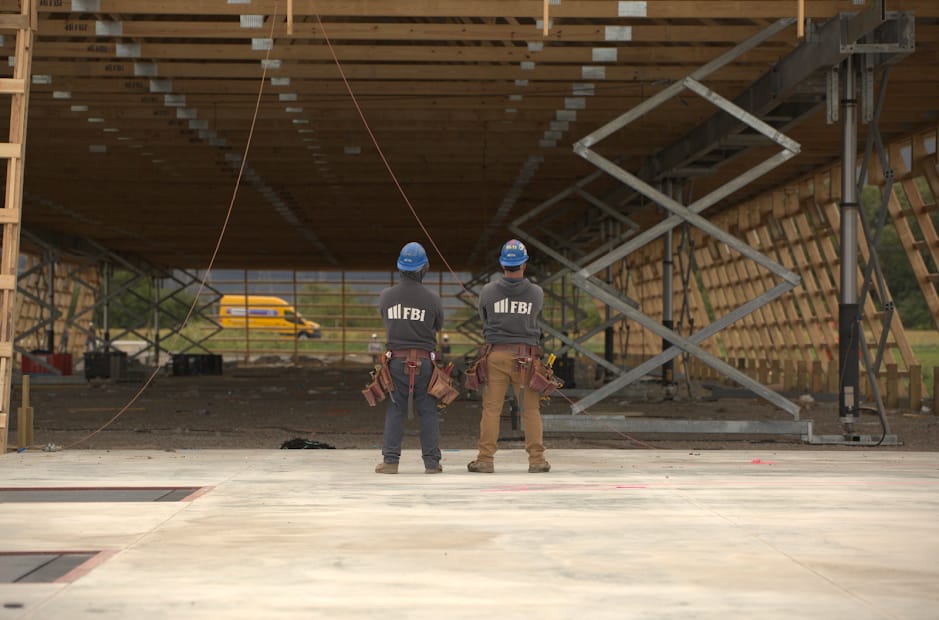 Photo: FBi Buildings, Inc.
A typical residential draw schedule looks like this. Percentages are industry-standard estimates and your lender's version will differ in the details:
| Draw | Milestone | Share of budget | Typical timing |
|---|---|---|---|
| 1 | Site work, footings, slab poured and cured | 15 to 20% | Month 1 to 2 |
| 2 | Steel or post frame up, framing complete | 25 to 30% | Month 2 to 4 |
| 3 | Dry-in: roof, wrap, windows, doors | 10 to 15% | Month 4 to 5 |
| 4 | Rough-in: plumbing, electrical, HVAC | 15 to 20% | Month 5 to 7 |
| 5 | Interior finishes: drywall, floors, cabinets | 15 to 20% | Month 7 to 10 |
| 6 | Final draw at certificate of occupancy | Remainder | Month 9 to 12 |
Budget $300 to $600 per inspection, with 4 to 6 inspections over the build. One quirk of barndo builds: the steel shell goes up fast, so draws 1 through 3 can land close together, then the schedule slows down during interior work. Our stage-by-stage build timeline shows how long each phase actually takes. Make sure your builder's contract payment schedule matches the lender's draw schedule. When they do not line up, the builder asks you to bridge the gap with cash.
Why do lenders deny barndominium loans?
The single biggest killer is appraisal comps. The appraiser has to find recent sales of similar homes nearby, and in most counties there are few or no barndominium resales on record. When comps are thin, the appraised value comes in low, the lender cuts the loan amount, and you either bring more cash or walk away. We dug into how appraisers actually handle barndos in our resale value and appraisal guide.
The second killer is classification. Some banks look at a metal building on a slab and cannot decide if it is a house, a shop, or an agricultural building. If the floor plan reads too mixed-use, say 2,000 square feet of living space attached to a 3,000 square foot shop, underwriters get nervous about resale and pass.
The rest of the denials are ordinary construction-loan problems: credit under 680, debt-to-income over 43 percent, a vague budget, or a builder the lender will not approve. Most lenders require a licensed general contractor and will not fund owner-builders at all. This is where kit marketing does real damage. A kit company quoting $50 per square foot is selling you a shell, not a house, and a lender will not fund a budget built on that number. We break down the difference in our shell vs turnkey guide, and our kit price comparison shows what each supplier's number actually covers. Our position is simple: any turnkey number under $100 per square foot is a shell quote in disguise, and underwriters know it even when buyers do not.
What are your actual approval odds?
Good, if you pick the right lender and show up with a complete package. Barndominiums get financed every day through local banks, credit unions, farm-credit lenders, and USDA and VA programs. The buyers who get denied are usually the ones who walked into a national bank with a kit brochure and no site budget.
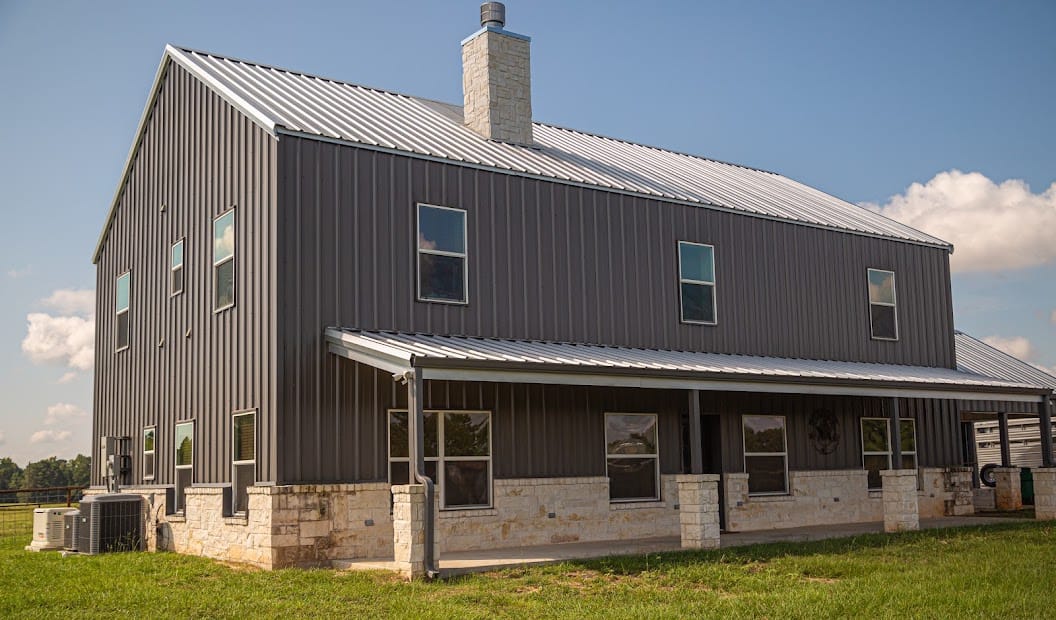 Photo: 1845 Barndominiums
Your odds improve in rough order of importance:
- Lender choice. Local and regional banks, credit unions, and farm-credit lenders like Rural 1st handle rural property, acreage, and non-traditional builds routinely. A loan officer who has closed 10 barndos will fight for your appraisal. One who has closed 0 will not.
- A residential-looking plan. Full residential finish, standard bedroom and bath counts, and a shop that reads as a garage, not a warehouse. This helps both classification and comps.
- A licensed builder with barndo experience. Lenders approve builders, not just borrowers. Our directory of 335 barndominium-specific builders across 40 states exists partly because financing goes smoother with a builder who has been through draws before.
- A complete budget. Land, well, septic, driveway, utility runs, site prep, the shell, and the finish-out, with a 10 percent contingency line. Lenders deny budgets with holes because the holes become their problem at month 8.
- Strong basics. 700 plus credit, DTI under 43 percent, and 20 percent or more down.
Can you use USDA, VA, or FHA loans for a barndominium?
Yes, on paper, and it is harder in practice. USDA, VA, and FHA all allow one-time close construction loans on barndominiums that meet residential standards, and USDA and VA can go to 0 percent down. The problem is lender participation. Only a handful of lenders run government one-time close construction programs, and they layer their own overlays on top: minimum credit scores around 640 to 680, approved builder lists, and full residential appraisals.
If you qualify for VA or USDA, it is worth the search because the down payment savings are enormous on a $400,000 build. Just start early. Expect the approval process to take longer than a conventional construction loan, and expect the builder-approval step to disqualify some small outfits.
How much cash do you really need?
More than the down payment. Here is a realistic cash plan for a $400,000 turnkey build with land already owned:
| Line | Estimate |
|---|---|
| Down payment (20%) | $80,000 |
| Closing costs (2 to 3%) | $8,000 to $12,000 |
| Draw inspections (4 to 6 at $300 to $600) | $1,200 to $3,600 |
| Interest during 12-month build | $10,000 to $16,000 |
| Contingency the lender may require (5 to 10%) | $20,000 to $40,000 |
That is roughly $120,000 to $150,000 in cash and reserves, not $80,000. Buying land at the same time pushes the down payment requirement to 25 to 30 percent at most lenders, though some rural lenders will count land equity toward your down payment if you already own it. Rural 1st, for example, counts acreage equity and existing outbuildings toward qualification. Also plan for builder's risk and homeowners coverage, because barndominium insurance quotes often come back higher than buyers expect and lenders require proof of coverage before closing.
Where you build moves the whole equation. Per our directory estimates, turnkey costs run $140 to $210 per square foot in Texas, $130 to $195 in Oklahoma, and $140 to $210 in Tennessee, against a national range of $125 to $320. A 2,000 square foot build that pencils at $340,000 in Oklahoma can pencil at $480,000 or more in California, and your loan, down payment, and interest carry all scale with it. The full state-by-state table is on our cost page.
How do you set yourself up to get approved?
Work the sequence backward from the appraisal. Before you apply, do these 5 things: get pre-qualified with 2 or 3 lenders who have closed barndominiums, pick a licensed builder with draw experience, get a real line-item bid rather than a kit price, keep the design residential, and document every site cost including well, septic, and driveway.
Then compare the lenders on 4 numbers: rate, down payment, construction term, and what happens if the appraisal comes in low. The last one is the question most borrowers never ask and the one that decides whether your project survives underwriting.
Get builder quotes before you talk to lenders
Lenders will not approve a budget you do not have, and you cannot build a budget from marketing numbers. Start with 2 or 3 real bids from builders who have been through bank draws before. Request quotes here and we will match you with barndominium builders in your state from our directory of 335 vetted companies. A firm bid in hand turns a hesitant loan officer into a fast one.
Common questions
What credit score do you need for a barndominium construction loan?
Most construction lenders want a 680 to 700 credit score, and many quote their best rates above 720. Some rural and portfolio lenders go lower, but expect a bigger down payment and a higher rate. Construction loans are stricter than regular mortgages because the lender is funding a building that does not exist yet.
How much down payment does a barndominium construction loan require?
Plan on 20 percent for most construction loans, and 25 to 30 percent if you are buying the land and building at the same time. Rural 1st advertises as little as 15 percent down on barndominium builds with no PMI. USDA and VA one-time close loans can go to 0 percent down if you, the property, and the builder all qualify, but few lenders offer them.
Why do banks refuse to finance barndominiums?
The 2 main reasons are weak appraisal comps and classification confusion. If the appraiser cannot find recent barndominium sales nearby, the appraised value comes in low and the loan shrinks or dies. Some banks also do not know whether to treat a metal building on a slab as a house or an outbuilding, so they pass. Local banks, credit unions, and rural lenders approve barndos far more often than big national banks.
Do you pay the full loan payment during construction?
No. During the build you make interest-only payments on the money actually drawn, not the full loan amount. Early in the build that payment is small because only 1 or 2 draws have funded. After the certificate of occupancy, a construction-to-permanent loan converts to a normal principal-and-interest mortgage.
Can you get a construction loan for an owner-built barndominium?
It is hard. Most lenders require a licensed general contractor and will not fund owner-builders, because half-finished owner builds are their worst-case collateral. A few portfolio and rural lenders allow owner-builders with proven experience, a detailed budget, and 25 to 30 percent down. If you want a kit you assemble yourself, expect to pay cash or borrow against other assets.
How long does a barndominium construction loan last?
The construction phase typically runs 9 to 12 months, and 12 months is the standard term lenders like Rural 1st offer. If the build runs long you request an extension, which usually costs a fee. After completion, construction-to-permanent loans convert to a 15 or 30-year mortgage without a second closing.
Ready to price your build?
Fill out one form. We send it to builders who work in your area. It costs nothing.
Request quotes