Builders / Texas
Barndominium builders in Texas
Planning a build? Read our guide to building a barndominium in Texas.
Builders tracked
Barndominium-specific, deduplicated
Turnkey
Per sqft, directory estimate
Shell only
Per sqft, directory estimate
Permits and codes in Texas
Texas has no statewide residential building permit. Outside city limits you typically need only a septic permit through the county (TCEQ rules), a driveway culvert permit, and floodplain clearance where applicable. Cities enforce the IRC and require full permitting. There is also no state contractor license for home builders, which is exactly why deposit-and-vanish stories cluster in Texas: verification falls entirely on you. Check insurance, references and completed builds, not a license that does not exist.
Financing a barndominium in Texas
Texas has the deepest barndo lending market in the country. Capital Farm Credit, Texas Farm Credit and dozens of community banks write construction-to-permanent loans on barndominiums, and appraisal comparables exist in most counties. Interior packages priced under about $100/sqft usually signal a shell contract, not a turnkey one; read the exclusions list.
The list (59)
Sorted by review count. Featured listings are labeled.

Hallsville, TX

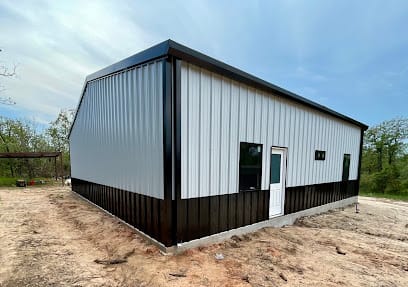


Cut and Shoot, TX
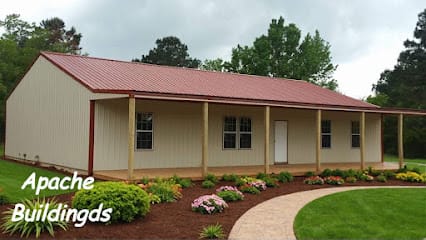
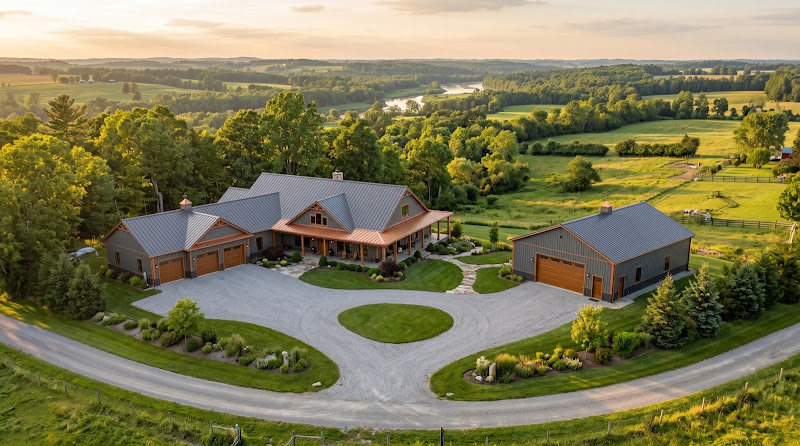

Photos pending

Weatherford, TX


Photos pending


Weatherford, TX
Photos pending
Spring Branch, TX

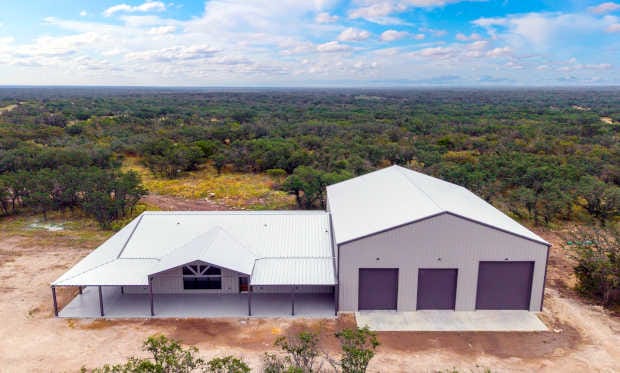


New Braunfels, TX
Photos pending
Photos pending

Mineral Wells, TX


Corpus Christi, TX

Jonestown, TX
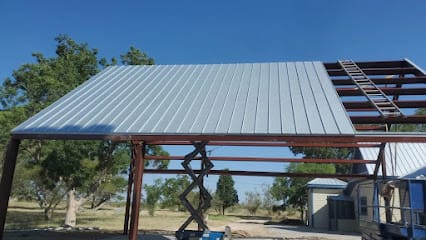


Gainesville, TX

College Station, TX


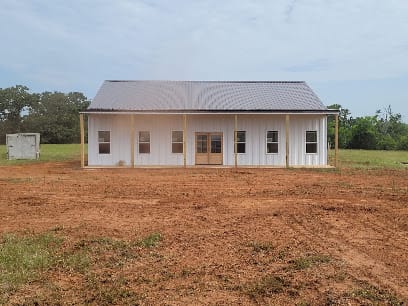

Jacksonville, TX

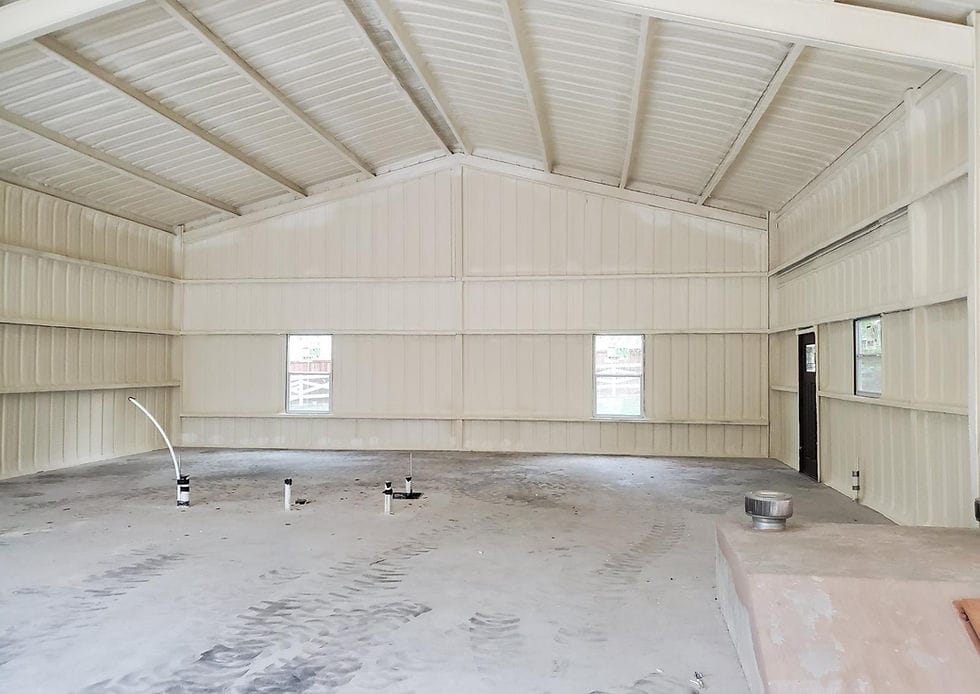


New Boston, TX

Santa Fe, TX

Montgomery, TX
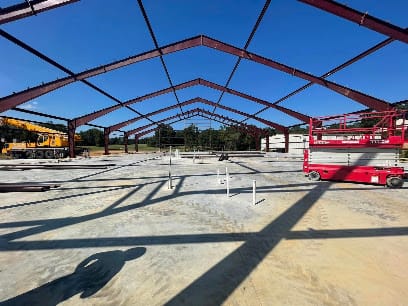


Photos pending
Gilmer, TX


Photos pending
Grapeland, TX

Photos pending
Weatherford, TX


Houston, TX


New Braunfels, TX

Ad space available
Your barndo business can be here
Builders, lenders, kit makers and suppliers: put your company in front of people planning a barndominium in Texas.
Get the deck and pricingBuilding a barndominium in Texas
A finished barndominium in Texas runs about $140 to $210 per square foot turnkey, or $40 to $70 per square foot for a shell, by our directory estimates. That puts a 2,400 square foot home at roughly $336,000 to $504,000 before land and site work. We list 58 Texas builders, more than any other state in our directory.
Three things make Texas different from almost everywhere else. First, outside city limits there is usually no county building permit and no county zoning, so the rules that actually bind you are private deed restrictions and the septic permit. Second, there is no state license for home builders, so vetting is your job. Third, the coast is a separate world: the 14 coastal counties run on windstorm certification and TWIA insurance, and that changes the design and the budget.
Land, zoning and deed restrictions
Texas counties have limited land-use authority that does not include zoning, per the Texas Real Estate Research Center. In practice that means a county will not tell you a metal home is not allowed on your 10 acres. Cities are different: inside city limits you deal with zoning districts, setbacks and sometimes exterior material rules, and a city can extend some rules into its extraterritorial jurisdiction.
The binding constraint in rural Texas is usually the deed. Recorded deed restrictions can prohibit metal siding, set a minimum heated square footage, ban mobile or "temporary" structures, or require an architectural committee sign-off. They run with the land and are enforced by neighbors or the HOA through a civil suit. Ask the title company for every recorded restriction on the tract before you close, and read them yourself. "Barndominium" rarely appears in older restrictions, so look for words like "metal," "exterior materials," "masonry" and "outbuilding."
Houston is a special case. The City of Houston is not zoned, and the city's legal department enforces recorded deed restrictions in their place. A barndo inside the city is a deed question, not a zoning one. Our Houston builder guide covers the area in more detail, and we have similar local guides for Dallas-Fort Worth, East Texas and the Hill Country.
Codes, engineering and climate
No single residential code covers all of Texas. Cities enforce the IRC. In the unincorporated county, state law lets a county opt in, by order, to a rule that new homes must meet the IRC and get at least three inspections: foundation before the pour, framing and mechanicals before drywall, and final. The county does not do those inspections. Tarrant County, for example, requires the builder to notify the county and obtain the three inspections, charges no fee and does no inspecting itself. In a county that has not opted in, a home outside any city's jurisdiction has no residential code requirement at all.
Light regulation is not a reason to skip engineering. Your lender, insurer and eventual buyer will all ask for stamped plans. Three Texas conditions drive the engineering:
- Coastal wind. In the 14 first-tier coastal counties (Aransas, Brazoria, Calhoun, Cameron, Chambers, Galveston, Jefferson, Kenedy, Kleberg, Matagorda, Nueces, Refugio, San Patricio, Willacy) and part of Harris County east of Highway 146, the TDI Windstorm Inspection Program applies. Since April 1, 2026, new construction must be certified to the 2024 IRC or IBC to qualify for TWIA coverage. Most of that area is now inside the windborne debris region, so plan on impact-rated openings or shutters.
- Expansive clay. The Blackland Prairie clays that run through the DFW, Waco and Austin corridor shrink and swell with moisture. A post-frame or steel barndo on a slab is exactly as exposed to this as a brick house. Pay for a geotechnical report and a slab designed to it.
- Hail. Much of Texas is hail country, and metal roofs dent. Ask your insurer how it treats cosmetic hail damage before you choose the panel gauge.
For energy, Texas adopted the 2015 IRC energy chapter for single-family homes effective September 1, 2016. Cities enforce it. In the county, your insulation and HVAC sizing are between you, your builder and your lender.
What a barndominium costs in Texas
Here is the math from our state table. These are Barndo Finder directory estimates, not transaction data, and they exclude land, well, septic, site work and the driveway.
| Size | Shell ($40 to $70/sqft) | Turnkey ($140 to $210/sqft) |
|---|---|---|
| 1,500 sq ft | $60,000 to $105,000 | $210,000 to $315,000 |
| 2,400 sq ft | $96,000 to $168,000 | $336,000 to $504,000 |
| 3,000 sq ft | $120,000 to $210,000 | $420,000 to $630,000 |
Texas sits slightly below the national medians in our data (shell $45 to $75, turnkey $145 to $215), which fits a state with deep builder competition and a long building season. Coastal builds will land toward the top of the range once windstorm engineering, openings and elevation are priced in. For how size choices move the total, see our guide to barndominium sizes, and for the national picture, the 2026 cost report. The full state table is on our cost page.
One rule of thumb from our directory work: a "turnkey" quote under about $100 per square foot in Texas is almost always a shell contract with a nicer name. Ask for the written inclusions list.
Financing and insurance in Texas
Texas lenders know this building type. Several Farm Credit associations publish barndominium programs: Capital Farm Credit lists barndominiums and metal homes among the builds its construction loans cover, and Texas Farm Credit offers one-time-close construction loans with a 12-month construction period and terms up to 30 years. Lone Star Ag Credit, AgTexas, Legacy Ag Credit, Plains Land Bank and Heritage Land Bank also lend in parts of the state, and community banks fill in the rest. Our construction loan guide explains draw schedules and approval odds, and the financing page covers lender types.
Insurance inland is a normal homeowners policy with an agent who knows post-frame and steel homes. On the coast it gets harder. The Texas Windstorm Insurance Association is the insurer of last resort for wind and hail in the coastal counties. You must have been declined by at least one private insurer, and every structure built since 1988 needs a WPI-8 certificate of compliance. Homes in certain V flood zones built after September 1, 2009 also need proof of flood insurance. Get the WPI-8 inspections scheduled with your builder before the slab is poured, because a missed inspection can be impossible to recover. Our barndominium insurance guide covers carriers and pricing.
Utilities, well and septic
Most rural Texas barndos run on a well and a septic system. Septic is regulated by the TCEQ as an on-site sewage facility (OSSF), and in many counties the permit comes from a county authorized agent rather than a TCEQ regional office. The process starts with a site evaluation by a licensed site evaluator or engineer, then a design by a licensed designer. Tight clay can push the design to an aerobic treatment unit, which comes with an ongoing obligation: after the initial two-year service policy, you either keep a service contract with a licensed provider or, where the county allows it, maintain the system yourself after a training course. Budget for that as a yearly cost.
Wells are drilled by TDLR-licensed drillers, and a State Well Report is filed for every one. If your land sits in a groundwater conservation district, a household well is generally exempt from a production permit but still must be registered with the district. Call the district before you drill.
For budgeting, published estimates run $3,500 to $8,500 and up for a septic system and $10,000 to $30,000 for a drilled well, per our build process guide. Long power runs from the road can cost as much as the well.
A realistic timeline in Texas
Plan on 12 to 18 months from first design conversation to move-in, the same range we see nationally in our build timeline guide. Texas usually lands at the fast end because rural permitting is light and crews work most of the year. Where the time goes:
- Before you buy: deed restrictions, survey, floodplain check and a septic site evaluation. Do these during the option period, not after closing.
- Pre-construction: 3 to 6 months. Design and stamped engineering (1 to 2 months), the loan (1 to 2 months) and permits. An unincorporated county with no building permit leaves only the septic and driveway permits, which is where Texas saves time. A coastal build adds windstorm inspection scheduling.
- Construction: 6 to 12 months for a turnkey home. The shell goes up in weeks; interior finish-out is the long stretch.
What stretches Texas timelines is rarely the county. It is builder backlog and long-lead orders like steel, windows and cabinets.
Builders we list in Texas
We list 58 barndominium builders in Texas. Here are some of the most reviewed, by region, with what our data shows. Review counts are public Google reviews at the time we indexed them.
| Region | Builder | City | Build type | Rating |
|---|---|---|---|---|
| East Texas | 1845 Barndominiums | Hallsville | Shell and turnkey | 4.3 (67 reviews) |
| East Texas | Sawyer Metal | Tyler | Shell | 4.5 (53 reviews) |
| North Texas | Gateway Builders Metal Buildings | Decatur | Turnkey | 4.9 (43 reviews) |
| North Texas | 14B Construction Inc. | Weatherford | Shell and turnkey | 5.0 (32 reviews) |
| Central Texas | Jon DeL Construction | Luling | Turnkey | 5.0 (43 reviews) |
| Hill Country | Kellers Imperial Construction | Boerne | Turnkey | 5.0 (20 reviews) |
| Greater Houston | Texas Pride Buildings | Cut and Shoot | Turnkey | 4.4 (42 reviews) |
| Coastal Bend | Built Strong | Corpus Christi | Shell and turnkey | 4.6 (11 reviews) |
Photo: CB4 Services
Shell builders erect the steel or post-frame building and leave the interior to you or another contractor. If you go that route, our shell vs turnkey guide explains what you take on. For layout ideas before you call anyone, browse our barndominium floor plans.
Ready to price your build? Request quotes from Texas builders who serve your county, and check the cost table against every number you get back.
Updated September 2026 · Barndo Finder research
Building in Texas: common questions
Do you need a permit to build a barndominium in Texas?
Inside city limits, yes: cities enforce a residential code and issue building permits. Outside city limits there is usually no county building permit, but you still need a septic (OSSF) permit, floodplain clearance where it applies, and often a driveway permit. Some counties have opted into a state law that requires three third-party inspections on new homes, and the 14 coastal counties add TDI windstorm certification.
How much does a barndominium cost in Texas?
Our directory estimate for Texas is $140 to $210 per square foot turnkey and $40 to $70 per square foot for a shell. A 2,400 square foot turnkey build works out to about $336,000 to $504,000 before land, well, septic, driveway and site work. Those are estimates from our state table, not quotes.
Can you get a loan for a barndominium in Texas?
Yes, and Texas lenders know this building type well. Capital Farm Credit, Texas Farm Credit, Lone Star Ag Credit and other Farm Credit associations publish construction loan programs that cover barndominiums, and many community banks write them too. Expect the lender to want stamped plans, a fixed-price contract and a builder they can vet.
Are barndominiums allowed in Texas counties?
Usually, because Texas counties have no general zoning power. The real limit is private deed restrictions and HOA covenants, which can ban metal siding, set a minimum square footage or require architectural approval. Read the recorded restrictions for the exact tract before you buy. Inside cities, zoning and design rules apply, except in Houston, which has no zoning but enforces deed restrictions.
Do you need windstorm certification for a barndominium in Texas?
Only if you build in one of the 14 first-tier coastal counties or the covered part of Harris County and want wind coverage from TWIA. There, the home must be inspected and certified (a WPI-8) by a TDI-appointed inspector or engineer. Since April 1, 2026, new work must be certified to the 2024 IRC or IBC. Inland, there is no windstorm program.
Do Texas barndominium builders need a license?
No. Texas has no state license for home builders or general contractors, so there is nothing to look up. Electricians, plumbers and HVAC contractors are state licensed. Vetting the builder falls on you: ask for insurance certificates, recent completed builds you can visit, and references from owners in your county.