Resources / Design ideas
Black Barndominium: Real Builds, Panel Colors and Heat Facts
Updated October 2026 · Barndo Finder research
Quick answer
A black barndominium costs about the same as any other color, because black is a standard color in most steel panel lines. The tradeoffs are heat and fading: a typical black panel reflects about 25 percent of sunlight versus about 61 percent for white, and dark colors show chalking sooner. A lighter roof and PVDF paint solve most of it.
A black barndominium costs about the same to build as a white or gray one, because black is a standard color in most steel panel lines, not a premium upgrade. What changes is heat gain, how fast fading shows, and the trim you pair with it. Below are 9 real black builds from builders listed in our directory, what "black" is actually called on panel charts, and the numbers on heat and paint systems.
Key takeaways
- Black is rare. Of the 161 usable exterior photos we have catalogued from builder profiles, only 11 were tagged black or near-black, about 7 percent. White (39) and gray (32) dominate.
- "Black" on a color chart is several colors: Black, Matte Black, Dark Charcoal, Charcoal, Burnished Slate and Dark Bronze all read as black in photos. Burnished Slate is actually a dark brown-gray.
- A black steel panel reflects roughly 25 percent of sunlight; a white one about 61 percent. Black absorbs close to twice the solar energy, and the roof is where that matters.
- Dark colors show chalking and fading sooner. PVDF (Kynar 500 type) paint holds color better than SMP; read the chalk and fade terms, not just the 40-year headline.
- The color itself is usually standard pricing. The look costs money through cedar, timber trusses and black-framed windows.
- National medians from our directory: shell $45 to $75 per square foot, turnkey $145 to $215. Black does not move those numbers much.
What do real black barndominiums look like?
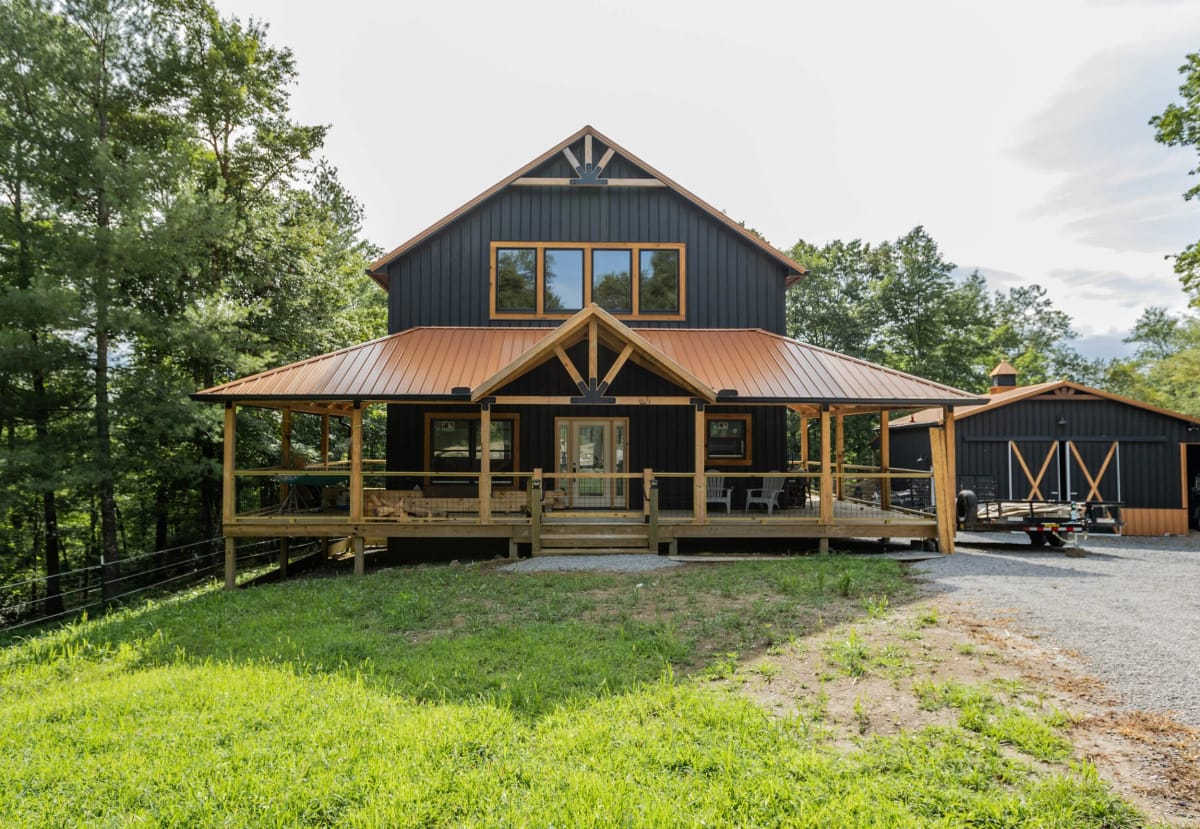
Most black barndos in builder photos fall into two camps: black steel warmed up with wood, and all-black builds that lean modern. The featured photo above, from Tennessee builder Barndos Direct, is the first camp at full strength: black walls, a copper-colored roof, cedar posts and exposed trusses on a wraparound porch, with a matching black shop behind it.
Black with wood accents
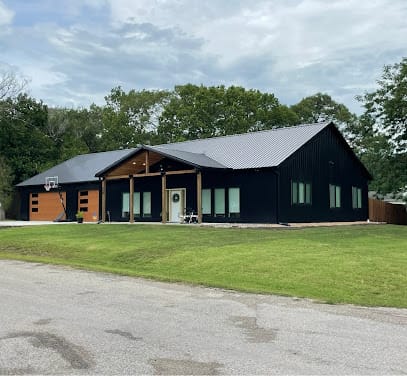 Photo: LaClef Construction - Wick Buildings
This single-story build from a Kansas Wick Buildings dealer is the smartest black barndo in our set for hot summers. The walls are black, but the roof is a light silver, so the surface that takes the most sun reflects far more of it. The timber gable over the entry and the wood-look garage doors keep the long black wall from reading like a warehouse.
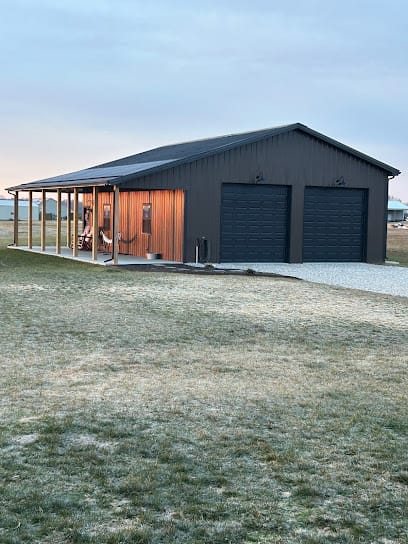 Photo: Hobgood Post Frames Inc
An Indiana post-frame build with one good trick: the wall under the porch is cedar, not steel. You get the black box from the road and a warm, wood-lined porch where people sit. Everything that is not wood, roof and garage doors included, is one color, which is why it looks deliberate.
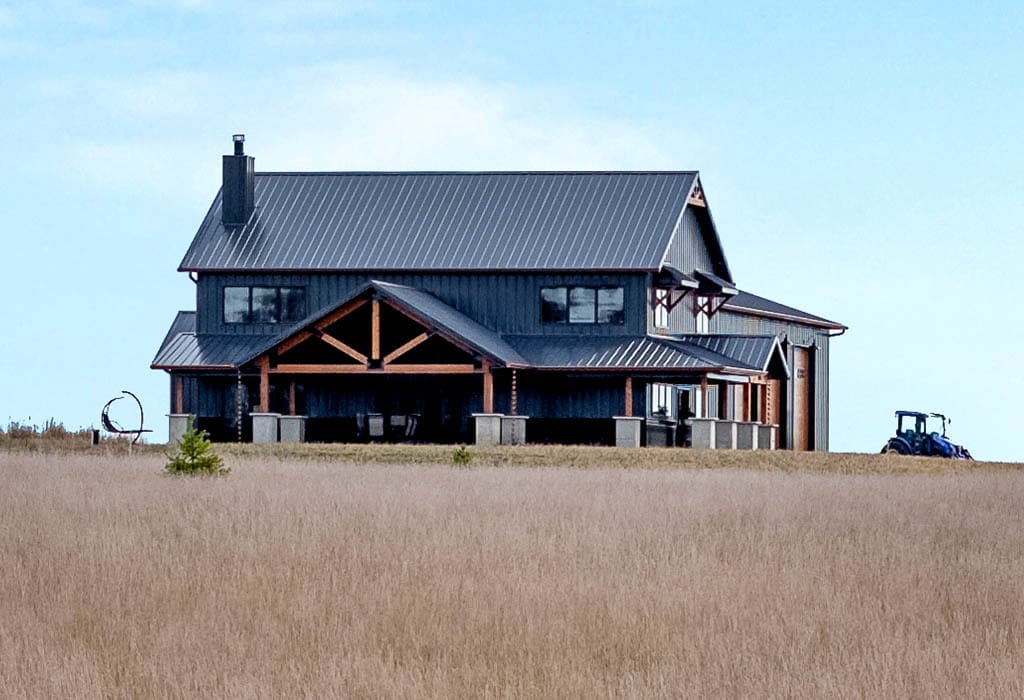 Photo: Walters Buildings
This Wisconsin two-story is closer to dark charcoal than jet black, which is common. The timber truss over the porch, masonry pier bases and a chimney give it a lodge feel, and the shop wing shares the roof color, so it reads as one building.
All-black and modern black
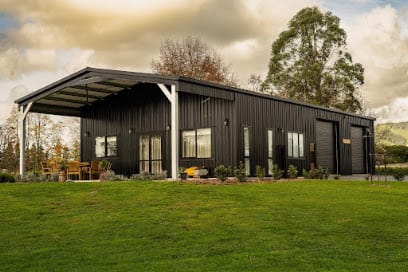 Photo: Triangle Buildings and Barndos
From Florida-based Triangle Buildings and Barndos: a simple black rectangle with a roof extension that turns one end into a covered patio. The only contrast is the light patio posts and window frames. It works because the proportions are clean; the same box on bare dirt would look like a shop.
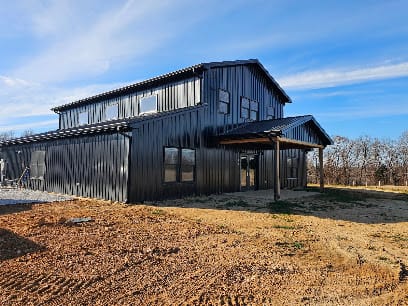 Photo: Ridgeline Building Group llc
A raised center section (the monitor-barn shape) with lower wings on each side, from a Tennessee builder. The upper row of windows pulls daylight into the middle of the plan. The raw dirt around it is how most builds look in their first photos.
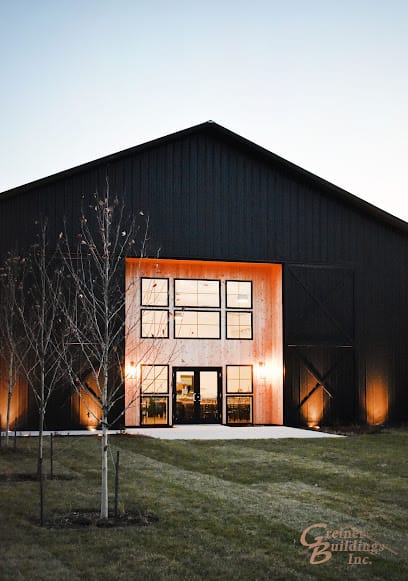 Photo: Greiner Buildings, Inc.
The most architectural photo in the set: an Illinois build with a two-story block of glass framed in pale wood, cut into a black gable. Black makes the light wood and lit windows pop at night, and the black sliding barn doors nearly disappear.
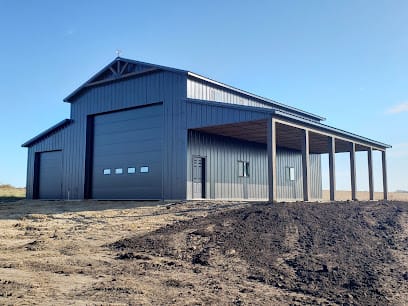 Photo: Witt Construction, Inc.
A South Dakota build in dark charcoal with a raised center bay, a tall overhead door and a lean-to porch down the side. This is black with no wood at all: clean and a bit severe. The lean-to shades a long black wall without a separate porch structure.
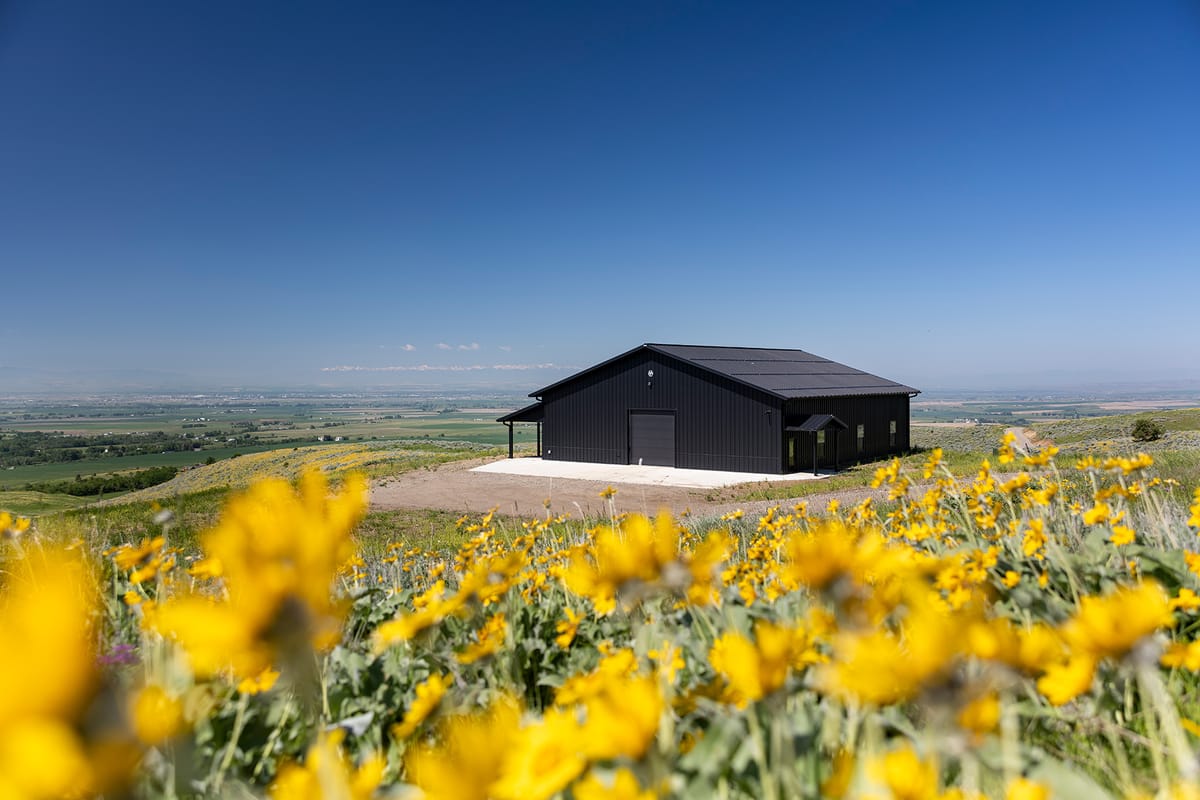 Photo: Morton Buildings, Inc.
A Montana build from a Morton Buildings location. Against open sky, a plain black gable looks sharper than any other color would, and in a cool, high-altitude climate the heat penalty of a black roof is smaller than in Texas. We review the company itself in our Morton Buildings barndominium guide.
What color is "black" on a steel panel chart?
Several colors, and most "black barndominium" photos are not the one called Black. Here is what three manufacturers actually list, with published solar reflectance where we could find it. Solar reflectance is the share of sunlight the surface bounces back (1.0 is all of it). SRI, the Solar Reflectance Index, scales a surface so a standard black is 0 and a standard white is 100.
| Manufacturer | Color name | What it looks like | Solar reflectance | SRI |
|---|---|---|---|---|
| Dean Steel Buildings | Black | True black | 0.25 | 24 |
| Berridge | Matte Black | Flat black | 0.26 | 24 |
| Berridge | Charcoal Grey | Very dark gray | 0.29 | 28 |
| Berridge | Dark Bronze | Near-black brown | 0.28 | 27 |
| Dean Steel Buildings | Burnished Bronze | Dark bronze-brown | 0.28 | 29 |
| Dean Steel Buildings | Polar White (for comparison) | White | 0.61 | 73 |
Mueller's panel color chart lists six colors in the black family: Black, Matte Black, Dark Charcoal, Charcoal, Burnished Slate and Dark Bronze. Availability depends on gauge. Black is offered in 24, 26 and 29 gauge profiles; Matte Black in 24 and 26 gauge; Dark Charcoal only in 24 gauge panels. If you want Dark Charcoal from Mueller, you are buying heavier 24 gauge steel.
Metal Sales' Classic Rib color chart (26 and 29 gauge, ColorFast45 paint with a 45-year paint warranty) lists Charcoal and Burnished Slate but no Black on that version. Burnished Slate is the one people most often mistake for black: it is a dark brown-gray that looks black in photos and at a distance, and noticeably browner beside a true black door.
Two practical rules. Look at physical chips outdoors, in sun and shade; screen colors are useless for dark metal. And source roof, walls and trim from one manufacturer, because two suppliers' blacks rarely match and the mismatch shows most on dark colors.
How much hotter does a black barndominium get?
Noticeably hotter on the surface, and the roof matters far more than the walls. A black panel with a solar reflectance of 0.25 absorbs about 75 percent of the sunlight that hits it. Polar White at 0.61 absorbs about 39 percent. That is close to twice the solar energy.
The research on what that does to surface temperature is solid. Lawrence Berkeley National Laboratory's Heat Island Group found that on a typical summer afternoon, a cool-colored roof reflecting 35 percent of sunlight stays about 22°F cooler than a roof that looks the same but reflects only 10 percent. ENERGY STAR's cool roofs page puts a clean white roof reflecting 80 percent at about 50°F cooler than a gray roof reflecting 20 percent, and notes that cool roofs save the most energy in hot, sunny climates on buildings with low levels of roof insulation.
That last clause is the whole story for a barndo:
- Roof first. The roof takes the most direct sun. Black walls under a lighter roof, like the LaClef build above, keep most of the look and most of the energy benefit.
- Insulation second. A black roof over an open-rafter ceiling with thin insulation will cost you in cooling. The same roof over closed-cell spray foam or a well insulated attic makes a much smaller difference indoors. Our upcoming barndominium insulation guide covers the options.
- Climate third. A black barndo in Montana or Wisconsin has fewer cooling hours to pay for. In south Texas or Florida, black on the roof is a real operating cost.
- Cool pigments help. Per LBL, cool-colored dark roofs look like traditional dark roofs but reflect more near-infrared light, which is nearly half of sunlight. Ask your supplier for the solar reflectance of the exact color you are ordering; the blacks in the table above sit at 0.25 to 0.26.
Does black steel siding fade, and which paint holds up?
All painted steel chalks (a powdery surface film) and fades over time. Dark colors show it sooner because a thin gray haze is obvious on black and nearly invisible on white. Sheffield Metals says as much directly: lighter colors will not show chalking and fading as much as deep colors.
The two paint systems you will be offered:
| SMP (silicone modified polyester) | PVDF (Kynar 500, Hylar 5000) | |
|---|---|---|
| What it is | Polyester resin with silicone, typically about 30 percent silicone | At least 70 percent PVDF resin to carry the Kynar 500 name |
| Typical film warranty | 40 years (no cracking, peeling) | 40 years |
| Typical chalk and fade warranty | 30 years in Sheffield's example | 30 years, with tighter chalk and fade limits |
| Color retention | Good | Better |
| Where you see it | Most barndo kits and post-frame packages | Architectural standing seam, premium panels |
Resin figures are from McElroy Metal. Warranty lengths vary by maker: Mueller advertises a 35/40-year limited paint warranty, Metal Sales a 45-year paint warranty on ColorFast45. The headline number is almost always the film warranty. For a black building, the number you care about is the chalk and fade limit, because that is what you will see.
Our view: on a black barndo, PVDF is worth pricing on the roof and the south and west walls at minimum. If your builder only stocks SMP, accept it with open eyes and expect the sunniest walls to look a shade lighter than the shaded ones within a decade or two.
What trim and roof colors go with black?
The pairings that show up in our photo catalog, and what each one does:
| Pairing | Example above | What it does | Watch out for |
|---|---|---|---|
| All black (walls, roof, trim, doors) | Triangle, Hobgood | Monolithic, modern | Heat on the roof; dust and pollen show |
| Black walls, light or silver roof | LaClef | Keeps the look, cuts roof heat | Roof reads gray from a distance |
| Black with cedar or timber | Barndos Direct, Walters | Warm, lodge or farmhouse | Wood needs sealing on a schedule |
| Black with a copper-look roof | Barndos Direct | High contrast, rustic | Metallic colors can carry an upcharge |
| Black with pale wood cladding | Greiner (Illinois) | Architectural, strong at night | Wood cladding is a custom cost |
| Black with white columns or trim | See our farmhouse barndominium page | Farmhouse contrast | White trim shows dirt fast |
More palettes are in the barndominium exterior colors guide, and black trim on white walls is covered in our modern barndominium guide.
What does a black barndominium cost?
About the same as any barndo of the same size and finish. McElroy Metal says dark bronzes and blacks are commonly in its standard color group, with premium Kynar colors running 8 to 10 percent more and metallics 10 to 12 percent more than standard. Mueller offers Black across its 24, 26 and 29 gauge panels. So the paint color is rarely the line that moves.
Here is the math on a 40x60 (2,400 square foot) black barndo using our directory estimates. These are estimates, not transaction data, and they exclude land, well, septic, site work and driveway.
| Scope | Rate per sq ft | 2,400 sq ft total |
|---|---|---|
| Shell, national median range | $45 to $75 | $108,000 to $180,000 |
| Turnkey, national median range | $145 to $215 | $348,000 to $516,000 |
| Turnkey, Tennessee | $140 to $210 | $336,000 to $504,000 |
| Turnkey, Kansas | $125 to $190 | $300,000 to $456,000 |
What does add cost is the stuff that makes black look good:
- Wood accents. Cedar board-and-batten siding runs $6 to $16 per square foot installed, per HomeGuide. A 300 square foot cedar porch wall like the Hobgood build is roughly $1,800 to $4,800.
- Porches. A front porch costs $40 to $120 per square foot per HomeGuide's porch data. A 10x40 porch is $16,000 to $48,000 at that rate. A lean-to framed with the building is often cheaper; ask for it itemized.
- PVDF paint. Priced by the supplier, not published as a flat rate. Ask for SMP and PVDF quotes side by side.
The full breakdown by state is on our cost page, and our shell vs turnkey guide explains which number applies to you.
Our take
Black is a good barndo color if you treat it as a design decision with consequences, not a paint chip. Put a lighter or cool-pigment roof on it in the South, spend the money on insulation before you spend it on timber trusses, and price PVDF for the sunniest faces. Then add wood. Every black build in our catalog that looks finished has cedar, stained timber or pale wood somewhere; the ones without it look like shops.
And know what you are ordering: the black barndo you liked online may well be Burnished Slate or Charcoal. Decide with a chip in your hand.
Price a black barndominium in your state
Paint color will not move your quote much. Size, finish level and your county will. Browse more real builds in our barndominium pictures gallery, check the per-square-foot range for your state on the cost table, then request quotes from builders who have put up black steel before. Ask each one which manufacturer's Black they use and whether the roof is SMP or PVDF.
Common questions
Is a black barndominium hotter inside?
It can be, mostly through the roof. A black steel panel reflects roughly a quarter of the sunlight that hits it, against about 60 percent for a white panel, so it absorbs close to twice the solar energy. Closed-cell spray foam or a well insulated ceiling shrinks the indoor difference a lot. The cheapest fix is a lighter roof over black walls.
Does black metal siding fade?
All painted steel chalks and fades slowly, and dark colors show it sooner than white. On SMP paint, expect a gradual grayish haze on the sunniest walls over the years. PVDF finishes such as Kynar 500 hold color better and cost more. Ask for the chalk and fade warranty terms in writing, not just the headline film warranty.
What trim color goes with a black barndominium?
Three combinations dominate builder photos: black on black, with trim, doors and window frames all matched; black with cedar or stained timber posts and trusses; and black with white columns or trim. Galvalume, silver or copper-look roofs also pair well with black walls and run cooler than a black roof.
Does a black barndominium cost more to build?
Usually not for the steel itself. McElroy Metal says blacks are commonly in its standard color group, and Mueller offers Black across its 24, 26 and 29 gauge panels. The extra cost comes from what the look tends to include: cedar posts, timber trusses, black-framed windows and PVDF paint.
Is Burnished Slate the same as black?
No. Burnished Slate is a dark brown-gray on both the Metal Sales and Mueller charts. At a distance and in photos it reads nearly black, which is why many barndos people call black are actually Burnished Slate, Charcoal or Dark Bronze. Check a physical sample outdoors before you order.
Ready to price your build?
Fill out one form. We send it to builders who work in your area. It costs nothing.
Request quotes