Builders / Iowa
Barndominium builders in Iowa
Planning a build? Read our guide to building a barndominium in Iowa.
Builders tracked
Barndominium-specific, deduplicated
Turnkey
Per sqft, directory estimate
Shell only
Per sqft, directory estimate
Permits and codes in Iowa
Iowa has no mandatory statewide residential building code, though the state energy code applies to every new one- and two-family home. Cities and counties adopt their own building codes, most urban jurisdictions run the IRC, and many rural counties have no building department at all, so a barndominium outside city limits often needs only a septic permit and a floodplain check. Contractors earning over $2,000 a year must register with the state through the Department of Inspections, Appeals and Licensing, and the registry is searchable online, but registration is not a competency license, so check references anyway. Engineering drivers are 105-115 mph wind, 25-35 psf ground snow loads, and 42-48 inch frost depth, which sets post embedment. Septic permits run through county health departments, and Iowa's time of transfer law requires a septic inspection when the property sells.
Financing a barndominium in Iowa
Farm Credit Services of America covers all 99 Iowa counties and closes rural construction-to-permanent loans on post-frame homes. Iowa community banks are strong ag lenders and will often carry the construction note themselves. Appraisal comps are thin outside a few counties, so appraisers lean on site-built ranch comps and come in conservative. Plan on 15-20 percent down, or land equity in place of cash.
The list (16)
Sorted by review count. Featured listings are labeled.

Missouri Valley, IA

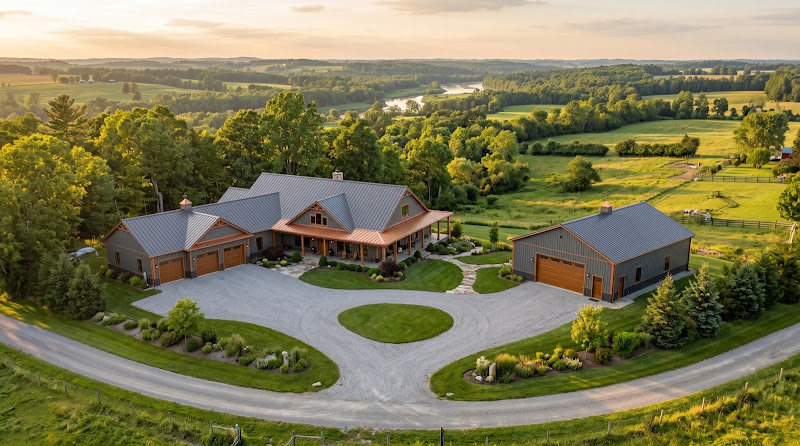

Photos pending
Washington, IA

New Hartford, IA
Photos pending

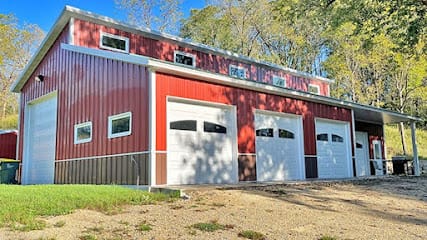
Indianola, IA


Cedar Rapids, IA
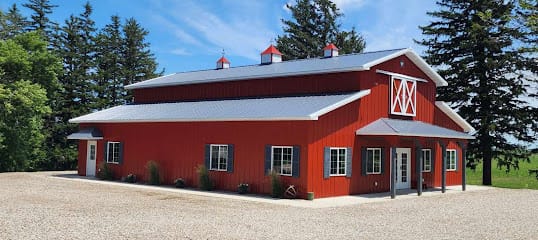
Photos pending
Photos pending

Shenandoah, IA

Cedar Falls, IA

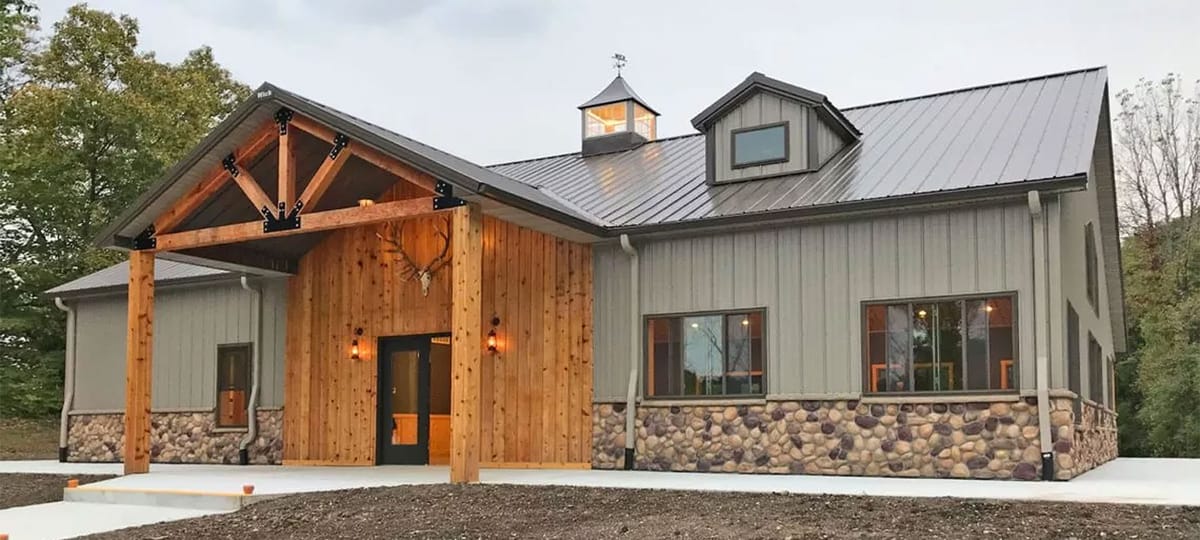
Ad space available
Your barndo business can be here
Builders, lenders, kit makers and suppliers: put your company in front of people planning a barndominium in Iowa.
Get the deck and pricingBuilding a barndominium in Iowa
A finished barndominium in Iowa runs about $130 to $200 per square foot turnkey, or $40 to $70 per square foot for a shell, by our directory estimates. That puts a 2,400 square foot home at roughly $312,000 to $480,000 before land and site work, under the national medians in our data. We list 16 Iowa builders, and 10 of them sell turnkey.
Three things set Iowa apart. State law keeps county zoning and county building codes off farm houses, so a barndo on a working farm can fall outside both. Outside that exemption, the county alone decides if your house gets a building inspection. And the state still reaches every new home through electrical licensing and inspection, the energy code and the county septic permit.
Land, zoning and deed restrictions
Start with the farm exemption, because it shapes everything. Iowa Code 335.2 says no county zoning ordinance applies to "land, farm houses, farm barns, farm outbuildings, or other buildings or structures that are primarily adapted, by reason of nature and area, for use for agricultural purposes, while so used." Floodplain rules still apply. Land enrolled in a soil or water conservation program counts as agricultural.
The words that matter are "primarily adapted" and "while so used." A barndominium on a working farm, lived in by the people farming it, can qualify. A barndo on a five-acre lot split off a field generally does not. Counties draw the line differently: Guthrie County presumes any tract under 20 acres is not primarily agricultural, and Mitchell County exempts farmstead dwellings from its zoning certificate but still wants notice and keeps homes out of the 100-year floodplain. Note one gap: the statute bars counties from charging an application or fee to confirm the exemption for barns and outbuildings, but farm houses are not on that list, so expect paperwork for the house.
If you are not a farm, you are an ordinary rural residence. Check minimum lot size, setbacks, whether the district allows a new home on your parcel, and any acreage subdivision covenants on metal siding.
Codes, engineering and climate
Iowa has a state building code, now the 2024 IBC and IRC with amendments under 481 IAC 301, administered by the Department of Inspections, Appeals and Licensing since the rules moved there in late 2025. But it binds only the buildings and jurisdictions Iowa Code chapter 103A reaches. Cities and counties can adopt it or their own code, and Iowa Code 331.304 says a county building code "shall not apply to farm houses or other farm buildings which are primarily adapted for use for agricultural purposes, while so used or under construction for that use." Where your county has not adopted a building code, there is no building permit or inspection for the house.
Three state requirements reach almost every new home anyway:
- Energy code. Iowa Code 103A.8A applies the state energy conservation requirements to new single- and two-family construction started on or after July 1, 2008, statewide. Plan insulation and air sealing to it even where nobody inspects; our insulation guide covers metal-roof condensation.
- Electrical. Iowa licenses electricians and runs a state inspection program. Muscatine County notes that even farm-exempt projects must have electrical work inspected by a state official, and service installations must be done by a state-licensed electrician.
- Plumbing and HVAC. The Plumbing and Mechanical Systems Board licenses anyone working in or contracting for those trades, with exemptions in Iowa Code 105.11.
There is no general contractor license. Contractors earning at least $2,000 a year from construction must register with DIAL, which documents workers' compensation and unemployment insurance. People working on their own property are exempt.
On structure, Iowa is cold, open and windy. Frost depth, ground snow load and wind exposure come from your local design criteria or, where there is no building department, from your engineer. Open farm ground often means a higher wind exposure category than a wooded lot, which changes post and connection design on a tall post-frame building. Tornadoes are a real planning item; FEMA's safe room guidance and our storm safety guide cover a reinforced room inside a barndo.
What a barndominium costs in Iowa
These figures come from our state table. They are Barndo Finder directory estimates, not transaction data, and exclude land, well, septic, site work and the driveway.
| Size | Shell ($40 to $70/sqft) | Turnkey ($130 to $200/sqft) |
|---|---|---|
| 1,500 sq ft | $60,000 to $105,000 | $195,000 to $300,000 |
| 2,400 sq ft | $96,000 to $168,000 | $312,000 to $480,000 |
| 3,000 sq ft | $120,000 to $210,000 | $390,000 to $600,000 |
Iowa sits $5 a foot under the national shell median in our data ($45 to $75) and $15 under the turnkey median ($145 to $215). Our Iowa list leans toward established post-frame dealers: five sell Wick kits, two sell Lester, and the oldest firm in the list, Meyer Construction of Sumner, shows 60 years in business. Iowa also has about 11,200 Amish residents in 29 settlements per the Young Center, a smaller pool of crews than Indiana's.
In a county with no inspections, the cheapest bid is often the one that skipped something. Compare scopes line by line with our shell vs turnkey guide. The full state comparison is on our cost page.
Financing and insurance in Iowa
Farm Credit Services of America is the only Farm Credit association the Farm Credit Council lists for Iowa. Its rural home loans page covers country homes, and its own site markets financing for "a barndominium where your prized fishing boat is always outside the kitchen door." Iowa community banks are strong rural lenders and often carry construction notes themselves. Our construction loan guide and financing page explain draws and approvals.
The farm exemption cuts both ways at the bank. A house built with no permit and no inspections can still be financed, but the lender will want stamped drawings, a licensed electrician's state inspection, and third-party draw inspections. Insurers ask about wind design and construction type; our insurance guide covers how they classify post-frame homes.
Utilities, well and septic
County boards of health have primary responsibility for private septic systems serving four homes or fewer, applying minimum state standards set by the Iowa DNR in 567 IAC chapter 69. The farm exemption does not touch this: a farm house still needs a septic permit. Book the soil evaluation early, since tight clay or a high water table can force a mound or a different site.
Iowa adds a resale rule most states do not have. Under 567 IAC 69.2, before ownership of a building served by a private septic system transfers, the system must be inspected by a DNR-certified time of transfer inspector, with limited exemptions. Build the system right the first time and keep the permit and as-built records; your eventual buyer's lender will ask. Budget with published ranges of $3,500 to $8,500 and up for septic and $10,000 to $30,000 for a drilled well from our build process guide, then get local bids. Ask the county whether a rural water system serves the parcel before you price a well.
A realistic timeline in Iowa
Plan on 12 to 18 months from design to move-in, the range in our build timeline guide.
- Before you buy: confirm whether the parcel is farm-exempt or residential, the zoning district, rural water availability, and septic soils.
- Pre-construction: 3 to 6 months. Engineering to frost, snow and wind exposure, the loan, any county building permit, the septic permit and the electrical permit.
- Construction: 6 to 12 months. Set posts or pour once the ground thaws, close in before November, and finish over winter.
Builders we list in Iowa
We list 16 barndominium builders in Iowa: 10 turnkey, 3 shell-only, 2 that do both and 1 with no build type listed. Here are the ten with the most public reviews. Ratings are public Google reviews at the time we indexed them.
| Region | Builder | City | Build type | Rating |
|---|---|---|---|---|
| West | Gingerich Structures | Missouri Valley | Turnkey | 4.7 (65 reviews) |
| East | Eastern Iowa Building, Inc. | Fairfax | Shell, Lester kits | 4.7 (42 reviews) |
| Southeast | Greiner Buildings, Inc. | Washington | Turnkey | 4.4 (21 reviews) |
| Northeast | Gingerich Post & Frame | New Hartford | Turnkey | 5.0 (12 reviews) |
| Southwest | Simmons Contracting | Red Oak | Shell | 5.0 (10 reviews) |
| Central | IPF Construction | Indianola | Shell, Lester kits | 5.0 (6 reviews) |
| Central | Greiner Buildings, Inc. | Urbandale | Not listed | 4.3 (6 reviews) |
| Southwest | Sycamore Buildings | Glenwood | Turnkey | 5.0 (5 reviews) |
| East | Greiner Buildings, Inc. | Cedar Rapids | Shell and turnkey | 5.0 (4 reviews) |
| Northeast | Meyer Construction Inc | Sumner | Shell and turnkey, Wick kits | 3.3 (3 reviews) |
Photo: Greiner Buildings, Inc.
Ask each builder whether they will engineer for your site's wind exposure, who pulls the electrical permit, and whether they are registered with DIAL. Western Iowa buyers near Council Bluffs can also look at Nebraska builders; eastern Iowa buyers can add Illinois builders near the Mississippi.
Photo: Gee Building Systems
When you are ready, request quotes from Iowa builders who serve your county, and check each one against our cost table.
Updated October 2026 · Barndo Finder research
Building in Iowa: common questions
Do you need a building permit for a barndominium in Iowa?
It depends on where you build. Iowa has no building code that every county must enforce. Cities and many counties adopt one and issue permits; where a county has not, there is no county building permit. Everywhere, you still need a county septic permit, state-licensed electrical work with state or local inspection, and compliance with the state energy code for new one- and two-family homes.
How much does a barndominium cost in Iowa?
Our directory estimate for Iowa is $130 to $200 per square foot turnkey and $40 to $70 per square foot for a shell, both below the national medians in our data. A 2,400 square foot turnkey home works out to about $312,000 to $480,000 before land, well, septic and site work. Those are estimates from our state table, not quotes.
Is a farm house exempt from county zoning in Iowa?
Often, yes. Iowa Code 335.2 says county zoning does not apply to farm houses, barns and other buildings primarily adapted for agricultural use while so used, and Iowa Code 331.304 keeps county building codes off farm houses too. A barndo on a five-acre home site is not a farm house. Some counties presume tracts under 20 acres are not agricultural.
Do Iowa contractors need a license?
Iowa has no general contractor license, but anyone earning at least $2,000 a year from construction must register with the Department of Inspections, Appeals and Licensing. Plumbers, HVAC contractors and electricians need state licenses. Registration proves workers' compensation and unemployment insurance compliance, not skill, so check references too.
Can you get a loan for a barndominium in Iowa?
Yes. Farm Credit Services of America, the Farm Credit association listed for Iowa, advertises rural home loans and names barndominiums on its own site. Iowa community banks also finance rural construction. Expect a lender to want stamped plans and draw inspections even in a county that does not issue building permits.
What septic inspection does Iowa require when you sell?
Iowa requires a time of transfer inspection. Before ownership of a building served by a private septic system changes hands, a DNR-certified inspector must inspect the system, with limited exemptions. If the system fails, the buyer can sign a binding agreement with the county board of health to bring it up to standard.