
Resources / Costs
Cheap Barndominium: Can You Build One for Under $100k?
Updated October 2026 · Barndo Finder research

Quick answer
Yes, but only small. In our five cheapest states a hired turnkey barndominium runs $125 to $190 per square foot, so $100,000 buys about 525 to 800 finished square feet. Raw land then adds roughly $20,000 to $65,000 for a well, septic, power, driveway and permit. Under $100k all-in usually means a 600 to 864 sq ft shell you finish yourself.
You can build a cheap barndominium for under $100,000, but only a small one, in a low-cost state, and usually with your own labor. In the five cheapest states in our cost table, a hired turnkey build runs $125 to $190 per square foot, so $100,000 buys about 525 to 800 finished square feet before you add a well, septic, power and a driveway.
This page runs that math line by line, using our state table and sourced site-cost ranges, then shows the five cheapest realistic paths, what you must never cut, and how "under $100k" ads get to their number.
Key takeaways
- Cheapest states in our data: Alabama, Arkansas, Kansas, Mississippi and South Dakota, at $125 to $190 per square foot turnkey and $35 to $60 for an erected shell (Kansas shells $35 to $65). These are directory estimates, not quotes.
- $100,000 at those rates buys 526 to 800 finished square feet, or a 1,670 to 2,860 square foot empty shell.
- Raw land adds about $19,800 to $64,600 for a survey, clearing, pad, gravel drive, well, septic, power and permit, per HomeGuide's national ranges.
- The realistic under-$100k build is a 600 to 864 square foot plain gable, on a lot that already has utilities, with a hired shell and an owner-finished interior.
- Never cut stamped engineering, the slab's vapor retarder and insulation, or the foundation design. They are cheap now and very expensive later.
- "Under $100k" ads almost always price a kit or a shell, not a house.
Can you really build a barndominium for under $100k?
Yes, at 600 to 864 square feet, and only if the site costs are small. Here is what our cheapest-state rates produce at small footprints:
| Footprint | Square feet | Erected shell ($35 to $60) | Turnkey ($125 to $190) |
|---|---|---|---|
| 20x30 | 600 | $21,000 to $36,000 | $75,000 to $114,000 |
| 24x30 | 720 | $25,200 to $43,200 | $90,000 to $136,800 |
| 24x36 | 864 | $30,240 to $51,840 | $108,000 to $164,160 |
| 25x40 | 1,000 | $35,000 to $60,000 | $125,000 to $190,000 |
| 30x40 | 1,200 | $42,000 to $72,000 | $150,000 to $228,000 |
Rates are Barndo Finder directory estimates for Alabama, Arkansas, Kansas, Mississippi and South Dakota from our cost table. They exclude land, well, septic, driveway and site work. The national median is higher: $45 to $75 shell and $145 to $215 turnkey.
Two things push real numbers toward the right side of each range. First, small houses cost more per square foot, because a kitchen, a bathroom, a water heater and a panel cost about the same in 600 square feet as in 1,500. Our small barndominium guide walks through that effect. Second, the fixed site costs below do not shrink with the house.
So a hired, finished 20x30 can squeeze under $100,000 in a cheap state, but only before the land needs anything. Anything larger, finished by a builder, will not.
What costs do people forget when they price a cheap barndominium?
The site. On raw rural land, these lines come before a single wall goes up, and none of them get cheaper because the house is small. Ranges are HomeGuide's national figures, with each guide's last update date:
| Line item | Typical range | Source |
|---|---|---|
| Boundary survey, 1 acre | $500 to $1,000 | HomeGuide land survey, Jan 2026 |
| Land clearing | $1,200 to $8,000 per acre | HomeGuide land clearing, Nov 2025 |
| Excavation for the pad | $1,100 to $5,600 | HomeGuide excavation, Feb 2026 |
| Gravel driveway, 100 x 10 ft | $4,000 to $10,000 | HomeGuide gravel driveway, Dec 2025 |
| Well, 200 ft, with pump | $6,000 to $16,000 | HomeGuide well drilling, Jul 2025 |
| Conventional septic | $3,500 to $8,500 | HomeGuide septic, Sep 2025 |
| Electric service from the road | $2,500 to $12,500 | HomeGuide utilities, Jan 2026 |
| Building permit for a house | $1,000 to $3,000 | HomeGuide permits, Jan 2024 |
| Total, one cleared acre | $19,800 to $64,600 | Our sum |
And that table still assumes the easy version. HomeGuide prices an alternative septic system at $4,000 to $15,000 where soil fails a standard design, and a well in rock or deep water can run well past the 200-foot figure. Land itself is extra: USDA's 2025 land values survey put average US farm real estate at $4,350 per acre, and small homesite parcels usually sell for more per acre than farmland.
Here is why that matters. On a 600 square foot house, $19,800 to $64,600 of site work adds $33 to $108 per square foot. A buyer who multiplies $125 by 800 and calls it a budget is missing a sixth to two-fifths of the bill.
What are the cheapest realistic paths to a sub-$100k barndominium?
We ran five paths using the rates above. "Utility-ready lot" means land that already has a working well or water tap, septic or sewer, and power at the pad, such as family land or a lot where an old home is being replaced. There we count only the permit and pad excavation, $2,100 to $8,600. "You as GC" removes a builder margin of 11 to 17 percent, based on NAHB's 2024 cost survey finding 11.0 percent profit and 5.7 percent overhead as shares of a new home's sales price.
| Path | Size | Building | Site | All-in, before land | Under $100k? |
|---|---|---|---|---|---|
| A. Builder turnkey, raw land | 600 sq ft | $75,000 to $114,000 | $19,800 to $64,600 | $94,800 to $178,600 | Only at the very bottom |
| B. Builder turnkey, utility-ready lot | 720 sq ft | $90,000 to $136,800 | $2,100 to $8,600 | $92,100 to $145,400 | At the low end |
| C. You as GC, all trades hired, utility-ready lot | 720 sq ft | $74,700 to $121,800 | $2,100 to $8,600 | $76,800 to $130,400 | Plausible |
| D. Hired shell, you finish, raw land | 864 sq ft | $30,240 to $51,840 plus interior | $19,800 to $64,600 | $50,040 to $116,440 before interior | Only with a very lean interior |
| E. Hired shell, you finish, utility-ready lot | 864 sq ft | $30,240 to $51,840 plus interior | $2,100 to $8,600 | $32,340 to $60,440 before interior | Most realistic |
Path E is the one that works for most people who actually get under $100,000. With $32,340 to $60,440 spent on the shell and site, $39,560 to $67,660 is left for insulation, plumbing, wiring, HVAC, drywall, a kitchen and a bath, or about $46 to $78 per square foot.
Compare that with what a builder charges to finish the same shell in these states: our turnkey minus shell spread is $90 to $130 per square foot. Closing that gap means your own labor has to replace roughly 13 to 65 percent of the finish cost, plus builder-grade everything. That is possible for a skilled owner with time. It is not possible for someone hiring every trade. Our DIY barndominium guide covers which trades you can legally do yourself and what owner-builders forget to budget.
Path D, the same shell on raw land, leaves $0 to $49,960 for the interior. At the bad end of the site range, the money is gone before the insulation goes in.
What does a cheap barndominium layout look like?
A cheap layout is a small rectangle with its plumbing in one place and almost no hallway. We drew this layout concept to the 864 square foot size used in paths D and E.
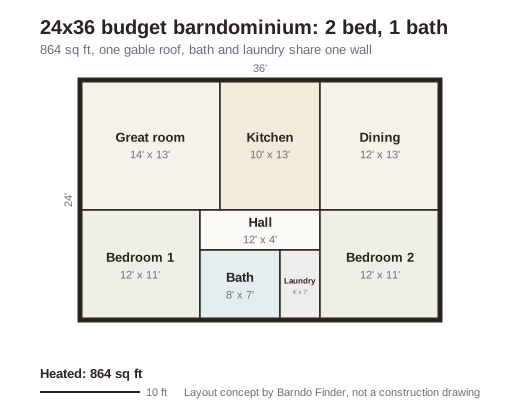 Layout concept by Barndo Finder. Dimensions in feet, not a construction drawing.
What keeps it cheap:
- One wet zone. The bath and laundry sit back to back, and the kitchen is 4 feet across the hall. Under-slab drains stay short, and one water heater serves everything with short runs.
- A 12x4 hall, nothing more. Both bedrooms and the bath open off one small hall, so almost every square foot is a room.
- Bedrooms at 12x11. Big enough for a queen bed and comfortably above the IRC's 70 square foot room minimum.
- No porch, no dormers, one roof. A shed-roof porch can come later. Every added roofline adds steel, trim and labor now.
- 24 feet wide. A 24-foot span needs a lighter frame than a 40-foot clear span, and 24x36 is a common stock size.
For more small layouts at 640, 1,080 and 1,440 square feet, see the small barndominium floor plans.
Which states make a cheap barndominium most realistic?
The five states tied for the lowest turnkey estimate in our data, and the builders we list there:
| State | Turnkey ($/sq ft) | Shell ($/sq ft) | Listed builders |
|---|---|---|---|
| Alabama | $125 to $190 | $35 to $60 | 8 |
| Arkansas | $125 to $190 | $35 to $60 | 4 |
| Kansas | $125 to $190 | $35 to $65 | 6 |
| Mississippi | $125 to $190 | $35 to $60 | 5 |
| South Dakota | $125 to $190 | $35 to $60 | 4 |
Oklahoma, Indiana, North Dakota and West Virginia sit just above, at $130 to $195 or $130 to $200 turnkey. A shell-first plan needs a builder who sells shells. Among builders we list as shell builders in these states are CJ Contracting in Seale, Alabama (5.0 stars, 25 Google reviews) and Vap Construction in Atwood, Kansas (4.6, 33 reviews). Ask each for a written scope that says what the shell includes.
Cheap states are cheap mostly because of lower labor and land costs and, in some rural counties, lighter permitting. Lighter permitting does not mean lighter engineering. Your lender and insurer will still want a house that meets code.
What should you never cut on a cheap barndominium?
Three things, because each one is cheap to do right during the build and brutal to fix afterward.
1. Stamped engineering for your site. The frame has to be designed for your county's wind speed and snow load, and the foundation for the frame's column loads. A kit engineered for someone else's zip code can fail inspection or fail in a storm. Ask who the engineer of record is before you pay a deposit.
2. The vapor retarder and insulation. The IRC calls for a 10-mil Class A vapor retarder under a heated slab, and a steel building without a continuous insulation and air barrier will sweat. Condensation on the underside of a metal roof can rot ceilings and grow mold. Closed-cell spray foam is common for exactly this reason. Cut the tile budget, never this.
3. The foundation design. Anchor bolts, column footings, slab thickness and frost depth come from the engineer's drawings, not from a generic slab quote. Every drain and conduit in the slab is permanent. Our barndominium foundation guide lists the code minimums and the mistakes owners regret.
Two more that save money only on paper: skipping the permit (lenders, insurers and future buyers all ask for the certificate of occupancy) and doing your own electrical or gas work where your state requires a licensed trade.
Where do "under $100k barndominium" ads mislead?
 Photo: Ogden Metal Solutions
A building like the one above, an erected steel shell on a gravel pad, is what many low advertised prices actually buy. Here is how ads get to an under-$100k number:
| What the ad says | What it usually means | What is missing |
|---|---|---|
| "Barndominium kits from $X" | Steel or post-frame materials only | Slab, erection, insulation, every system and finish |
| "Homes from $X per sq ft" | An erected shell price | Plumbing, electrical, HVAC, insulation, interior |
| "40x60 barndo under $100k" | A 2,400 sq ft kit or shell | At our cheapest turnkey rate, 2,400 sq ft finished is $300,000+ |
| "Delivered price" | Kit on a truck at your gate | Unloading equipment, erection crew, foundation |
| "Turnkey starting at" | Smallest plan, base finishes, flat lot | Site work, upgrades, longer drives and utility runs |
HomeGuide's metal building homes guide lists metal house kits at $10 to $25 per square foot for plans and materials, with shell assembly adding $5 to $10. Those are real prices for what they include. The trap is reading them as house prices. Our kit price comparison shows what each major supplier charges and what each package leaves out, and our shell vs turnkey guide explains why we treat any turnkey quote under $100 per square foot as a shell quote until a line-item scope proves otherwise.
How do you keep a cheap barndominium cheap after the quote?
Most budget blowouts on small builds come from decisions made after the first quote, not from the quote itself.
- Freeze the plan before the slab. Moving a toilet after the pour means cutting concrete.
- Use the slab as the floor. Sealed or stained concrete removes most of the flooring line.
- Pick standard window and door sizes from the frame supplier's list; every custom opening is extra framing in a steel wall.
- Buy appliances and fixtures yourself at builder-grade prices, and get your builder's agreement in writing if they normally supply them.
- Carry a 10 percent contingency. On a $90,000 build that is $9,000, and on a small build it is usually the difference between finishing and stalling.
Financing shapes the budget as well. A lender will fund a permitted house with a fixed-price contract, not an open-ended shell. Our construction loan guide covers who lends on small and owner-built projects.
Our take
A cheap barndominium is real, but "cheap" has a size limit and a land condition attached. If you already have land with water, septic and power, and you can do much of the interior work yourself, an 800 square foot barndo under $100,000 is a reasonable goal in the states above. On raw land, with every trade hired, plan on $100,000 being the shell and the site, not the house. We would rather see someone build 720 square feet that is finished, insulated and permitted than 1,200 square feet that stalls at the shell stage. For the full comparison against stick-built homes, read are barndominiums cheaper to build.
Price a small barndominium in your state
Check your state's shell and turnkey rates on our cost table, add the site lines above as separate items, then request quotes from builders who sell both shells and finished homes. Comparing two or three written scopes is the fastest way to find out whether your $100,000 is a house or a shell.
Common questions
Can you build a barndominium for $50,000?
Not a finished one with hired labor. At our lowest shell rate of $35 per square foot, $50,000 buys an erected shell of about 1,400 square feet, or a 600 to 864 square foot shell with money left for a well or septic. It will not have insulation, plumbing, wiring or any interior. A $50,000 livable home only happens on land that already has utilities, with almost all labor your own.
What is the cheapest barndominium to build?
A plain rectangle under one gable roof, about 600 to 900 square feet, on a slab, with one bathroom whose plumbing shares a wall with the laundry and sits a few feet from the kitchen. Build it in a low-cost state, on land that already has a well, septic and power, and finish the interior yourself. Every jog, dormer and extra bathroom adds cost.
What is the cheapest state to build a barndominium?
In our directory estimates, Alabama, Arkansas, Kansas, Mississippi and South Dakota tie for the lowest turnkey rate at $125 to $190 per square foot, with shells at $35 to $60 (Kansas $35 to $65). Oklahoma, Indiana, North Dakota and West Virginia follow at $130 to $195 or $130 to $200. Land, well and septic costs vary by county more than by state, so price the site separately.
How much does a 30x40 barndominium cost in the cheapest states?
A 30x40 is 1,200 square feet. At $35 to $60 per square foot for an erected shell, that is $42,000 to $72,000. At $125 to $190 turnkey, it is $150,000 to $228,000. Those are Barndo Finder directory estimates for Alabama, Arkansas, Kansas, Mississippi and South Dakota, before land, well, septic and site work.
Can you get a loan for a cheap barndominium?
Yes, if it is a real house: permitted, engineered, on a permanent foundation and finished to code. Lenders want a fixed-price contract and a line-item budget. Owner-builder loans are harder to find, and a lender will not fund an unfinished shell as a home. Ask local banks and credit unions early.
Ready to price your build?
Fill out one form. We send it to builders who work in your area. It costs nothing.
Request quotes