Resources / Guides
Barndominium vs Traditional House: Cost, Speed, Insurance and Resale
Updated July 2026 · Barndo Finder research
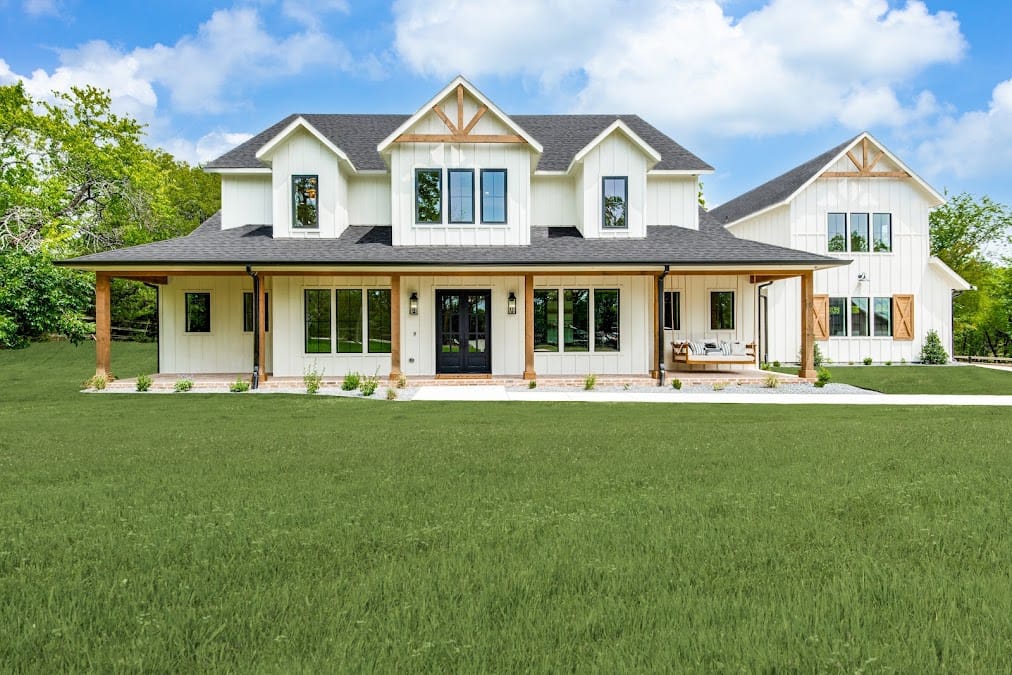
A barndominium usually costs 10 to 25 percent less than a comparable stick built house, goes up faster, and gives you cheap square footage for shop space that a traditional house can't match. It is not the 50 percent savings that kit marketing suggests, and it comes with real friction on insurance, appraisals, and financing. Here is the honest comparison, line by line.
Key takeaways
- Turnkey barndominium builds run $125 to $320 per square foot in our directory estimates. Stick built custom homes commonly run $150 to $400. The overlap is bigger than most people expect.
- The real barndo savings are in the shell and the schedule. Kitchens, bathrooms, septic, and HVAC cost the same in both buildings.
- Any turnkey quote under $100 per square foot is almost always a shell quote in disguise. Read the exclusions.
- Barndos dry in faster. Expect roughly 6 to 9 months to move-in against 9 to 14 for a comparable custom stick built house.
- Insurance premiums are often similar or lower, but fewer carriers will write the policy. Quote it before you pour concrete.
- Resale is fine in rural markets with barndo comps and shaky in suburbs without them.
How much cheaper is a barndominium than a house?
On comparable finishes, plan on a barndominium saving you about 10 to 25 percent against stick built, not the 40 to 50 percent that kit sellers advertise. Industry cost guides for 2026 put standard barndo builds around $100 to $150 per square foot and stick built construction from roughly $150 up to $400 depending on market. Our own directory estimates, built from 335 barndominium-specific builders across 40 states, put realistic turnkey barndo pricing at $125 to $320 per square foot. We ran the full cost comparison in our are-barndominiums-cheaper analysis if you want the line items.
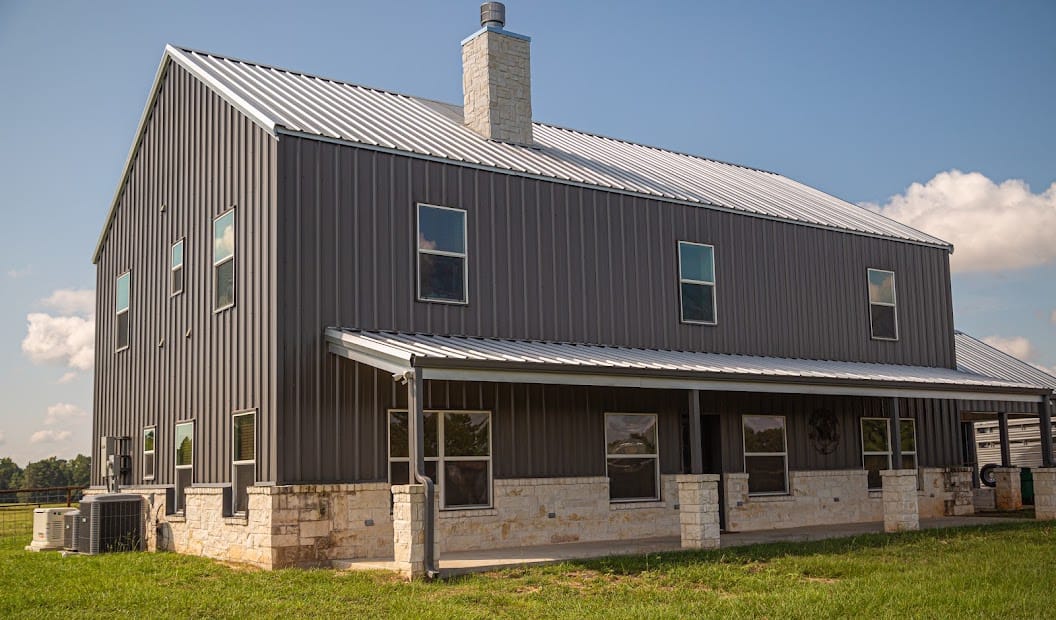 Photo: 1845 Barndominiums
Why the gap between marketing and reality? The steel shell is genuinely cheap. A pre-engineered frame and metal skin cost less per square foot than framed walls, sheathing, siding, and shingles, and they go up in a fraction of the time. But the shell is maybe a third of the total budget. The other two thirds is concrete, plumbing, electrical, HVAC, insulation, drywall, cabinets, and fixtures, and none of that cares what the walls are made of.
Where the barndo pulls clearly ahead is mixed-use space. If you want 1,800 square feet of living space plus a 1,200 square foot shop under the same roof, the barndo wins by a wide margin, because that shop space finishes out at shell prices while an attached garage on a stick built house finishes out near house prices. See our full state-by-state cost table for how this plays out by region.
What does each cost per square foot?
Turnkey barndos in most states land between $130 and $220 per square foot, while shells run $35 to $95, and stick built custom work starts around $150. The table below uses Barndo Finder directory estimates, which are pending verified builder quotes, alongside commonly published stick built ranges.
| Market | Barndo turnkey ($/sqft) | Barndo shell only ($/sqft) | Typical custom stick built ($/sqft) |
|---|---|---|---|
| Texas | 140 to 210 | 40 to 70 | 150 to 250 |
| Oklahoma | 130 to 195 | 35 to 65 | 145 to 240 |
| Tennessee | 140 to 210 | 40 to 70 | 150 to 250 |
| North Carolina | 150 to 220 | 45 to 75 | 160 to 270 |
| Florida | 160 to 240 | 50 to 85 | 175 to 300 |
| California | 180 to 270 | 60 to 95 | 250 to 400 |
| National range | 125 to 320 | 35 to 120 | 150 to 400 |
Stick built figures are broad market ranges from published 2025 and 2026 cost guides, not our quotes. The takeaway is the same in every row: the barndo is cheaper, but it is a 15 to 25 percent discount, not a half-price building.
Run the numbers on a 2,400 square foot build in Texas. At $170 per square foot, the barndo costs about $408,000 turnkey. A stick built equivalent at $200 per square foot costs $480,000. That $72,000 is real money. It is also not the $200,000 savings a $70 per square foot Facebook ad implied.
Why do so many barndominium quotes look too cheap?
Because most cheap quotes are shell quotes wearing a turnkey costume. We have compared enough builder pricing to say this plainly: a quote under $100 per square foot almost never includes the concrete slab, plumbing rough-in, electrical, HVAC, insulation, interior walls, or fixtures. It is a steel frame, metal skin, and a roll-up door. Our shell vs turnkey breakdown explains exactly what each route includes.
Kit marketing makes this worse. A $60,000 kit for a 2,000 square foot barndo sounds like $30 per square foot. Owners on forums like TractorByNet report the same pattern over and over: the kit was the cheap part, and wiring, finishing, and extras are where the budget doubled. The same budget blowups top our list of owner mistakes and regrets.
A real budget also needs lines the per-square-foot number never includes. Land. Well or water tap. Septic, which commonly runs $8,000 to $25,000 depending on soil. Site work, driveway, and utility trenching, which can add $15,000 to $50,000 on raw rural land. These costs hit stick built projects too, but barndo buyers get blindsided more often because the advertised number was smaller to begin with. Our cost guide breaks out these line items by state.
How much faster is a barndominium build?
Meaningfully faster on the front end. A steel shell can be erected and dried in within days to weeks, while framing and drying in a stick built house typically takes 2 to 4 months. Published timelines put many barndo projects at 6 to 9 months to move-in, against 9 to 14 months for comparable custom stick built homes. For a stage-by-stage schedule, see our barndominium build timeline.
Be honest about where the speed comes from, though. Interior finish-out is the slow part of any build, and it takes the same trades the same time in either building. If your builder is quoting 4 months turnkey, ask hard questions. The realistic pitch is that a barndo saves you 2 to 4 months, mostly by getting the structure weather-tight fast so interior trades can start earlier.
Speed also depends on your builder's backlog more than the building type. Builders in high-demand states like Texas and Tennessee often carry 6 to 12 month backlogs before a shovel hits dirt.
Is insurance cheaper or harder on a barndominium?
Both, depending on where you are. On premium, barndos often do fine. Metal roofs carry a Class A fire rating, and insurers in hail and wildfire markets give credits for metal roofing that published guides put at 5 to 35 percent of the roof-related premium. Barndominium insurance guides for 2026 put typical annual policies around $1,500 to $4,500 depending on state, size, and attached shop use.
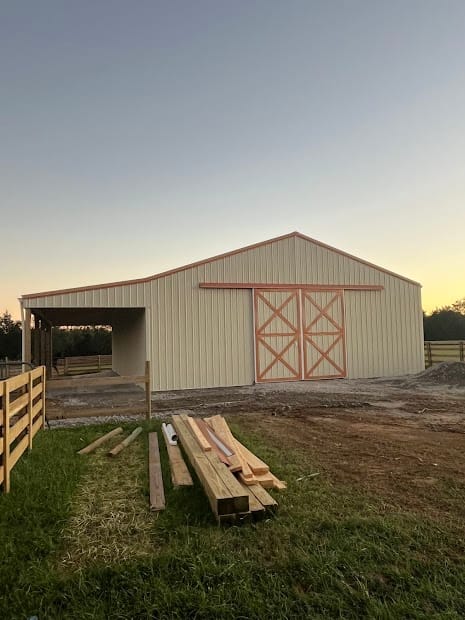 Photo: The Barn Store
The harder problem is finding a carrier at all. Fewer insurers write metal residential buildings, and an attached workshop, especially one with welding equipment, vehicle lifts, or business use, can push you out of standard homeowner policies into farm and ranch or specialty products. Owners in some rural markets report shopping 4 or 5 carriers before getting a bindable quote. Our barndominium insurance guide covers which carriers actually write these policies.
Our advice is blunt: get an insurance quote during design, before you build. A stick built house will never surprise you here. A barndo might, and it is a cheap phone call to find out.
Do barndominiums hold their value like a regular house?
In the right market, yes. In the wrong one, resale is the barndo's weakest link. The core issue is comparable sales. Appraisers value homes against recent sales of similar properties, and in rural Texas, Oklahoma, or Tennessee there are now enough barndo sales that appraisals generally come in fine and values track the local market. We dug into the actual numbers in our resale value and appraisal guide.
In suburban markets with no barndo comps, industry analyses report the failure mode clearly: an appraiser who has never valued a barndominium defaults to agricultural building comparables and produces a number well below what a buyer would actually pay. That low appraisal then caps what a financed buyer can offer, which drags the real sale price down with it.
You can protect yourself. Build with full residential permits and inspections, keep complete documentation of the build, use conventional residential proportions and windows on the street-facing side, and buy in an area where barndos already exist. A barndo that photographs like a house and papers like a house sells like a house.
Is a barndominium harder to finance?
Somewhat, and it is the same comp problem wearing a different hat. Most barndo builds use a construction loan that converts to a mortgage, and lenders underwrite that against an appraisal of the finished home. Where comps exist, financing is routine. Where they don't, lending guides report months of delays and outright declines, not because of the borrower's credit but because the lender can't value the collateral. Our guide to barndominium construction loans covers rates, draw schedules, and approval odds in detail.
Practical fixes: use a local bank or farm credit lender that already finances barndos in your county, ask your builder which lenders have closed their projects before, and look at USDA construction-to-permanent loans if your site qualifies as rural. A stick built house in a subdivision will always be the easier loan. Budget extra weeks for approval on a barndo and you'll rarely be surprised. Our financing overview lists the lender types worth calling first.
So which should you build?
Build the barndominium if you're rural, you want shop or storage space under the same roof, and you can accept a slightly harder insurance and financing path in exchange for roughly 10 to 25 percent savings and a faster dry-in. The economics genuinely favor you, and the more non-living square footage you want, the more they favor you.
Build stick built if you're in a suburb without barndo comps, resale within 10 years matters to you, or your lot and HOA push you toward conventional construction anyway. At $180 to $220 per square foot for either building, the barndo discount is not worth fighting appraisers in a market that doesn't understand the product.
Either way, do not make the decision on advertised per-square-foot numbers. Make it on 2 or 3 real turnkey quotes with written exclusion lists, plus your land, septic, and site work lines.
Get real quotes and compare
The fastest way to settle barndominium vs house for your specific build is to price both with real numbers. We track 335 barndominium-specific builders across 40 states, with directory pages for high-activity states like Texas, Oklahoma, and North Carolina. Browse the full builder directory, check your state's numbers on the cost table, and request quotes from builders who actually work in your county. Two matching turnkey quotes will tell you more than any comparison article, including this one.
Common questions
Is a barndominium really cheaper than a house?
Usually, but by less than the marketing says. On comparable finishes, expect a barndominium to come in about 10 to 25 percent under a stick built house, not 50 percent. The savings come from the shell, the roof, and the speed of dry-in. Kitchens, bathrooms, HVAC, and septic cost the same in both.
What does a barndominium cost per square foot vs a stick built house?
Our directory estimates put turnkey barndominium builds at $125 to $320 per square foot nationally, with most states in the $130 to $220 range. Stick built construction commonly runs $150 to $400 per square foot depending on market and finish. Shell-only barndo pricing of $35 to $95 per square foot is a different product and should never be compared to a turnkey house number.
Are barndominiums faster to build than traditional houses?
Yes. A steel shell can be dry in within days to weeks, and many barndominium projects finish in 6 to 9 months against 9 to 14 months for comparable custom stick built homes. Interior finish-out takes roughly the same time either way, so the savings come mostly at the front of the schedule.
Is barndominium insurance more expensive?
The premium itself is often fine. Published 2026 guides put typical barndo policies around $1,500 to $4,500 per year, and metal roofs carry a Class A fire rating that can earn discounts. The real problem is carrier availability. Fewer insurers write metal residential buildings, especially with attached shops, so quote insurance before you build, not after.
Do barndominiums hold their resale value?
In rural markets with other barndos nearby, yes, they generally appreciate with the local market. In suburban markets with no comparable sales, appraisals and resale get harder, because appraisers may lean on agricultural building comps. Full residential permitting, good documentation, and conventional curb appeal all protect value.
Ready to price your build?
Fill out one form. We send it to builders who work in your area. It costs nothing.
Request quotes