Builders / Washington
Barndominium builders in Washington
Planning a build? Read our guide to building a barndominium in Washington.
Builders tracked
Barndominium-specific, deduplicated
Turnkey
Per sqft, directory estimate
Shell only
Per sqft, directory estimate
Permits and codes in Washington
Washington enforces statewide codes adopted by the State Building Code Council, and every county runs plan review. The Washington State Energy Code is among the strictest in the country: expect heat pump credits, blower door testing and insulation levels that add real cost to a post-frame shell. Contractors must register with the Department of Labor & Industries, carry a bond and insurance, and buyers can check any contractor on the L&I Verify a Contractor tool. West of the Cascades you are in Seismic Design Category D and engineering gets serious. Eastern counties add snow load. On rural land, septic approval runs through the county health district under Department of Health rules, and critical areas ordinances for wetlands and slopes can slow a permit by months. In some watersheds, RCW 90.94 caps new permit-exempt household wells at 950 or 3,000 gallons a day and adds a $500 fee.
Financing a barndominium in Washington
AgWest Farm Credit, formerly Northwest Farm Credit Services, covers Washington and regularly finances rural homes on acreage, including post-frame construction. Community banks in eastern Washington see enough barndominiums that comps are workable around Spokane, the Tri-Cities and Yakima. West side appraisals are harder because inventory is thin. Expect 20 to 25 percent down and a fixed-price contract from a registered builder.
The list (7)
Sorted by review count. Featured listings are labeled.

Photos pending
Mount Vernon, WA




Ad space available
Your barndo business can be here
Builders, lenders, kit makers and suppliers: put your company in front of people planning a barndominium in Washington.
Get the deck and pricingBuilding a barndominium in Washington
A finished barndominium in Washington runs about $165 to $245 per square foot turnkey, or $50 to $85 per square foot for a shell, by our directory estimates. That puts a 2,400 square foot home at roughly $396,000 to $588,000 before land and site work, above the national medians in our data. We list 7 Washington builders, split between the I-5 corridor, the Yakima Valley and Spokane.
Three things set Washington apart. The energy code is a points system that rewards heat pumps and makes a bare metal shell expensive to bring up to standard. Water is a legal question on many rural parcels, because a growing list of watersheds restrict new household wells. And the Cascades split the state: west-side builds are designed for earthquakes and rain, east-side builds for snow and cold.
Land, zoning and deed restrictions
Washington counties zone their own rural land, but every county and city must also adopt rules that protect critical areas. State law defines those as wetlands, aquifer recharge areas, fish and wildlife habitat, frequently flooded areas and geologically hazardous areas. West of the Cascades, a wooded 5-acre parcel with a creek or a wet corner can need a wetland or stream study and a buffer that shrinks the usable building area. Order the county's critical areas map for the parcel before you make an offer.
Water belongs in the land decision too. AgWest Farm Credit's construction loan checklist tells borrowers to ask the county about wetland studies, buffers and watershed water requirements, and to request the area's water feasibility study before they apply. A cheap parcel with no legal water source is not a cheap homesite.
Private restrictions still apply. Rural subdivisions around Spokane, Olympia and the Skagit Valley often carry recorded covenants on exterior materials, colors and outbuildings. Read them for the exact lot, and search for "metal" and "accessory building."
Codes, engineering and climate
Washington has one statewide code, adopted by the State Building Code Council and enforced by your city or county. The 2021 editions of the IRC, IBC and Washington State Energy Code are in effect; Edmonds, for one, lists them as effective March 15, 2024. The council is adopting the 2024 codes, which it says take effect May 3, 2027, so a project designed in 2026 and permitted in mid-2027 may land under a different edition. Ask the building department which one your application will be reviewed under.
The energy code is where a barndo budget moves. Under Section R406 of the 2021 Residential Energy Code, every new home must earn energy credits on top of the base insulation tables:
| Home | Credits required |
|---|---|
| Small: under 1,500 sq ft conditioned, under 300 sq ft of windows | 5.0 |
| Medium: everything not small or large | 8.0 |
| Large: over 5,000 sq ft conditioned | 9.0 |
The heating system counts toward the total. A heat pump that meets federal standards earns 3.0 credits, a heat pump with a gas or electric backup earns 1.5, and a gas furnace earns 0. A 2,400 square foot barndo heated by a heat pump needs 5 more credits from the options table (better windows, tighter air sealing, efficient water heating, solar); the same home with a gas furnace needs all 8 from that table. Settle the heating plan before you pick the wall and roof insulation, and read our guide to barndominium insulation.
The structural drivers split at the Cascades. On the west side, earthquakes govern: Edmonds lists Seismic Design Category D1 for houses, with a 25 psf ground snow load and 98 mph wind. That means engineered shear walls or bracing for a post-frame building with long open walls and big doors. East of the mountains, snow takes over. Okanogan County's design criteria sheet lists ground snow loads from 40 to 105 psf depending on location, Seismic Design Category C, a 24-inch frost line and a winter design temperature of 10 degrees. A kit priced for a 25 psf site will not stamp at 105 psf without heavier trusses and tighter purlin spacing, so put the design snow load in the contract.
Wildfire rules are arriving east of the Cascades and in the foothills. Under RCW 19.27.560, a wildland-urban interface code applies to parcels mapped as high or very high hazard, with Class A roofs, fire-resistant exterior walls, rules for decks and driveway access standards. It depends on state and local wildfire maps, so ask the county whether it applies to your parcel today.
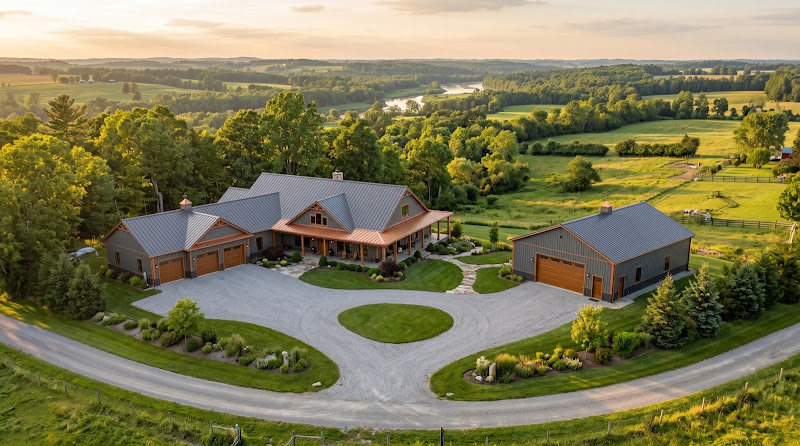
Photo: Steel Structures America
What a barndominium costs in Washington
These figures come from our state table. They are Barndo Finder directory estimates, not transaction data, and exclude land, well, septic, site work and the driveway.
| Size | Shell ($50 to $85/sqft) | Turnkey ($165 to $245/sqft) |
|---|---|---|
| 1,500 sq ft | $75,000 to $127,500 | $247,500 to $367,500 |
| 2,400 sq ft | $120,000 to $204,000 | $396,000 to $588,000 |
| 3,000 sq ft | $150,000 to $255,000 | $495,000 to $735,000 |
Washington sits above the national medians in our data (shell $45 to $75, turnkey $145 to $215) on both ranges, by $20 to $30 per square foot at the turnkey level. Keep the small-dwelling line in mind: a home under 1,500 square feet with under 300 square feet of windows needs 5 energy credits instead of 8. For national context see the 2026 cost report, and for every state side by side, our cost page.
Financing and insurance in Washington
AgWest Farm Credit is the Farm Credit lender for Washington. Its all-in-one construction loan has one closing, rate options that can be locked for the life of the loan and interest-only payments during construction. The terms on its getting started page matter for barndos: a licensed general contractor that AgWest approves, building and septic permits before closing, plans, specs and bids before the appraisal is ordered, a maximum loan of 80 percent of the finished property value, and reserves of 10 percent of the construction bid plus four months of payments. Credit unions and community banks fill in the rest. Our construction loan guide covers draws and lender types.
If you plan to be your own general contractor, expect AgWest and most construction lenders to decline, and price a cash or land-equity route first. Insurance is ordinary for a well-built post-frame or steel home on the west side; in mapped wildfire country east of the Cascades, get a quote before you close on land. Our insurance guide explains how carriers classify these homes.
Utilities, well and septic
Start with water. Under RCW 90.44.050, a household well can use up to 5,000 gallons a day without a water right, plus water for stock and a noncommercial lawn or garden up to half an acre. That baseline no longer holds everywhere:
- 15 Streamflow Restoration watersheds. In the Snohomish, Cedar-Sammamish, Duwamish-Green, Puyallup-White, Chambers-Clover, Deschutes, Kennedy-Goldsborough and Kitsap basins, RCW 90.94.030 caps a new household well at an annual average of 950 gallons a day, for domestic use only, and allows curtailment to 350 gallons a day for indoor use in a drought. In the Nooksack, Nisqually, Lower and Upper Chehalis, Okanogan, Little Spokane and Colville basins, RCW 90.94.020 sets a cap of 3,000 gallons a day. Both add a $500 fee to the building permit, paid to the city or county.
- Basin rules can be tighter. The Nooksack rule in Whatcom County limits a new home on a new exempt well to 500 gallons a day indoors and 1/12 acre of outdoor watering. In the Skagit basin, Ecology says its 2001 instream flow rule limits new water uses of any size, permit-exempt wells included.
If you want horses, a big garden or a shop wash bay, read your watershed's rule before you buy.
Septic is permitted by the local health jurisdiction, which administers the state on-site sewage rule, WAC 246-272A. Wet, shallow soils on the west side often push a design to a mound or pressure system. Budget with published ranges of $3,500 to $8,500 and up for septic and $10,000 to $30,000 for a drilled well from our build process guide, then get local bids.
Power is its own permit. Outside cities that run their own program and Tacoma Power's area, L&I sells the electrical permit and inspects the work, and the permit must be bought by the electrical contractor or by the owner doing the work. Ask your PUD or power company for a line extension estimate before you buy.
A realistic timeline in Washington
Plan on 12 to 18 months from design to move-in, the range in our build timeline guide, with critical areas review the likeliest delay.
- Before you buy: confirm the watershed's well rules, septic feasibility, critical areas and covenants. Ask which code edition your permit will fall under.
- Pre-construction: 3 to 6 months. Engineering to your seismic category or snow load, the energy credit worksheet, septic design, the loan and the building permit. A wetland or stream study can add months.
- Construction: 6 to 12 months. West of the Cascades, get the slab poured and the shell dried in before the wet season. East of the mountains, plan the shell around winter snow and frozen ground.
Builders we list in Washington
We list 7 barndominium builders in Washington. Here are all of them, grouped by region, with what our data shows. Ratings are public Google reviews at the time we indexed them.
| Region | Builder | City | Build type | Rating |
|---|---|---|---|---|
| North Sound | Spane Buildings | Mount Vernon | Not listed | 4.9 (96 reviews) |
| North Sound | Alvord-Richardson Construction, Texmo Buildings | Lynden | Shell and turnkey | 5.0 (4 reviews) |
| Southwest | Western Edge Exteriors & Construction LLC | Winlock | Shell | 5.0 (7 reviews) |
| Southwest | 3six0 Quality Construction LLC | Chehalis | Shell | 5.0 (3 reviews) |
| Yakima Valley | Steel Structures America | Zillah | Shell and turnkey, Mueller kits | 4.8 (63 reviews) |
| Spokane | Solid Structures | Spokane | Turnkey | 4.2 (47 reviews) |
| Spokane | Kuenzel Construction LLC - Pole Barn Builder | Spokane Valley | Shell | 5.0 (12 reviews) |
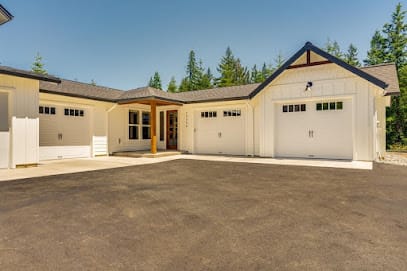
Photo: 3six0 Quality Construction LLC
Most of the list builds shells, so many Washington buyers will pair a post-frame or steel shell with a separate general contractor for the interior. Look up every contractor's registration, bond and insurance on L&I's Verify a Contractor tool; state law requires registration with a $30,000 bond for general contractors and $15,000 for specialty contractors. Building for yourself on your own land is exempt from registration, unless the purpose is to sell or lease the property. Our shell vs turnkey guide and DIY barndominium guide cover what you take on. If you are on the Idaho line or along the Columbia, our Idaho and Oregon pages list more builders.
For layouts that suit a clear-span building, browse our barndominium floor plans. Then request quotes from builders who serve your county, and compare each one to our cost table.
Updated October 2026 · Barndo Finder research
Building in Washington: common questions
Do you need a permit to build a barndominium in Washington?
Yes. The State Building Code applies in every city and county, and the local building department reviews plans and inspects the work. Most rural homes also need a septic permit from the local health jurisdiction, and in most of the state the electrical permit comes from the Department of Labor and Industries rather than the county. In 15 watersheds a new household well adds a $500 fee to the building permit.
How much does a barndominium cost in Washington?
Our directory estimate for Washington is $165 to $245 per square foot turnkey and $50 to $85 per square foot for a shell, above the national medians in our data. A 2,400 square foot turnkey home works out to about $396,000 to $588,000 before land, well, septic and site work. These are estimates from our state table, not quotes.
Does the Washington energy code make a barndominium more expensive?
It adds cost, mostly through the credit system in the 2021 Washington State Energy Code. A medium-size home needs 8.0 energy credits on top of the base insulation rules. A qualifying heat pump as the heating system earns 3.0 of those credits, while a gas furnace earns none, so a heat pump design usually needs fewer envelope or equipment upgrades to get to 8.
Can you drill a well for a barndominium in Washington?
Often, but check the watershed first. A household well can use up to 5,000 gallons a day without a water right under state law. In 15 watersheds covered by the Streamflow Restoration law, new household wells are capped at 950 or 3,000 gallons a day and carry a $500 fee. Some basins, such as the Skagit and Nooksack, have stricter instream flow rules.
Can I build my own barndominium in Washington without registering as a contractor?
Yes, if you are building on your own property for yourself. State law exempts people working on their own property, but the exemption does not apply if you are doing the work for the purpose of selling or leasing the property. Anyone you hire to build for you must be registered with Labor and Industries, with a $30,000 bond for a general contractor.
Can you get a loan for a barndominium in Washington?
Yes. AgWest Farm Credit offers a one-closing construction loan in Washington. It requires a licensed general contractor it approves, building and septic permits before closing, a maximum loan of 80 percent of the finished value, and cash reserves of 10 percent of the construction bid plus four months of payments. Owner-builders usually need a different lender or a cash path.