
Builders / Utah
Barndominium builders in Utah
Planning a build? Read our guide to building a barndominium in Utah.
Builders tracked
Barndominium-specific, deduplicated
Turnkey
Per sqft, directory estimate
Shell only
Per sqft, directory estimate
Permits and codes in Utah
Utah adopts the IRC statewide under the State Construction and Fire Codes Act (Utah Code Title 15A), and every city and county enforces it through a local building department. There is no unpermitted rural option here. General contractors need a B100 or R100 license from the Division of Professional Licensing (DOPL), and buyers can verify any license on the DOPL lookup. The engineering driver is seismic: the Wasatch Front sits along the Wasatch fault, so post-frame plans get real structural review. Mountain counties add 60 psf or higher snow loads. On rural land, septic goes through the local health department under Division of Water Quality rules, and several counties require proof of water rights before issuing a building permit.
Financing a barndominium in Utah
Western AgCredit is the Farm Credit association for Utah and lends on rural residences with acreage; its Country Home Loans are an AgWest Farm Credit program. Community banks and credit unions along the Wasatch Front will do construction loans but most underwrite post-frame homes cautiously, and appraisers benchmark against stick-built comps because barndominium sales are still thin. Expect 20 to 25 percent down and a full set of engineered plans before approval.
The list (6)
Sorted by review count. Featured listings are labeled.
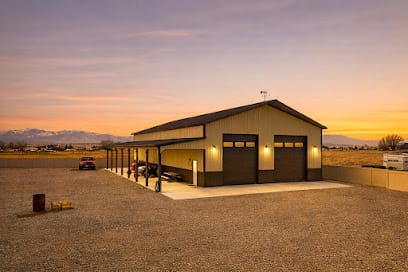
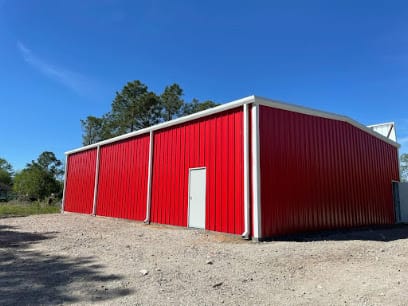
North Ogden, UT
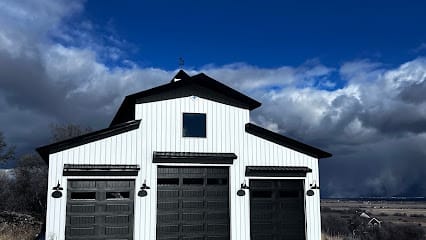
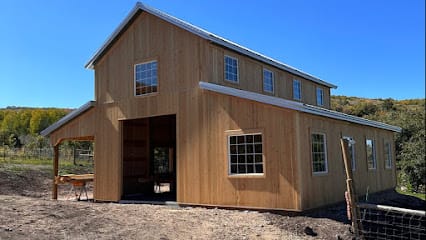
Kaysville, UT
Ad space available
Your barndo business can be here
Builders, lenders, kit makers and suppliers: put your company in front of people planning a barndominium in Utah.
Get the deck and pricingBuilding a barndominium in Utah
A finished barndominium in Utah runs about $150 to $220 per square foot turnkey, or $45 to $75 per square foot for a shell, by our directory estimates. That puts a 2,400 square foot home at roughly $360,000 to $528,000 before land and site work, a touch above the national turnkey median in our data. We list 6 Utah builders, all along the Wasatch Front and in Morgan County.
Utah is more uniform than most western states. One state code applies everywhere, so no rural county lets a home go uninspected. But three local facts decide whether a parcel works: whether you can get legal water, what ground snow load the town is assigned, and whether the lot sits on a mapped fault, slide or wildfire area.
Land, zoning and deed restrictions
Counties zone unincorporated land and cities zone their own. Before anything else, confirm the parcel is a buildable lot. Weber County's development packet, for example, asks first whether the property is a "Lot of Record"; if it is not, a subdivision approval comes before any building plans are accepted. The same packet flags flood zones, slopes over 25 percent, wetlands and, in Ogden Valley, ridgeline rules. Large accessory buildings in front of or beside the house must match its style and materials.
The state's agricultural exemption is narrower than many buyers assume. Under Utah Code 15A-1-204, a structure is exempt from the building code only if it is used solely for agriculture and not for human occupancy, and even then not on small lots inside town limits or in subdivisions. A pole barn permitted as an ag building cannot later become a home without going through a full residential permit. Our barndominium zoning guide covers the conversion trap in more detail.
Private covenants are the third filter. Rural subdivisions often record restrictions on exterior materials and outbuildings. Search the recorded covenants for "metal" and "accessory building" before you make an offer.
Codes, engineering and climate
Utah adopts its codes in statute. Utah Code 15A-2-103 names the 2021 IRC and the 2021 IECC as the State Construction Code, with state amendments in chapter 3 of the same title. The residential code took effect July 1, 2023, and the amended 2021 IECC for homes took effect July 1, 2024. Since 2016, local governments generally cannot adopt rules more restrictive than the state code on subjects it covers, so plan review should look similar from Logan to Kanab.
Snow load is set in the state amendments themselves. Utah Code 15A-3-202 replaces the IRC's snow map with a table of Utah towns, and points everywhere else to the 2018 Utah Snow Load Study by Bean, Maguire and Sun at Utah State University.
| Location | Elevation | Ground snow load |
|---|---|---|
| St. George | 2,585 ft | 21 psf |
| Salt Lake City | 4,239 ft | 28 psf |
| Provo | 4,541 ft | 31 psf |
| Ogden | 4,334 ft | 37 psf |
| Logan | 4,531 ft | 43 psf |
| Morgan | 5,062 ft | 52 psf |
| Heber City | 5,604 ft | 60 psf |
| Monticello | 7,064 ft | 67 psf |
Elevation alone does not predict the number: Logan at 4,531 feet carries more load than Price at 5,558 feet (31 psf). Heber City's 60 psf is roughly double Salt Lake City's, which means heavier trusses, tighter purlin spacing and bigger posts on the same footprint. Ask every kit supplier which load their quote is engineered for, and put it in the contract.
Earthquakes are the second driver. The Utah Geological Survey's working group forecasts a 43 percent chance of one or more magnitude 6.75 or larger earthquakes in the Wasatch Front region in the next 50 years, and 57 percent for magnitude 6.0 or larger. For a post-frame or steel building, that puts the engineering focus on lateral bracing, shear walls around the living space and the connection between posts and foundation. In Weber County, a lot in a mapped geologic hazard area needs a report signed by a geologist and a geotechnical engineer at permit submittal.
Wildfire rules are new. House Bill 48, passed in 2025, requires local governments to map their wildland-urban interface and apply the Utah Wildland Urban Interface Code to new construction there. Millcreek's notice to residents summarizes what that means for new homes: fire-resistant roofing and siding, ember-resistant vents and decks, and defensible space. Separately, properties the state rates as high-risk WUI owe a state wildfire mitigation fee, a flat fee by square footage for 2026 and 2027, collected on the property tax bill. Steel roofing helps, but vents and a wood porch still have to comply.
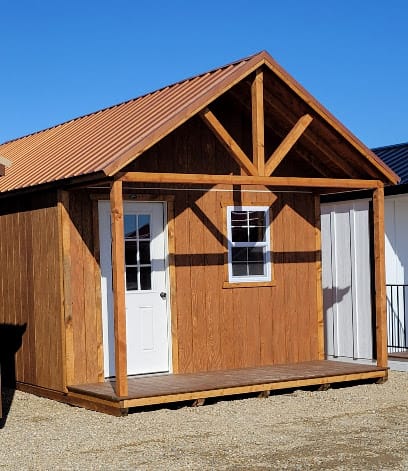
Photo: Beehive Buildings
What a barndominium costs in Utah
These figures come from our state table. They are Barndo Finder directory estimates, not transaction data, and exclude land, water rights, well, septic, site work and the driveway.
| Size | Shell ($45 to $75/sqft) | Turnkey ($150 to $220/sqft) |
|---|---|---|
| 1,500 sq ft | $67,500 to $112,500 | $225,000 to $330,000 |
| 2,400 sq ft | $108,000 to $180,000 | $360,000 to $528,000 |
| 3,000 sq ft | $135,000 to $225,000 | $450,000 to $660,000 |
The shell range matches the national medians in our data (shell $45 to $75), and turnkey runs $5 per square foot above them (national $145 to $215) at both ends. Two Utah costs sit outside the table and can be large: buying a water right where the basin is closed, and engineering for a 50-plus psf snow load or a mapped hazard. For context see the 2026 cost report and the state comparison on our cost page.
Financing and insurance in Utah
Western AgCredit is the Farm Credit association for Utah and parts of Wyoming, Nevada and Arizona. For homes, it does not lend on its own paper: its Country Home Loans page says those loans are an AgWest Farm Credit program, made with Western AgCredit's consent and owned and serviced by AgWest. AgWest's all-in-one construction loan has one closing and interest-only payments during building, and its new construction loan guide spells out the conditions: a licensed general contractor approved by AgWest, building and septic permits before closing, a maximum loan of 80 percent of the finished value, and reserves of 10 percent of the bid plus four months of payments.
That rules out owner-builders with this lender; price a cash or land-equity plan, or talk to Utah credit unions and community banks early. Our construction loan guide explains draws, and the financing page compares lender types.
Utah also gives homeowners a lien shield worth using. Under the Residence Lien Restriction and Lien Recovery Fund Act, if you sign a written contract with a licensed (or exempt) contractor and pay it in full, an unpaid subcontractor or supplier generally cannot foreclose a lien on your owner-occupied home; it claims against the state fund instead. For coverage, our insurance guide explains how carriers rate steel and post-frame homes, and in a mapped WUI area get a quote before you close on land.
Utilities, well and septic
Water is a legal right in Utah, not just a hole in the ground. The Division of Water Rights is blunt: a well owner must have a valid water right before the well is built. Once the right is approved, the Division issues a start card, which works as the permit to construct, and the well must be drilled by a licensed driller. Per the Division's FAQ:
- Each area is open, restricted or closed to new rights. Check the map before you buy.
- In a closed area you cannot apply for new water. You must acquire all or part of an existing right and file a change application.
- The standard duty for one home is 0.45 acre-foot per year, indoor only. Livestock add 0.028 acre-foot per animal and irrigation 4.0 acre-feet per acre, so horses and a lawn need a bigger right.
- Water rights are real property conveyed by their own paperwork; confirm the right actually comes with the parcel.
Counties tie this to the building permit. Weber County will not issue one until you show an approved culinary water source (a water company connection or a tested well approved by county environmental health) and an approved wastewater system. Tooele County Health requires a copy of the water right and the start card, a 100-foot protection zone around the well, and lab testing; its well page notes septic permits are not issued until the well results pass.
Septic is governed by the state onsite wastewater rule, R317-4, which makes the regulatory authority either the Division of Water Quality or the local health department with jurisdiction. In practice you apply to your county or district health department. Budget with published ranges of $3,500 to $8,500 and up for septic and $10,000 to $30,000 for a drilled well from our build process guide, and add the cost of buying a water right where you must.
A realistic timeline in Utah
Plan on 12 to 18 months from design to move-in, the range in our build timeline guide.
- Before you buy: confirm the lot is buildable, the water right (or a water connection), septic feasibility, WUI and geologic hazard maps, and covenants. A change application on a water right can take months, so start it first.
- Pre-construction: 3 to 6 months. Engineering to your town's snow load, any geotechnical report, the loan, and permits.
- Construction: 6 to 12 months. In St. George crews work year-round. On the Wasatch Front and in the mountain valleys, aim to pour concrete and dry in the shell before winter so interior work can continue.
Builders we list in Utah
We list 6 barndominium builders in Utah. Here are all of them, with what our data shows. Ratings are public Google reviews at the time we indexed them.
| Region | Builder | City | Build type | Rating |
|---|---|---|---|---|
| Davis County | Beehive Buildings | Layton | Turnkey | 4.5 (51 reviews) |
| Davis County | Wright Buildings | Kaysville | Shell | 4.8 (18 reviews) |
| Weber County | Ogden Metal Solutions | North Ogden | Shell | 4.8 (22 reviews) |
| Weber County | North Star Buildings | Roy | Shell | 5.0 (21 reviews) |
| Utah County | Custom Metal Buildings | Provo | Shell | 5.0 (17 reviews) |
| Morgan County | Premier Structures - Post Frame Buildings | Morgan | Not listed, Lester kits | 4.7 (3 reviews) |
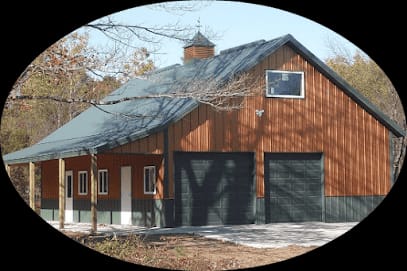
Photo: Wright Buildings
Every listed builder is in the northern Wasatch Front, and four of six are shell suppliers, so most buyers will pair a shell with a licensed contractor or build as owner-builder. Utah's owner-builder exemption covers a sole owner building on their own land for noncommercial use, one home per year, with unpaid helpers only; anyone you pay must be licensed. Southern Utah buyers should ask whether a crew will travel to Washington or Iron County, and compare with builders on our Idaho and Colorado pages. Check every contractor's license and classification (B100 general building or R100 residential and small commercial) on the state license lookup, and read our shell vs turnkey guide if you will finish the inside yourself.
Browse our barndominium floor plans for layouts that suit a clear-span building. Then request quotes from builders who serve your county, and compare each one to our cost table.
Updated October 2026 · Barndo Finder research
Building in Utah: common questions
Do you need a permit to build a barndominium in Utah?
Yes. Utah has one State Construction Code, built on the 2021 IRC with state amendments, and every city and county enforces it through a building permit. The state's agricultural exemption covers only structures used solely for agriculture and not for human occupancy, so a barndo with living space is a dwelling. Expect plan review, inspections, plus culinary water and septic approvals before the permit is issued.
How much does a barndominium cost in Utah?
Our directory estimate for Utah is $150 to $220 per square foot turnkey and $45 to $75 per square foot for a shell. The shell range matches the national medians in our data and turnkey sits $5 above them at both ends. A 2,400 square foot turnkey home works out to about $360,000 to $528,000 before land, water, septic and site work.
What snow load does a Utah barndominium need?
It depends on the town and elevation. The state amendments to the IRC list ground snow loads by location: 28 psf in Salt Lake City, 37 psf in Ogden, 43 psf in Logan, 52 psf in Morgan, 60 psf in Heber City and 67 psf in Monticello. Places not on the list use the 2018 Utah Snow Load Study from Utah State University. Get the figure from the building department in writing.
Can you drill a well for a barndominium in Utah?
Only with a water right. The Division of Water Rights requires a valid right before any well is built, and a licensed driller needs the start card it issues. In areas closed to new appropriation you must buy all or part of an existing right and file a change application. The state's standard figure for one home's indoor use is 0.45 acre-foot per year.
Can I build my own barndominium in Utah without a contractor license?
Yes. Utah exempts a sole owner building a home on their own property for noncommercial, nonpublic use, limited to one residence per year and three per five years. Helpers must work for no more than token pay under your direction. Anyone you pay to do the work must hold the license the job requires, and you still need every permit and inspection.
Can you get a loan for a barndominium in Utah?
Yes. Western AgCredit is the Farm Credit association for Utah, and it offers Country Home Loans through a partnership with AgWest Farm Credit, which owns and services those loans. AgWest's construction loan requires a licensed general contractor it approves, building and septic permits before closing, and a maximum loan of 80 percent of the finished value. Credit unions and community banks are the other route.