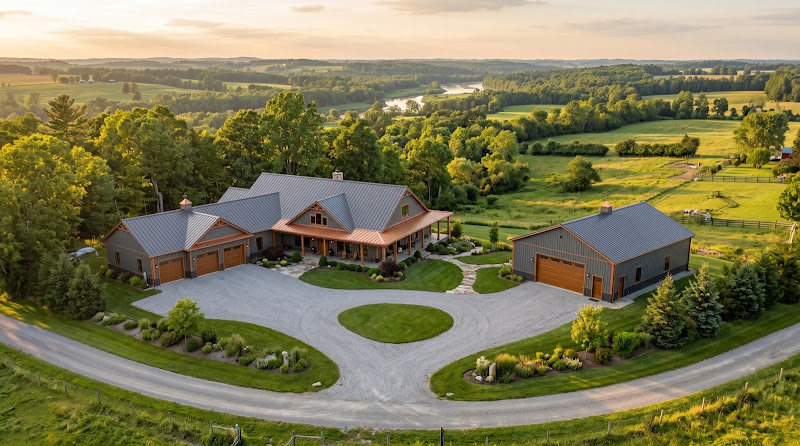
Builders / Rhode Island
Barndominium builders in Rhode Island
Planning a build? Read our guide to building a barndominium in Rhode Island.
Builders tracked
None passed the barndominium check yet
Turnkey
Per sqft, directory estimate
Shell only
Per sqft, directory estimate
Permits and codes in Rhode Island
Rhode Island runs a single mandatory State Building Code based on the IRC, administered by the State Building Code Commission and enforced by municipal building officials in all 39 cities and towns. Every general contractor must register with the Contractors' Registration and Licensing Board under the Department of Business Regulation, and registrations are searchable online at crb.ri.gov. The practical obstacle is land, not code: lots are small, zoning boards are slow, and metal-sided buildings draw scrutiny in village districts. Coastal parcels need roughly 121 to 137 mph wind design for ordinary homes and flood zone compliance. Septic on unsewered land goes through the RIDEM OWTS program, which requires a licensed designer and can take months. Budget real time for approvals.
Financing a barndominium in Rhode Island
Farm Credit East covers Rhode Island and is the realistic construction lender for a barndominium on the few rural parcels in Exeter, Foster or West Greenwich. Local banks such as Centreville and Washington Trust do construction lending but want conventional stick-built comparables, which do not exist for barndominiums here. Expect appraisal pushback, 20 to 25 percent down, and underwriting that treats the project as custom construction rather than a standard product.
The list
Sorted by review count. Featured listings are labeled.
No builders from Rhode Island are listed yet. Builders from nearby states often work here. Send a quote request below and we will match you.
Ad space available
Your barndo business can be here
Builders, lenders, kit makers and suppliers: put your company in front of people planning a barndominium in Rhode Island.
Get the deck and pricingBuilding a barndominium in Rhode Island
A finished barndominium in Rhode Island runs about $165 to $245 per square foot turnkey, or $55 to $90 per square foot for a shell, by our directory estimates. A 2,400 square foot home lands around $396,000 to $588,000 before land and site work. We do not list any Rhode Island builders yet.
Rhode Island's rules are unusually clear. The state code prints snow load, wind speed and frost depth for every one of its 39 cities and towns, so you can look up your design loads before you call anyone. The hard parts are land and water: small lots, a state septic program with its own licensed designers, and coastal rules on anything near the shore.
Land, zoning and deed restrictions
Zoning is local. Parcels big enough for a barndominium with a shop are easier to find in the rural western and southern towns, such as Foster, Glocester, Exeter, West Greenwich and Richmond. Check minimum lot size and frontage, accessory building limits, and whether a village or historic district puts the exterior under design review.
Near the water, a second agency joins in. The Coastal Resources Management Council's rules reach activities on coastal features and within a 200-foot contiguous area inland of the shoreline feature, and in mapped critical erosion areas, non-water-dependent structures must be set back 30 times the annual erosion rate. If any part of your lot is within 200 feet of a coastal feature, talk to CRMC before you design.
Read the deed and subdivision covenants too; recorded limits on exterior materials bind you whatever zoning says. Our barndominium zoning guide covers the questions for the town.
Codes, engineering and climate
The Rhode Island One and Two Family Dwelling Code, RISBC-2, adopts the 2021 International Residential Code with state amendments, and the current amendments took effect December 1, 2025. It applies statewide and is enforced by local building officials.
Its most useful feature for a barndo buyer is section 2.4, a table of design loads for every municipality. A sample, using Risk Category II wind speeds (the category for ordinary homes):
| Town | Ground snow load | Wind speed (Risk Cat. II) | Frost depth |
|---|---|---|---|
| Burrillville | 40 psf | 121 mph | 3 ft 4 in |
| Foster | 40 psf | 123 mph | 3 ft 4 in |
| West Greenwich | 35 psf | 127 mph | 3 ft 4 in |
| Exeter | 35 psf | 128 mph | 3 ft 4 in |
| South Kingstown | 30 psf | 130 mph | 3 ft 4 in |
| Westerly | 30 psf | 137 mph | 3 ft 4 in |
| New Shoreham (Block Island) | 25 psf | 134 mph | 2 ft 6 in |
Two things follow. Northern towns carry the most snow, so a kit engineered for a southern state needs heavier roof framing there. And the shore carries the most wind: the code flags areas within a mile of the coastal mean high water line where speeds exceed 130 mph as wind-borne debris regions, which brings protection requirements for windows and doors. For a tall, wide steel or post-frame building near the coast, get the frame engineered to the listed speed and have the drawings stamped. Our storm safety guide covers wind design for metal buildings, and our foundation guide covers footings at the 40-inch frost depth most towns use.
Flood maps matter on the coast and along rivers; the state table points to each community's flood insurance rate maps. Energy rules follow the state energy code, so plan insulation and condensation control under a metal roof early with our barndominium insulation guide.
What a barndominium costs in Rhode Island
These figures come from our state table. They are Barndo Finder directory estimates, not transaction data, and exclude land, well, septic, site work and the driveway.
| Size | Shell ($55 to $90/sqft) | Turnkey ($165 to $245/sqft) | National turnkey median ($145 to $215/sqft) |
|---|---|---|---|
| 1,500 sq ft | $82,500 to $135,000 | $247,500 to $367,500 | $217,500 to $322,500 |
| 2,400 sq ft | $132,000 to $216,000 | $396,000 to $588,000 | $348,000 to $516,000 |
| 3,000 sq ft | $165,000 to $270,000 | $495,000 to $735,000 | $435,000 to $645,000 |
Rhode Island's turnkey range runs $20 to $30 per square foot above the national median, about 14 percent, and its shell range $10 to $15 above (national shell: $45 to $75). Coastal wind engineering and an engineered septic system can add more on top, outside these per-square-foot figures. On a tight lot, a smaller footprint may fit better; see our small barndominium guide. Compare every state on our cost page, with context in the 2026 cost report.
Financing and insurance in Rhode Island
Farm Credit East is the Farm Credit cooperative for Rhode Island and the rest of New England. Its Country Living loans cover rural homes, home lots and new construction, and Country Living offers one closing for construction-to-permanent financing with the rate fixed at closing for the life of the loan. Farm Credit East says it charges interest during construction only on funds already advanced. Local banks and credit unions also lend. Our construction loan guide and financing page explain draws and approvals.
Expect appraisers to compare a barndominium with stick-built homes; our appraisal and taxes guide covers how to prepare. Near the coast, insurers will ask about the design wind speed, opening protection and flood zone before anything else. Our insurance guide explains which carriers write metal and post-frame homes.
Utilities, well and septic
Septic in Rhode Island is a state program run by the Department of Environmental Management under its onsite wastewater treatment system rules, and it has its own licensed professionals:
- Soil evaluation. Required for every new building application. DEM licenses soil evaluators (a Class IV license) to perform it.
- Design. Plans for a new building's system must be prepared by a Class II or Class III licensed designer and submitted to DEM.
- Critical resource areas. In the Salt Pond and Narrow River critical resource areas, extra setbacks apply and nitrogen-reducing technology, defined as cutting total nitrogen by at least 50 percent, comes into play. Drinking water supply watersheds carry their own setbacks.
On a small or wet lot, that design decides where the house can go. Most rural lots also need a private well, and the state dwelling code sets rules for it: no well drawing from a water table less than 10 feet below the surface, and casing that extends at least 10 feet below grade. Budget with the published septic and well ranges in our build process guide, then get local quotes.
A realistic timeline in Rhode Island
Plan on 12 to 18 months from design to move-in, the range in our build timeline guide, with approvals taking the longest.
- Pre-construction: 4 to 8 months. Soil evaluation and DEM septic approval, CRMC review if you are near the shore, zoning, engineering to your town's listed loads, and the loan. Farm Credit East puts its loan process at 45 to 60 days.
- Construction: 6 to 12 months. Footings at 40 inches once the ground thaws, a closed-in shell by fall, and interior work through winter.
Builders we list in Rhode Island
We do not list any barndominium builders in Rhode Island yet. Neighboring Connecticut and Massachusetts have none listed either; our closest listings are in New York, and our data does not show any of them serving Rhode Island. Without a local listing, one route is to buy a kit and hire a registered local builder to erect and finish it; our barndominium kit prices guide shows what suppliers charge.
Whoever you hire must be registered. Under the board's registration rules, every contractor, remodeler and most subcontractors building or repairing residential structures must register with the Contractors' Registration and Licensing Board, and the board's public records show each registration's status, insurance, education compliance and any claims or violations. Check them, then ask for the wind speed and snow load the frame was designed to and who stamps the drawings.
When you are ready, request quotes and compare each number to our cost table.
Updated October 2026 · Barndo Finder research
Building in Rhode Island: common questions
Do you need a permit to build a barndominium in Rhode Island?
Yes. Rhode Island's One and Two Family Dwelling Code, the 2021 International Residential Code with state amendments, applies statewide and is enforced by local building officials. On an unsewered lot you also need a septic approval from the Department of Environmental Management, and lots near the shore can need a Coastal Resources Management Council approval as well.
How much does a barndominium cost in Rhode Island?
Our directory estimate for Rhode Island is $165 to $245 per square foot turnkey and $55 to $90 per square foot for a shell. A 2,400 square foot turnkey home works out to about $396,000 to $588,000 before land, well, septic and site work. These are estimates from our state table, not contractor quotes.
What snow and wind loads apply in Rhode Island?
The state code lists them by town. Ground snow loads run from 25 psf on Block Island to 40 psf in northern towns such as Burrillville and Foster. Design wind speeds for ordinary homes run from about 121 mph inland to 137 mph in Westerly, and shoreline areas within a mile of the coast can fall in a wind-borne debris region.
Do Rhode Island contractors need a license?
They must register. Every contractor, remodeler and most subcontractors who build or repair residential structures must register with the Contractors' Registration and Licensing Board. The board keeps public records of each registration's status, insurance, education compliance, and any claims or violations, so check them before you sign.
Who approves septic systems in Rhode Island?
The Department of Environmental Management, under its onsite wastewater treatment system rules. A new home needs a soil evaluation by a licensed soil evaluator and a system designed by a Class II or Class III licensed designer. Lots in the Salt Pond and Narrow River critical resource areas face extra setbacks and nitrogen-reducing treatment requirements.
Can you get a loan for a barndominium in Rhode Island?
Yes. Farm Credit East serves Rhode Island and finances rural homes, lots and new construction through its Country Living loans, with one closing for construction-to-permanent financing and the rate fixed at closing. Local banks and credit unions also lend, but expect appraisers to compare your home with stick-built houses.