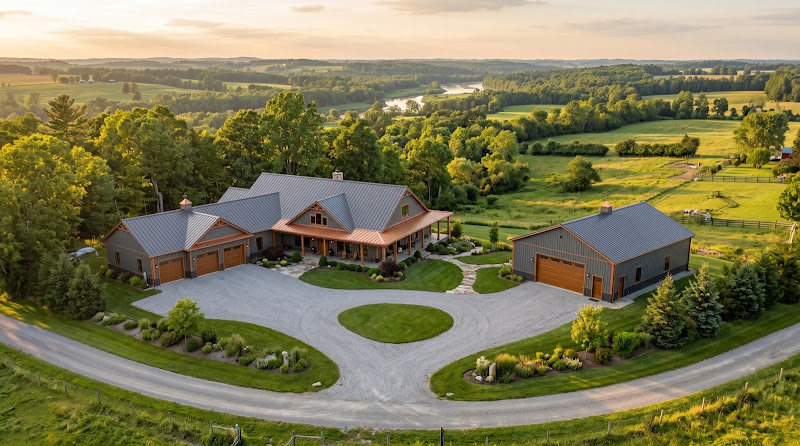
Builders / Massachusetts
Barndominium builders in Massachusetts
Planning a build? Read our guide to building a barndominium in Massachusetts.
Builders tracked
None passed the barndominium check yet
Turnkey
Per sqft, directory estimate
Shell only
Per sqft, directory estimate
Permits and codes in Massachusetts
Massachusetts enforces 1 statewide code, 780 CMR, with no local structural amendments, so requirements are uniform town to town. Any builder supervising work needs a Construction Supervisor License (CSL) from the Office of Public Safety and Inspections, plus Home Improvement Contractor registration for remodel work. Both are verifiable through the mass.gov license lookup. Most municipalities have adopted the Stretch Energy Code, and a growing list runs the Specialized opt-in code, so expect HERS ratings, continuous insulation and blower door testing. Post-frame homes are rare here and inspectors scrutinize them, so stamped engineering is effectively mandatory. Snow loads and coastal wind zones drive the structural design. Septic falls under Title 5, administered by MassDEP through local boards of health, with a perc test required before permitting.
Financing a barndominium in Massachusetts
Farm Credit East covers Massachusetts and is the most realistic construction lender for a barndominium on rural land in the central and western counties. Local savings banks do construction-to-perm but their appraisers rarely find barndominium comps, so valuations default to conventional homes and can come in low. Expect 20 to 25 percent down and a full plan-and-spec review. Land equity in a paid-off lot counts toward the down payment.
The list
Sorted by review count. Featured listings are labeled.
No builders from Massachusetts are listed yet. Builders from nearby states often work here. Send a quote request below and we will match you.
Ad space available
Your barndo business can be here
Builders, lenders, kit makers and suppliers: put your company in front of people planning a barndominium in Massachusetts.
Get the deck and pricingBuilding a barndominium in Massachusetts
A finished barndominium in Massachusetts runs about $180 to $270 per square foot turnkey, or $60 to $95 per square foot for a shell, by our directory estimates. That puts a 2,400 square foot home at roughly $432,000 to $648,000 before land and site work, the most expensive New England state in our table. We do not list any Massachusetts builders yet.
Massachusetts is the most regulated place in this guide to build one. One state code applies everywhere, with town-by-town wind speeds. The person running your job needs a state license. Your town picks one of three energy codes, and most have picked a stricter one. And Title 5 decides whether the lot can take a septic system at all.
Land, zoning and deed restrictions
Zoning is local under the Zoning Act, Chapter 40A, and the building official cannot issue a permit for work that does not comply with it. Larger rural lots are easier to find in central and western Massachusetts, but even there expect minimum lot area and frontage rules, limits on accessory structures, and in some towns, site plan or design review.
Appearance is the bigger risk in Massachusetts than structure. A metal-sided house can be built to code anywhere, but a town with a local historic district, a village overlay or a scenic road bylaw can make the exterior a negotiation. Ask the planning office directly whether the parcel sits in any district with design review. One common answer is board-and-batten or lap siding over the frame, which reads as a farmhouse; our farmhouse barndominium guide shows the look. Also read the deed for recorded restrictions, and see our barndominium zoning guide.
Codes, engineering and climate
The Massachusetts Residential Code, 780 CMR 51.00, is a set of state amendments to the 2021 International Residential Code, with the current amendments effective October 11, 2024. It applies in every city and town. Two procedural rules work in your favor: under R105.3, the building official must issue or deny a permit in writing within 30 days of filing, and a denial has to state the reasons.
Wind is handled town by town. The state's climatic amendments list design wind speeds for each city or town in Table R301.2(2). Where the ultimate design wind speed reaches 140 mph or more, the code's prescriptive wind rules stop applying and the house must be designed to ICC 600, ASCE 7 or another listed method. Coastal flood zones and dunes fall under section R322. For a steel or post-frame barndo near the coast or on the Cape and Islands, that means an engineer, not a kit catalog, sets the frame. Inland, snow governs: ask the building department for the design snow load and frost depth it uses and put both in the contract. Our storm safety guide covers wind design for metal buildings.
Energy is where Massachusetts differs most. Each municipality runs one of three residential energy codes:
| Tier | What it requires | Where it applies |
|---|---|---|
| Base code | 2021 IECC with Massachusetts amendments | Towns that have not opted up |
| Stretch Code | Minimum HERS index targets | More than 300 municipalities |
| Specialized Code | Stricter rules for fossil fuel homes, net-zero and all-electric pathways | Opt-in towns, including Boston, Worcester and Cambridge |
The Specialized Code does not ban fossil fuels for new homes, but it pushes hard toward all-electric. The state's largest cities adopted it early, and towns keep adding it; Andover's takes effect July 1, 2026. For a barndominium, the practical upshot is a HERS rater involved from the design stage, a blower door test, and an insulation plan that controls condensation under the metal roof. Our insulation guide and HVAC guide cover both.
What a barndominium costs in Massachusetts
These figures come from our state table. They are Barndo Finder directory estimates, not transaction data, and exclude land, well, septic, site work and the driveway.
| Size | Shell ($60 to $95/sqft) | Turnkey ($180 to $270/sqft) | National turnkey median ($145 to $215/sqft) |
|---|---|---|---|
| 1,500 sq ft | $90,000 to $142,500 | $270,000 to $405,000 | $217,500 to $322,500 |
| 2,400 sq ft | $144,000 to $228,000 | $432,000 to $648,000 | $348,000 to $516,000 |
| 3,000 sq ft | $180,000 to $285,000 | $540,000 to $810,000 | $435,000 to $645,000 |
Massachusetts runs about 25 percent above the national median on turnkey and $15 to $20 per square foot above on shell (national shell: $45 to $75). Only Hawaii and Alaska sit higher in our table, with California tied. Licensed supervision, energy code modeling and testing, and engineered wind design near the coast all show up in the number. A smaller footprint is the most reliable savings; see our 1,500 sq ft barndominium guide. Compare every state on our cost page, with context in the 2026 cost report.
Financing and insurance in Massachusetts
Farm Credit East is the Farm Credit cooperative for Massachusetts and the rest of New England. Its Country Living loans cover rural homes, lots and new home construction, with one closing and a rate fixed at closing for the construction phase and the life of the loan. The lender also says it appraises extra land, barns and other farm buildings at full value, which matters if your barndo includes a big shop. Local savings banks and credit unions are the other route. Our construction loan guide and financing page explain draws and approvals.
Appraisal is the weak spot. With few barndominium sales in the state, appraisers fall back on stick-built comparables, so a farmhouse-style exterior and a strong HERS score help the valuation. Our appraisal and taxes guide covers what moves the number. For insurance, coastal wind exposure is the question carriers will ask first; see our insurance guide.
Utilities, well and septic
Title 5, 310 CMR 15.000, governs septic systems, and it is the first thing to test on any unsewered lot. Under section 15.101, every proposed leach area must be examined by a Soil Evaluator and the approving authority, usually the local board of health, using deep observation holes, a soil profile, percolation testing, landscape position and groundwater analysis. The board of health issues the permit.
Do this before you close on land. A lot that fails, or that only passes with an advanced treatment system, changes both the budget and where the house can sit. If there is no public water at the lot, add a private well to the plan. Use the published septic and well ranges in our build process guide as a starting point, then get local quotes.
A realistic timeline in Massachusetts
Plan on 12 to 18 months from design to move-in, the range in our build timeline guide, with more time up front than most states.
- Pre-construction: 4 to 8 months. Title 5 soil testing and septic design, zoning and any design review, engineering, the HERS energy model, and the loan. Farm Credit East puts its loan process at 45 to 60 days, so apply two to three months ahead.
- Construction: 6 to 12 months. Pour footings once the ground thaws, close in before winter, and leave time at the end for the final blower door test.
Builders we list in Massachusetts
We do not list any barndominium builders in Massachusetts yet. Our nearest listings are in New York and Vermont, including Morton Buildings in Castleton, Vermont, but our data does not show any of them serving Massachusetts. Ask before you assume coverage.
Whoever you hire, check the Construction Supervisor License first. Under 780 CMR 110.R5, the person supervising construction of a home needs one, and the regulation separately defines a homeowner as someone building a one- or two-family home on land where they live or will live; anyone who builds more than one home in two years does not qualify. Ask too for proof of insurance, the wind speed and snow load the frame was designed to, and who stamps the drawings. If you are comparing kit suppliers, start with our barndominium kit manufacturers guide.
When you are ready, request quotes and compare each number to our cost table.
Updated October 2026 · Barndo Finder research
Building in Massachusetts: common questions
Do you need a permit to build a barndominium in Massachusetts?
Yes. Every new home falls under the statewide building code, 780 CMR, enforced by the local building official, who must issue or deny a permit in writing within 30 days of filing. The house also has to clear local zoning under Chapter 40A, and a home on a septic system needs a Title 5 permit from the local board of health.
How much does a barndominium cost in Massachusetts?
Our directory estimate for Massachusetts is $180 to $270 per square foot turnkey and $60 to $95 per square foot for a shell, tied with California for the third highest turnkey range in our table. A 2,400 square foot turnkey home works out to about $432,000 to $648,000 before land, septic and site work.
What license does a Massachusetts builder need?
The person supervising construction of a home needs a Construction Supervisor License under 780 CMR 110.R5. Contractors doing residential home improvement work also register under Chapter 142A, and the permit application asks for that number where it applies. The regulation defines homeowners building on land where they live separately, and someone who builds more than one home in two years is not a homeowner.
Does the Massachusetts stretch energy code apply to a barndominium?
If your town has adopted it, yes. Massachusetts has three residential energy tiers: the base code, the Stretch Code with minimum HERS index targets, used by more than 300 municipalities, and the Specialized Code with net-zero and all-electric pathways. A barndominium is a new home like any other, so plan on a HERS rater from the design stage.
What is a Title 5 perc test in Massachusetts?
Title 5 is the state septic code, 310 CMR 15.000. Before a new system is approved, a Soil Evaluator and the local approving authority, usually the board of health, examine the proposed leach area using deep observation holes, a soil profile, percolation testing, landscape position and groundwater analysis. The results decide whether and where a system can go.
Can you get a loan for a barndominium in Massachusetts?
Yes. Farm Credit East serves Massachusetts and finances rural homes, lots and new construction through its Country Living loans, with one closing for construction-to-permanent financing. Local savings banks and credit unions also lend. Expect appraisers to compare a barndominium with stick-built homes, since local barndo sales are rare.