Builders / California
Barndominium builders in California
Planning a build? Read our guide to building a barndominium in California.
Builders tracked
Barndominium-specific, deduplicated
Turnkey
Per sqft, directory estimate
Shell only
Per sqft, directory estimate
Permits and codes in California
California enforces one statewide code, the California Building Standards Code (Title 24), updated on a 3-year cycle. Every city and county enforces it, and local amendments are common. General contractors need a Class B license from the Contractors State License Board, verifiable at cslb.ca.gov. Engineering is the hard part: seismic design statewide, plus ignition-resistant construction in fire hazard severity zones under the California Wildland-Urban Interface Code (Title 24, Part 7), which replaced Chapter 7A on January 1, 2026; vents and eaves get the closest scrutiny. Title 24 energy code requires solar on most new homes and drives envelope costs up. Septic runs through county environmental health under the State Water Board OWTS Policy, and percolation failures kill rural deals. Coastal zone parcels add Coastal Commission review.
Financing a barndominium in California
Farm Credit works on acreage: seven Farm Credit institutions operate in California, including American AgCredit, AgWest Farm Credit and Golden State Farm Credit, plus smaller Central Valley associations like Fresno Madera and Yosemite Farm Credit. Comparable sales exist in the foothills and far north but are thin in coastal counties, so appraisals often lean on custom home comps. Expect 20-25 percent down on construction loans. Some community banks in Redding, Chico and Bakersfield will do construction-to-perm on metal buildings.
The list (2)
Sorted by review count. Featured listings are labeled.
Ad space available
Your barndo business can be here
Builders, lenders, kit makers and suppliers: put your company in front of people planning a barndominium in California.
Get the deck and pricingBuilding a barndominium in California
A finished barndominium in California runs about $180 to $270 per square foot turnkey, or $60 to $95 per square foot for a shell, by our directory estimates. That puts a 2,400 square foot home at roughly $432,000 to $648,000 before land and site work, tied with Massachusetts for the highest in the lower 48 in our data and well above the national medians. We list 2 California builders, both steel shell suppliers in the Central Valley and the north state.
California is the most code-heavy state in the country for a barndo, and the rules are the same everywhere. One statewide code, Title 24, applies in every city and county. It brings four things a Texas buyer never deals with: mandatory solar, an energy code that assumes a heat pump, seismic engineering on every house, and a new standalone wildfire code that covers a large share of the rural land buyers actually want. None of it makes a barndominium impossible. All of it shows up in the price.
Land, zoning and deed restrictions
Counties zone unincorporated land, and agricultural and rural residential zones are where most barndos go. Before you make an offer, ask the county planning department three questions: does the zone allow a single-family dwelling by right on this parcel, is there a minimum lot size or dwelling size, and is the parcel in a mapped Fire Hazard Severity Zone? The last answer changes your construction budget more than any other (see below). Our barndominium zoning guide covers the general checklist.
Two California-specific traps catch buyers. First, an existing "ag-exempt" barn is not a house. Some counties waive building permits for qualifying agricultural buildings, but living in one, or converting it, means a residential permit under the full California Residential Code, often with new foundations, insulation and solar. Price the conversion as new construction. Second, coastal parcels need a coastal development permit under the California Coastal Act on top of the building permit, which adds review time and design scrutiny. Most barndo buyers sidestep this by looking inland.
Private restrictions apply as usual. Foothill subdivisions in the Sierra and around Redding often have recorded CC&Rs on exterior materials and outbuildings. Read them before you close.
Codes, engineering and climate
California enforces the California Building Standards Code, Title 24, statewide. The current 2025 edition took effect on January 1, 2026, and the code is rewritten every three years. Your city or county building department enforces it. Local amendments are common, especially for snow, wind and fire, so get the local design criteria sheet before a kit is engineered.
Energy code. The 2025 Energy Code, summarized in this California Energy Commission training deck, applies to permit applications submitted on or after January 1, 2026. For a new single-family home:
| Requirement | What the 2025 code says |
|---|---|
| Solar PV | Prescriptive PV on all newly constructed homes, sized from floor area or the solar access roof area (18 W per sq ft of steep roof, 14 W on low slope) |
| Battery | Optional; a battery of at least 7.5 kWh lets you cut the PV size by 25 percent |
| Battery-ready | Mandatory where electrical service exceeds 125 amps |
| Space heating | Heat pump is the prescriptive baseline in all climate zones; gas only through the performance path |
| Walls | Mandatory R-15 in 2x4 walls or R-21 in 2x6, or the equivalent assembly U-factor |
| Windows | Maximum U-factor 0.40 everywhere; 0.27 or 0.30 prescriptive depending on climate zone |
Solar has been required on new homes since the 2019 code took effect in 2020; the 2025 edition added the heat pump baseline. For a steel or post-frame barndo, the wall and roof rules are the hard part, because steel girts and purlins conduct heat around batt insulation. Expect your energy consultant to model continuous insulation or closed-cell spray foam to hit the required assembly values. Our guides to barndominium insulation and barndominium HVAC explain the options.
Wildfire. As of January 1, 2026, the old Chapter 7A of the building code and Section R337 of the residential code were merged into a standalone California Wildland-Urban Interface Code, Title 24 Part 7. It applies to new buildings in a Fire Hazard Severity Zone (moderate, high or very high in State Responsibility Areas, and the zones local agencies designate) and in locally designated WUI fire areas. Its Chapter 5 requires a Class A roof, ember-resistant vents, ignition-resistant exterior walls, tempered or multi-pane glazing, and protected eaves, soffits and decks. Steel roofing and siding give a barndo a head start. The soffit vents, wood porch posts, deck boards and garage door seals are where plans get sent back.
Seismic and snow. Every California house is designed for earthquake loads, and the large open spans and tall walls of a barndo make the lateral system (bracing, shear walls, hold-downs and anchor bolts) the engineer's main job. A kit engineered for Oklahoma will not be accepted without California stamps. In the Sierra, snow takes over: Nevada County notes that the 2025 code moved ground snow loads to the ASCE 7-22 hazard tool and expects values for homes designed under the residential code to rise by roughly 50 percent. Ask every supplier what seismic and snow values their quote is engineered to, and write the numbers into the contract.
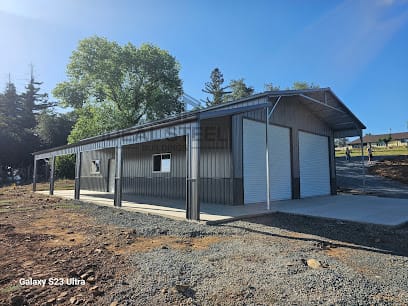
Photo: Ideal Steel Buildings
What a barndominium costs in California
These figures come from our state table. They are Barndo Finder directory estimates, not transaction data, and exclude land, well, septic, site work and the driveway.
| Size | Shell ($60 to $95/sqft) | Turnkey ($180 to $270/sqft) |
|---|---|---|
| 1,500 sq ft | $90,000 to $142,500 | $270,000 to $405,000 |
| 2,400 sq ft | $144,000 to $228,000 | $432,000 to $648,000 |
| 3,000 sq ft | $180,000 to $285,000 | $540,000 to $810,000 |
California sits $15 to $20 per square foot above the national shell medians in our data ($45 to $75) and $35 to $55 above the turnkey medians ($145 to $215). The code items above are the likely drivers of that gap: the PV system, the heat pump, engineered seismic connections, and wildfire-rated vents, glazing and decking in fire zones, on top of higher labor rates and permit fees. If you chose a barndo to build cheaper than a stick-built house, rerun that comparison with California numbers. See the 2026 cost report and the cost page for every state side by side. Smaller footprints save the most here; our barndominium sizes guide shows how size drives the total.
Financing and insurance in California
Seven Farm Credit institutions operate in California, and three advertise rural home lending. American AgCredit offers construction financing with "one loan, one set of fees and one closing" from land purchase through the finished home, for buyers with or without an agricultural use for the land. AgWest Farm Credit has an all-in-one construction loan that requires a licensed general contractor it approves, building and septic permits before closing, a loan of no more than 80 percent of finished value, and cash reserves. Golden State Farm Credit lists country home loans. Yosemite and Fresno Madera Farm Credit, in the Central Valley, did not list home construction loans on their homepages when we checked; call them if you are buying working farm land in their territory. Our construction loan guide and financing page explain draws and lender types.
Insurance is the bigger California question. In fire country, get a homeowners quote before you buy the land, not after. If no regular carrier will write the home, the California FAIR Plan is the fallback, but its standard policy is a limited fire policy, and the Department of Insurance points FAIR Plan customers to a separate difference in conditions policy for water damage, liability and theft. Your lender will require both to be in place. Our insurance guide explains how carriers classify steel and post-frame homes.
Utilities, well and septic
Septic systems are permitted by county environmental health under the State Water Board's OWTS Policy, last renewed in April 2023. Counties carry it out through their own local programs, so percolation testing, setbacks and when an engineered system is required all vary by county. In the foothills, shallow soil over rock often pushes a lot toward an engineered system. Get a perc test before you buy: a failed one can make a rural parcel unbuildable.
Wells are permitted by the county, and the driller must hold a C-57 well drilling license from CSLB. If the parcel sits in a groundwater basin managed under the Sustainable Groundwater Management Act, call the local groundwater sustainability agency as well as the county before you buy, since basin plans and local well permitting rules have tightened in parts of the Central Valley. Budget with published ranges of $3,500 to $8,500 and up for septic and $10,000 to $30,000 for a drilled well from our build process guide, and get local bids early. Power extensions on large rural parcels can cost as much as the well, and the solar requirement does not remove the need for a utility connection unless you design a fully off-grid system and the county accepts it.
A realistic timeline in California
Plan on 12 to 18 months from design to move-in, the range in our build timeline guide, and expect California to sit at the long end of it.
- Before you buy: confirm zoning, Fire Hazard Severity Zone status, a passing perc test, water source and an insurance quote.
- Pre-construction: 4 to 8 months. Stamped structural drawings, a Title 24 energy compliance report, wildfire code details where they apply, septic design, the loan and plan review. Corrections from plan check are normal; budget a round or two.
- Construction: 6 to 12 months. Most of the state builds year-round. Above the snow line, aim to dry in the shell before winter. Leave time at the end for the solar system and the field verification the energy code requires.
Builders we list in California
We list 2 barndominium builders in California, both steel shell suppliers. Ratings are public Google reviews at the time we indexed them.
| Region | Builder | City | Build type | Rating |
|---|---|---|---|---|
| North State | Ideal Steel Buildings | Chico | Shell | 4.7 (46 reviews) |
| Central Valley | Fresno Metal Solutions | Fresno | Shell | 4.8 (26 reviews) |
Two listings is a thin list for a state this size, and neither is a turnkey builder. Most California buyers will pair a steel or post-frame shell with a separately licensed general contractor (a Class B license) or act as owner-builder. Look up every contractor on CSLB's license check before you sign, and read our shell vs turnkey guide and DIY barndominium guide for what you take on. Far northern buyers can also check our Oregon builders, and desert buyers our Arizona builders, but confirm any out-of-state crew holds a California license.
For layouts that suit a clear-span building, browse our barndominium floor plans. Then request quotes from builders who serve your county, and compare each one to our cost table.
Updated October 2026 · Barndo Finder research
Building in California: common questions
Can you build a barndominium in California?
Yes. California has no special rule against steel or post-frame homes. A barndominium is permitted as a single-family dwelling under the California Residential Code, part of Title 24, by your city or county building department. The catches are engineering and paperwork: seismic design, the energy code's solar and heat pump rules, and the wildland-urban interface code if the lot sits in a mapped fire hazard zone.
How much does a barndominium cost in California?
Our directory estimate for California is $180 to $270 per square foot turnkey and $60 to $95 per square foot for a shell, well above the national medians in our data. A 2,400 square foot turnkey home works out to about $432,000 to $648,000 before land, well, septic and site work. Those are estimates from our state table, not quotes.
Does a new barndominium in California need solar panels?
In most cases, yes. The 2025 Energy Code, in effect for permit applications from January 1, 2026, prescriptively requires a solar PV system on newly constructed single-family homes, sized from the home's floor area or its usable roof area. Installing a battery of at least 7.5 kWh lets you shrink the PV system by up to 25 percent. Homes with electrical service over 125 amps must also be battery-ready.
What wildfire rules apply to a barndominium in California?
If the parcel is in a Fire Hazard Severity Zone or a locally designated wildland-urban interface area, the new California Wildland-Urban Interface Code (Title 24, Part 7) applies from January 1, 2026. It replaced the old Chapter 7A and requires a Class A roof, ember-resistant vents, ignition-resistant siding, tempered or multi-pane glazing and protected eaves and decks. Steel cladding helps, but vents and porches still need attention.
Can I build my own barndominium in California without a contractor license?
Yes, as an owner-builder, if you do the work yourself or with your own employees and the home is not built for sale, or if you hire licensed subcontractors directly. CSLB treats a sale within one year of completion as evidence you built it to sell. If you pay workers yourself, you become their employer, with payroll and workers' compensation duties.
Can you get a loan for a barndominium in California?
Yes. Seven Farm Credit institutions operate in California. American AgCredit offers one-loan, one-closing construction financing for rural homes, AgWest Farm Credit has an all-in-one construction loan, and Golden State Farm Credit lists country home loans. Expect the lender to want a licensed contractor, permits in hand and engineered plans before it funds.