
Resources / Costs
Cost to Finish a Barndominium Shell: Line-Item Math by State
Updated November 2026 · Barndo Finder research
Quick answer
Finishing an erected barndominium shell with hired trades costs about $100 to $140 per square foot at the median of our state estimates, the gap between shell ($45 to $75) and turnkey ($145 to $215) rates. On a 2,400 sq ft 40x60 that is $240,000 to $336,000. Plumbing, electrical and HVAC take about 47 percent of it.
Finishing an erected barndominium shell costs about $100 to $140 per square foot at the median of our 50 state estimates, which is the gap between our shell rate ($45 to $75) and our turnkey rate ($145 to $215). On a 2,400 square foot 40x60, that is $240,000 to $336,000 for the interior alone, roughly twice what the shell itself costs.
The cheap part of a barndominium is the part you see from the road. This page splits that finish gap into line items (insulation, plumbing, electrical, HVAC, drywall, kitchen, baths and the rest) for three sizes and three states, so you can see where the money goes before you sign a shell contract.
Key takeaways
- The finish gap is $100 to $140 per square foot at the national median of our state estimates. In Oklahoma it is $95 to $130, in Florida $110 to $155. Texas and Tennessee match the median gap.
- Finishing is about two thirds of a turnkey barndominium. A $45 to $75 shell becomes a $145 to $215 house.
- Mechanical systems are the biggest bucket. Plumbing rough-in, electrical with lighting, and HVAC take about 47 percent of the finish budget in our split.
- Kitchen, drywall and paint are next, at about 14 percent each. Bath fixtures alone are only about 4 percent; the expense in a bathroom is the plumbing behind the wall.
- Insulation is the line most likely to run over. Closed-cell foam on a 40x60 steel shell can cost $18,720 to $41,760 by our math, against $8,800 to $12,300 in the split.
- DIY-friendly lines (drywall, paint, doors, trim, flooring) are about 29 percent of the finish budget. That caps what owner labor can realistically save.
- Every dollar figure here is a Barndo Finder directory estimate, not a quote, and excludes land, well, septic, driveway and site work.
How much does it cost to finish a barndominium shell?
Subtract the shell rate from the turnkey rate for the same state. Our cost table publishes both for all 50 states. At the national median, the low end is $145 minus $45 and the high end is $215 minus $75, which gives $100 to $140 per square foot. Multiply by heated square feet and you have the finish budget with hired trades.
| Where | Erected shell ($/sq ft) | Turnkey ($/sq ft) | Finish gap ($/sq ft) | 1,500 sq ft | 2,400 sq ft (40x60) | 3,000 sq ft |
|---|---|---|---|---|---|---|
| National median | $45 to $75 | $145 to $215 | $100 to $140 | $150,000 to $210,000 | $240,000 to $336,000 | $300,000 to $420,000 |
| Texas and Tennessee | $40 to $70 | $140 to $210 | $100 to $140 | $150,000 to $210,000 | $240,000 to $336,000 | $300,000 to $420,000 |
| Oklahoma | $35 to $65 | $130 to $195 | $95 to $130 | $142,500 to $195,000 | $228,000 to $312,000 | $285,000 to $390,000 |
| Florida | $50 to $85 | $160 to $240 | $110 to $155 | $165,000 to $232,500 | $264,000 to $372,000 | $330,000 to $465,000 |
Two things stand out. First, finishing costs more than the shell everywhere: in Texas a 40x60 shell is $96,000 to $168,000 and the interior is $240,000 to $336,000. Second, the state shows up inside as much as outside. Oklahoma's shell is $5 a foot cheaper than Texas at both ends and its finish gap is $5 to $10 cheaper; Florida's gap runs $10 to $15 above Texas.
Small builds tend to price toward the top of each range. A 1,500 square foot house still needs a full kitchen, at least one bathroom, a water heater and an HVAC system, and those costs do not shrink in step with the floor area. Our 2026 barndominium cost report explains how the state ranges were built and what they leave out.
What does barndominium interior finish cost, line by line?
Our data has two numbers per state, shell and turnkey, but no split by trade. To break the gap into line items we used the NAHB Cost of Constructing a Home 2024 survey, which reports each trade's share of construction cost for a typical new single-family home. We took the 2024 shares for "major systems rough-ins" and "interior finishes", grouped them, and rescaled them to 100 percent of our gap.
 Photo: Heribacka Construction
Here is the national median gap split by line item, at three sizes.
| Line item | NAHB share of construction cost | Share of finish gap | $/sq ft | 1,500 sq ft | 2,400 sq ft | 3,000 sq ft |
|---|---|---|---|---|---|---|
| Insulation | 1.6% | 3.7% | $3.70 to $5.10 | $5,500 to $7,700 | $8,800 to $12,300 | $11,000 to $15,400 |
| Plumbing rough-in | 6.3% | 14.4% | $14.40 to $20.20 | $21,700 to $30,300 | $34,700 to $48,600 | $43,300 to $60,700 |
| Electrical rough-in and lighting | 7.7% | 17.7% | $17.70 to $24.70 | $26,500 to $37,100 | $42,400 to $59,300 | $53,000 to $74,200 |
| HVAC | 6.3% | 14.4% | $14.40 to $20.20 | $21,700 to $30,300 | $34,700 to $48,600 | $43,300 to $60,700 |
| Drywall and paint | 5.9% | 13.5% | $13.50 to $18.90 | $20,300 to $28,400 | $32,500 to $45,500 | $40,600 to $56,800 |
| Interior doors and trim | 3.0% | 6.9% | $6.90 to $9.60 | $10,300 to $14,400 | $16,500 to $23,100 | $20,600 to $28,900 |
| Kitchen cabinets, counters, appliances | 6.3% | 14.4% | $14.40 to $20.20 | $21,700 to $30,300 | $34,700 to $48,600 | $43,300 to $60,700 |
| Flooring | 3.6% | 8.3% | $8.30 to $11.60 | $12,400 to $17,300 | $19,800 to $27,700 | $24,800 to $34,700 |
| Plumbing fixtures (baths, sinks) | 1.9% | 4.4% | $4.40 to $6.10 | $6,500 to $9,200 | $10,500 to $14,600 | $13,100 to $18,300 |
| Fireplace and other | 1.0% | 2.3% | $2.30 to $3.20 | $3,400 to $4,800 | $5,500 to $7,700 | $6,900 to $9,600 |
| Total finish gap | 43.6% | 100% | $100 to $140 | $150,000 to $210,000 | $240,000 to $336,000 | $300,000 to $420,000 |
Texas and Tennessee have the same finish gap as the national median, so this table is also their table. Rows are rounded to the nearest $100, and the NAHB column sums to 43.6 percent rather than the survey's 43.3 percent subtotal because NAHB rounds each line.
A few notes on reading it. Electrical includes NAHB's separate lighting line (1.3 percent), because the fixtures and the wiring are usually one subcontract. The kitchen row combines cabinets and countertops (4.5 percent) with appliances (1.8 percent); NAHB's cabinet line does not separate kitchen from bath, so vanities sit inside it. "Fireplace and other" collects the fireplace line (0.6 percent) and two small "other" lines (0.2 percent each).
One thing the split cannot show: interior wall framing. NAHB's house frames its partitions with the structure, so that cost sits in the framing stage, not in the lines above. A barndo shell has no partitions, and framing them comes out of the finish gap, which means every row above runs a little lower in a real barndo budget.
What does each line cost in Texas, Oklahoma and Florida?
The same split applied to a 2,400 square foot 40x60 in our three example states. Change the size and every cell scales in proportion.
| Line item (40x60, 2,400 sq ft) | Texas and Tennessee | Oklahoma | Florida |
|---|---|---|---|
| Insulation | $8,800 to $12,300 | $8,400 to $11,400 | $9,700 to $13,700 |
| Plumbing rough-in | $34,700 to $48,600 | $32,900 to $45,100 | $38,100 to $53,800 |
| Electrical rough-in and lighting | $42,400 to $59,300 | $40,300 to $55,100 | $46,600 to $65,700 |
| HVAC | $34,700 to $48,600 | $32,900 to $45,100 | $38,100 to $53,800 |
| Drywall and paint | $32,500 to $45,500 | $30,900 to $42,200 | $35,700 to $50,300 |
| Interior doors and trim | $16,500 to $23,100 | $15,700 to $21,500 | $18,200 to $25,600 |
| Kitchen cabinets, counters, appliances | $34,700 to $48,600 | $32,900 to $45,100 | $38,100 to $53,800 |
| Flooring | $19,800 to $27,700 | $18,800 to $25,800 | $21,800 to $30,700 |
| Plumbing fixtures (baths, sinks) | $10,500 to $14,600 | $9,900 to $13,600 | $11,500 to $16,200 |
| Fireplace and other | $5,500 to $7,700 | $5,200 to $7,200 | $6,100 to $8,500 |
| Total finish gap | $240,000 to $336,000 | $228,000 to $312,000 | $264,000 to $372,000 |
| Gap per sq ft | $100 to $140 | $95 to $130 | $110 to $155 |
The Florida premium over Oklahoma is $36,000 at the low end and $60,000 at the high end on the same building. Same building and same line items; only the state rates change.
Why is our finish gap higher than NAHB's own numbers?
NAHB's 2024 survey home had 2,647 square feet of finished area, and its rough-ins ($82,319) plus interior finishes ($103,391) total $185,710, or about $70 per square foot. Our gap is $100 to $140. The difference is not a mistake, and it matters when you compare a finish quote against a shell quote.
NAHB's figures are the builder's construction cost before overhead and profit; the same survey puts overhead and general expenses at 5.7 percent and profit at 11.0 percent of the sales price. Our turnkey rate estimates what you pay a builder, so it carries both. The finish gap on a barndo also has to pay for framing every interior wall inside the steel or post frame, which NAHB counts in framing.
Treat our line items as proportions, not bids. If one line in a finish quote is far off these shares, ask what is in it.
Why does insulation cost more in a barndominium shell?
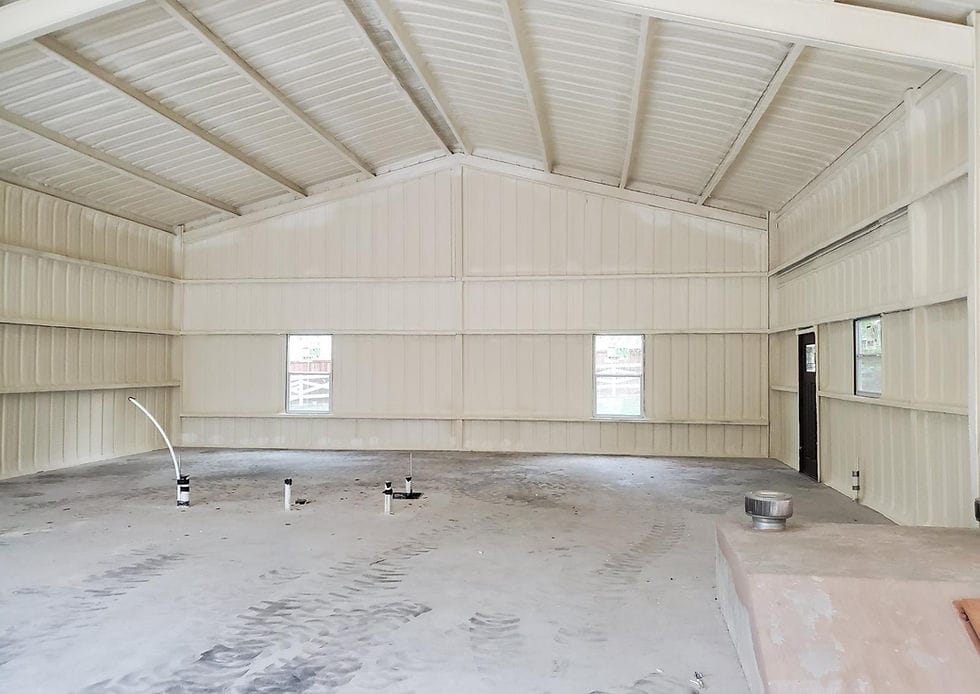
Because there is no wall cavity to fill. NAHB's 1.6 percent insulation share comes from wood-framed houses with batts between studs. A steel barndominium has metal panels on girts with no inner wall, and the insulation has to stop condensation on the inside face of the metal as well as hold heat. That is why many steel shells get closed-cell spray foam applied to the panels, like the insulated walls and ceiling in our featured photo from Energy Efficient Insulation LLC in Oak Point, Texas.
Run the numbers and the gap is obvious. HomeGuide's pole barn insulation guide puts closed-cell foam at $1.30 to $2.90 per board foot installed (one board foot is 1 square foot, 1 inch thick) and recommends 2 to 3 inches on walls and 4 to 5 inches on the roof deck. Here is a 40x60 with 12-foot walls at the thinnest recommended layers:
| Surface | Area | Foam thickness | Board feet | At $1.30 to $2.90 |
|---|---|---|---|---|
| Walls (200 ft of perimeter x 12 ft) | 2,400 sq ft | 2 in | 4,800 | $6,240 to $13,920 |
| Roof deck (flat plan area, before pitch) | 2,400 sq ft | 4 in | 9,600 | $12,480 to $27,840 |
| Total | 14,400 | $18,720 to $41,760 |
That is about 2 to 3.4 times the $8,800 to $12,300 insulation row above, and it still ignores gable ends, roof pitch and the thicker foam colder climates need. Budget the difference from contingency rather than from the kitchen. Some erected-shell packages include spray foam and some do not, so ask. Our barndominium insulation guide compares foam, board and batt options by climate zone, including how insulation choice changes the HVAC load.
Can you finish a barndominium shell yourself?
Partly. Sort the line items by who is usually allowed to do them.
| Group | Line items | Share of finish gap | 40x60 at national median |
|---|---|---|---|
| Usually licensed trades | Plumbing rough-in, electrical and lighting, HVAC | 46.6% | $111,700 to $156,400 |
| Owner-friendly finish work | Drywall and paint, doors and trim, flooring | 28.7% | $68,800 to $96,300 |
| Mostly purchased products | Kitchen, plumbing fixtures, insulation, fireplace and other | 24.8% | $59,400 to $83,200 |
The middle row is where sweat equity pays, and even there the dollar figures include materials. Doing the work yourself removes the labor portion of $68,800 to $96,300 on a 40x60, not the whole amount. Our data does not split labor from materials, so we will not guess at a percentage.
The top row is a different conversation. Rules vary by state and county: some let a homeowner pull a permit for their own house and pass inspection, others require licensed electricians and plumbers. Call your building department before you plan around it. Our DIY barndominium guide walks through owner-builder exemptions and what owner-builders typically keep and hand off, and our guides to barndominium electrical work and barndominium plumbing go trade by trade.
 Photo: Butler Built Homes LLC
What should a shell contract say about the finish work?
Most of the cost surprises in a shell-then-finish build come from the seam between the two contracts. A few items decide whether your finish budget holds:
- Under-slab plumbing. If the shell builder pours the slab, the drain lines have to be in before the concrete. The featured photo shows exactly that: rough-in stubs standing in a finished slab. Get the plumbing layout drawn and the rough-in included, or the finish plumber starts with a saw.
- Window and door locations. They are set by the shell. Moving one after the steel is up means new framing and panel work.
- Insulation scope. Whether spray foam is in the shell price or not moves $18,720 to $41,760 between the two contracts on a 40x60, per the math above.
- Electrical service. Confirm the meter base, panel location and utility service size before the shell is closed in.
Our guide to shell kits, erected shells and turnkey compares what each route includes, and our guide to the hidden costs of building a barndominium covers the site-side lines that no finish estimate touches.
How do you pay for finishing a shell?
The cleanest path is to finance both phases at once with a construction loan that covers the whole house, using a line-item budget like the tables above. Lenders fund a finished home, not a steel building, so a shell bought with cash and finished later can leave you looking for a second loan with an unfinished structure as collateral. Our guide to barndominium construction loans explains draw schedules and what lenders ask for.
Our take
The finish work is the house. A shell quote of $96,000 to $168,000 for a Texas 40x60 is real, but the interior behind it is another $240,000 to $336,000 at our estimates, and the plumbing, electrical and HVAC lines alone ($111,700 to $156,400) are close to the cost of the shell. Price both contracts before you sign either.
Our method has limits. The state rates are directory estimates, and the line-item split borrows NAHB's national shares for wood-framed houses. Insulation and interior wall framing will run higher in a barndo, and a modest kitchen will run lower than the median. Use the tables to check proportions and to spot a quote that is missing a trade, then replace our numbers with bids.
If you want an erected shell from a builder who lists that scope, our directory has shell builders such as Sawyer Metal in Tyler, Texas, Barndos Direct in Jamestown, Tennessee, and HRI Roofing & Post Frame in Ponca City, Oklahoma.
Get shell and finish bids side by side
Ask for the shell and the finish work as separate line items, even from a turnkey builder, so you can compare them against the tables above. Request builder quotes with your county and square footage, or browse the Texas builder list to see who quotes shell, turnkey or both.
Common questions
Why does finishing a barndominium cost more than the shell?
Because the shell is only the frame and the skin. In NAHB's 2024 survey of new homes, framing is 16.6 percent of construction cost and exterior finishes 13.4 percent, while systems rough-ins (19.2 percent) and interior finishes (24.1 percent) together are 43.3 percent. In our state estimates that shows up as a $45 to $75 shell and a $100 to $140 per square foot finish gap.
What is the most expensive part of finishing a barndominium shell?
The mechanical systems. Using NAHB's 2024 cost shares to split our shell-to-turnkey gap, plumbing rough-in, electrical with lighting, and HVAC together take about 47 percent of the finish budget. Kitchen cabinets, counters and appliances take about 14 percent, and so do drywall and paint. Insulation is under 4 percent on paper, but closed-cell foam on a 40x60 steel shell can cost 2 to 3.4 times that line by our math.
How much does it cost to finish a 40x60 barndominium shell?
A 40x60 is 2,400 square feet. In Texas our estimates put the erected shell at $96,000 to $168,000 and the finish work at $240,000 to $336,000, so the completed house lands at $336,000 to $504,000. In Oklahoma the finish work is $228,000 to $312,000, in Florida $264,000 to $372,000. All are directory estimates that exclude land, well, septic and site work.
Is it cheaper to buy a barndominium shell and finish it yourself?
It can be, but only on the lines you can legally and competently do. Drywall, paint, doors, trim and flooring make up about 29 percent of the finish budget in our split, and doing them yourself removes the labor part of that, not the materials. Plumbing, electrical and HVAC are about 47 percent, and many counties require licensed trades or a homeowner permit and inspections for them.
Can you get a loan to finish a barndominium shell?
Usually only as part of a construction loan for the whole house, with a line-item budget and a contract for the finish work. Lenders want collateral that is a finished home, so a shell bought with cash and finished later often needs a separate construction or personal loan. Ask local banks, credit unions and farm credit lenders before you buy the shell, not after.
Ready to price your build?
Fill out one form. We send it to builders who work in your area. It costs nothing.
Request quotes