
Resources / Guides
Are Barndominiums a Good Investment? Build Cost vs Home Values
Updated November 2026 · Barndo Finder research
Quick answer
Sometimes. A barndominium is a good investment when you can build it for well under what homes sell for per square foot nearby. In October 2026, Realtor.com median listing prices ran $45 to $132 per sqft above our turnkey cost midpoint in Tennessee, Florida, Montana and Washington, but roughly matched it in Texas, Oklahoma and Indiana, before land.
Sometimes. A barndominium is a good investment only when you can build it for clearly less per square foot than homes sell for nearby, and in 10 of the 20 states we checked, the median home listed for no more than $8 per sqft above a midpoint turnkey build, before land. We compared our turnkey cost estimates with October 2026 median listing prices from Realtor.com: in Tennessee, Montana and Washington there is room to spare, while in Texas, Oklahoma and Indiana a midpoint build costs about what the median home lists for per square foot before you buy any land.
Key takeaways
- The investment test is simple: finished market value minus land, site work and build cost. If that number is not positive on paper, it will not be positive at resale.
- In 10 of the 20 states we compared, the October 2026 median listing price per square foot was no more than $8 above our turnkey midpoint, or below it. Those include Texas, Indiana and Ohio, three of the four states with the most listed builders in our directory.
- In Tennessee, Wisconsin and Florida, median listings ran $41 to $50 per sqft above our midpoint. In Montana, Idaho and Washington, the gap was over $100.
- Barndominiums appreciate with their local market, not on their own. Statewide listing prices per square foot fell year over year in Texas, Florida and Georgia in October 2026.
- Thin comparable sales are the main risk to the paper value. Fannie Mae wants three closed comps and will not accept a comp built from a land sale plus a construction contract.
- A barndo rented long term is a rental house to the IRS: the building depreciates over 27.5 years, the land does not.
Are barndominiums a good investment compared with buying a house?
They can be, but the edge is smaller than kit ads suggest, and in the cheapest states it can disappear. The reason is in how a new home is priced. NAHB's 2024 Cost of Construction Survey found that construction costs made up 64.4 percent of the average new home's sales price, the finished lot 13.7 percent, and builder profit about 11 percent. When you build a barndominium on land you bought yourself, you pay the construction share and the land directly, and your builder still earns a margin. You are not getting the house at cost. You are getting it without buying a finished lot inside someone else's sales price.
That only creates equity if the market around you values finished homes above what they cost to build. Some markets do. Some barely do. Our view is that you should know which kind you are in before you buy land, and the fastest way to find out is to put our build costs next to what homes actually list for.
How does barndominium build cost compare with home values by state?
Here is the comparison. The turnkey range and midpoint are Barndo Finder directory estimates from our state cost table, which exclude land, well, septic, site work and the driveway. The listing figures are Realtor.com's statewide median listing price per square foot for October 2026, from its monthly housing inventory data, along with the year-over-year change in that figure.
| State | Turnkey build, our estimate ($/sqft) | Midpoint | Median listing, Oct 2026 ($/sqft) | Listing minus midpoint | Listing $/sqft, 1-year change |
|---|---|---|---|---|---|
| Texas | $140 to $210 | $175 | $179 | +$4 | -2.2% |
| Tennessee | $140 to $210 | $175 | $220 | +$45 | -0.4% |
| Oklahoma | $130 to $195 | $163 | $162 | -$1 | +0.9% |
| Indiana | $130 to $200 | $165 | $162 | -$3 | +3.8% |
| Ohio | $135 to $200 | $168 | $167 | -$1 | +1.5% |
| Iowa | $130 to $200 | $165 | $173 | +$8 | +4.0% |
| Florida | $160 to $240 | $200 | $250 | +$50 | -3.5% |
| Michigan | $140 to $210 | $175 | $186 | +$11 | +2.7% |
| Wisconsin | $140 to $210 | $175 | $216 | +$41 | +1.0% |
| Illinois | $140 to $210 | $175 | $185 | +$10 | +1.1% |
| Georgia | $140 to $210 | $175 | $187 | +$12 | -1.1% |
| Pennsylvania | $145 to $215 | $180 | $188 | +$8 | -1.4% |
| Alabama | $125 to $190 | $158 | $165 | +$7 | 0.0% |
| Mississippi | $125 to $190 | $158 | $150 | -$8 | +1.3% |
| Louisiana | $145 to $215 | $180 | $151 | -$29 | -0.4% |
| Kansas | $125 to $190 | $158 | $156 | -$2 | +4.0% |
| Montana | $150 to $230 | $190 | $320 | +$130 | +1.3% |
| Idaho | $150 to $225 | $188 | $290 | +$102 | +1.9% |
| Washington | $165 to $245 | $205 | $337 | +$132 | -0.7% |
| Colorado | $155 to $230 | $193 | $278 | +$85 | -1.7% |
Three caveats keep this honest. First, a listing price includes the land under the house, and our build cost does not, so a gap near zero means you are underwater once you add land. Second, a statewide median mixes city condos, old farmhouses and new suburban homes, so it is a benchmark, not your appraisal. Third, listing prices are asking prices, not closed sales. Even with those limits, the pattern is uncomfortable for the biggest barndo market: Texas, with 59 listed builders in our directory (more than three times any other state), lists homes within $4 per sqft of what a midpoint barndo costs to build. Louisiana is the only state in the table where the median listing sits well below our midpoint, by $29.
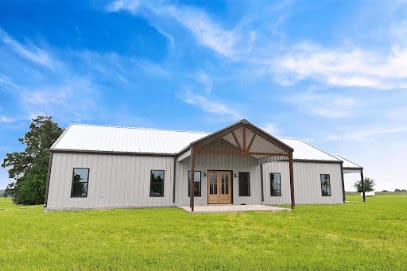 Photo: GAS Construction, LLC
What return can you expect on a 2,000 sqft barndominium?
Take a 2,000 sqft turnkey barndominium and run it against the statewide median listing price per square foot for the same size. The last column is what is left over for land, well, septic, driveway and site work if you build at our midpoint and want to come out even. These are directory estimates, not quotes.
| State | Build at our low | Build at our midpoint | Build at our high | Median listing $/sqft x 2,000 | Left for land and site work at midpoint |
|---|---|---|---|---|---|
| Texas | $280,000 | $350,000 | $420,000 | $358,000 | $8,000 |
| Tennessee | $280,000 | $350,000 | $420,000 | $440,000 | $90,000 |
| Oklahoma | $260,000 | $325,000 | $390,000 | $324,000 | -$1,000 |
| Mississippi | $250,000 | $315,000 | $380,000 | $300,000 | -$15,000 |
| Montana | $300,000 | $380,000 | $460,000 | $640,000 | $260,000 |
Read the Texas row closely, because Texas has more listed barndominium builders in our directory than any other state (59). A midpoint build leaves $8,000 for everything outside the building. That is not a land and site budget. To come out ahead in Texas, you need to build near the low end of our range, already own the land, put in real sweat equity, or be in a county where homes sell well above the statewide median.
Tennessee leaves $90,000 at the midpoint, which is real room for land and site work. Montana leaves $260,000, but Montana land prices vary widely, so price the land before you count that gap as equity. Our guide to the best states to build a barndominium goes state by state on that trade-off.
The site lines are where many investment cases quietly fail. Our list of hidden costs of building a barndominium covers what to budget before you assume any equity.
Why do comparable sales matter so much for a barndominium?
Because the appraisal, not the market, sets your loan and your paper equity. Fannie Mae's comparable sales rules require at least three closed comparable sales in the sales comparison approach. Sales from the last 12 months should be used, though the guide allows older sales in rural areas with little activity if the appraiser explains why. Where truly comparable sales are short "because of the nature of the property improvements," the appraiser may use properties that are not truly comparable, with documentation.
One rule hits barndominium builds directly. Fannie Mae says the appraiser may not create a comparable sale by combining a vacant land sale with the contract price of a home. Those land-plus-build transactions, which the guide notes are often part of a construction-to-permanent loan, can be added as support but cannot count toward the three required comps. Many barndos are financed exactly that way, so a county with plenty of new barndos can still have few closed barndo resales an appraiser can count.
What that means for your investment: if the appraiser cannot find good comps, your home gets valued against stick-built houses and older sales, and a low number shows up as cash you bring to closing. Our barndominium appraisal and taxes guide explains how living area and shop space get measured, and the construction loan guide covers what a short appraisal does to your draw budget.
Do barndominiums appreciate?
They appreciate when the local market does, and not otherwise. No public index tracks barndominium prices separately, so anyone quoting a barndo-specific appreciation rate is working from a handful of sales. Our barndominium resale value guide walks through the few documented resales that exist.
The broader market data is a useful reality check. In the Realtor.com October 2026 figures above, statewide median listing price per square foot fell year over year in Texas (-2.2 percent), Florida (-3.5 percent), Georgia (-1.1 percent) and Pennsylvania (-1.4 percent). It rose in Indiana (+3.8 percent), Iowa and Kansas (+4.0 percent each). A barndominium in a flat or falling market does not outrun it.
What you control is whether the house appreciates like a house. A barndo permitted as a residence, with finished interiors and living area that dominates the floor plan, tracks the residential market. A small apartment attached to a big shop tracks something closer to a shop building, because buyers and appraisers pay house prices for house space. If you want a big shop anyway, keep it clearly separate from the house.
Here is the shop problem in numbers. Take a Texas 40x60 with a 1,600 sqft house and an 800 sqft shop. At our directory estimates, the house costs $280,000 at the $175 turnkey midpoint and the shop about $44,000 at the $55 shell midpoint, for $324,000 total. Multiply the 1,600 sqft of living area by the $179 Texas median listing figure and you get $286,400. The shop has to earn back its $44,000 through whatever the appraiser adjusts for shop space locally, which is the line most likely to come in short.
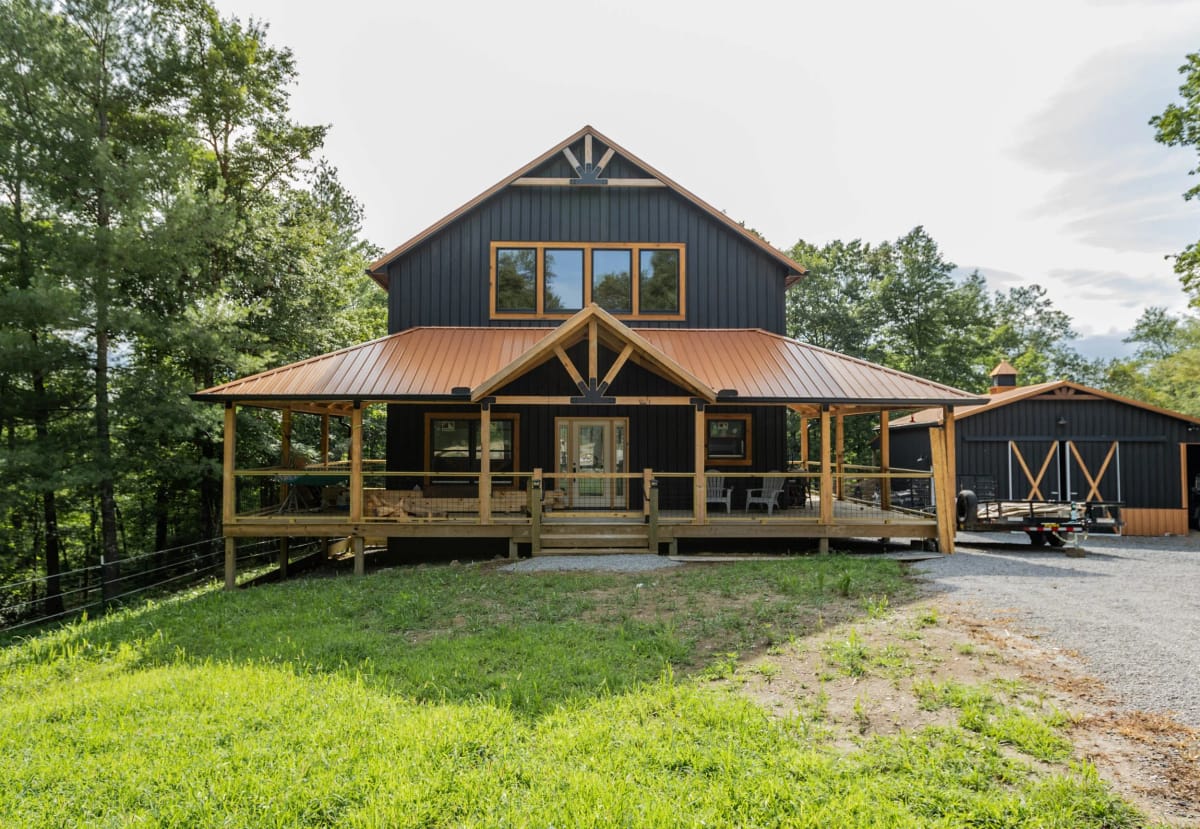 Photo: Barndos Direct
Can a barndominium work as a rental?
Yes, but run it as a rental house, with rental-house math. The IRS treats it the same as any residential rental. Under IRS Publication 527, residential rental property placed in service is depreciated with the straight line method over a 27.5-year recovery period under the general system, using a mid-month convention in the first year. Land is not depreciable, and clearing and grading costs generally go into the land's basis.
Here is what that looks like using our numbers. A 2,000 sqft Texas barndo at our $175 turnkey midpoint is a $350,000 building. A full year of straight-line depreciation on that is about $12,727 ($350,000 divided by 27.5), and the first year is smaller because of the mid-month convention. The land, and the clearing and grading folded into its basis, do not add to that. Talk to a tax professional about your own facts; this is the rule's arithmetic, not tax advice.
The rental test itself is local and we do not have rent data, so get a rent estimate from a property manager in your county and compare it with the monthly payment on your all-in cost. Rural long-term rentals can have a thin tenant pool, and a shop-heavy floor plan narrows it further. If you are thinking about nightly rentals instead, that is a different business with different rules, and our upcoming barndominium Airbnb guide covers it.
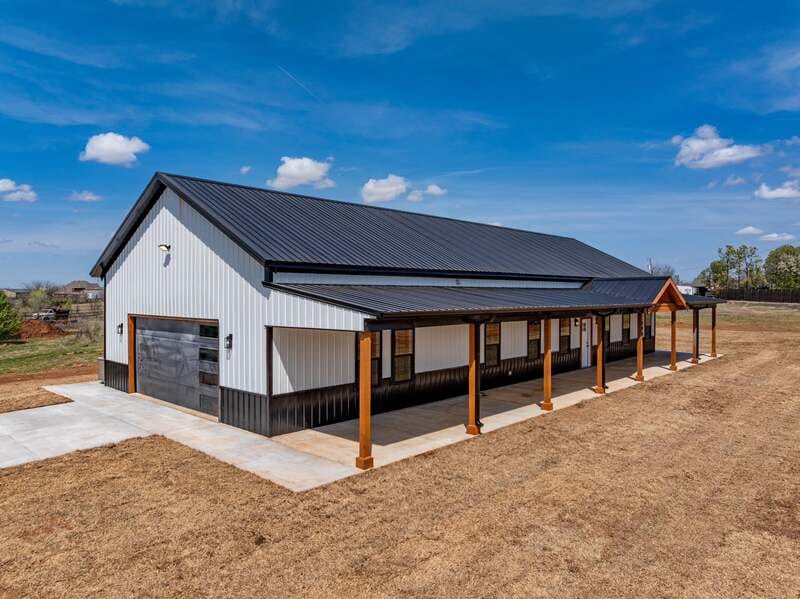 Photo: Route 66 Buildings
How do you run the investment test before you build?
Use this checklist before you sign a land contract. Every line comes from numbers you can get for free or from a builder's quote.
| Step | What to get | Pass signal |
|---|---|---|
| 1. Price the building | Line-item turnkey quote from a local builder, checked against our cost table | Quote includes kitchen, baths, HVAC and finishes, not just the shell |
| 2. Price the site | Land price plus written estimates for well, septic, power, driveway and pad | Every line has a number, none says "allowance TBD" |
| 3. Find the comps | Closed sales in the last 12 months of similar-size homes in your market area | At least three, ideally including barndos or post-frame homes |
| 4. Compare | Comp price per sqft x your living area, minus steps 1 and 2 | Positive with room to spare, not barely even |
| 5. Check the trend | One-year change in local listing or sale prices | Flat or rising, or a gap big enough to absorb a dip |
| 6. Stress the shop | Recompute with shop space at garage value, not living value | Still positive |
| 7. Decide your exit | Your likely buyer and how they would finance it | A buyer who can get a mortgage, not only cash buyers |
If step 1 comes back as a shell quote, read our shell vs turnkey comparison before you compare it with anything. A shell price set against finished home values makes every deal look good on paper.
Our take
A barndominium is a good place to live that can also be a decent investment. It is not a guaranteed equity machine. Our state comparison shows the uncomfortable part plainly: in Texas, Oklahoma, Ohio, Indiana, Kansas, Mississippi and Louisiana, a midpoint turnkey barndo costs about the same as, or more than, the median home lists for per square foot, before land. You make money there by building lean, owning the land already, or finishing parts yourself.
In Tennessee, Wisconsin, Florida and the western states, the numbers leave more room, and a well-planned build can come in under market value. Either way, the comps decide what a lender and a future buyer will pay, so collect them before you commit, and keep the living area the main event.
Check your numbers with real quotes
Start with your state's turnkey range on our cost table, then request quotes from builders in your area and ask each one for recent sale prices of homes they built nearby. Those sales are your first comps, and a line-item quote is the only way to know which row of the table above you are actually in.
Common questions
How much do barndominiums appreciate per year?
Nobody publishes a barndominium appreciation rate, because no index tracks barndo sales separately. The closest benchmark is the house market around you. Across the 20 states we compared, Realtor.com's median listing price per square foot changed anywhere from minus 3.5 percent (Florida) to plus 4.0 percent (Iowa and Kansas) in the year to October 2026. Treat any single barndo-specific rate you see quoted with suspicion.
Is a barndominium a good rental property?
It can be, if the rent covers the payment on what you actually spent, including land, well, septic and site work. A barndominium rented as a residence follows the same IRS rules as any rental house: the building is depreciated over 27.5 years under the general system and the land is not depreciable. Short-term rentals are a separate business with their own rules and risks.
Do you build equity faster with a barndominium?
Only if your all-in cost lands below what the finished home is worth. In states where median listing prices per square foot run well above our turnkey estimates, such as Tennessee or Montana, there is room for land and still some equity. In Texas, Oklahoma and Ohio, a midpoint build roughly matches the median listing price per square foot before land, so instant equity is unlikely.
Why is it hard to find comps for a barndominium?
Fannie Mae requires at least three closed comparable sales and prefers sales from the last 12 months. Rural areas often have few barndominium sales, so appraisers stretch to older sales or homes that are not truly comparable, and must explain why. Fannie Mae also bars creating a comp by adding a vacant land sale to a home's contract price, which is how many barndos are bought.
What is the return on investment of a barndominium?
There is no reliable average, because nobody publishes barndominium sale data at scale. Your return is the finished value minus land, site work and build cost, plus or minus what the market does while you own it. Run that test with a builder's line-item quote and recent local sales before you buy land, not after the slab is poured.
Ready to price your build?
Fill out one form. We send it to builders who work in your area. It costs nothing.
Request quotes