Builders / New Jersey
Barndominium builders in New Jersey
Planning a build? Read our guide to building a barndominium in New Jersey.
Builders tracked
Barndominium-specific, deduplicated
Turnkey
Per sqft, directory estimate
Shell only
Per sqft, directory estimate
Permits and codes in New Jersey
New Jersey runs a true statewide code, the Uniform Construction Code, administered by the Department of Community Affairs and enforced by municipal construction offices. New home builders must register with the DCA under the New Home Warranty program. Remodelers need Home Improvement Contractor registration with the Division of Consumer Affairs, now converting to full licensure under the 2024 licensing act, and both registries are searchable online. The code is the easy part. Zoning is the fight: many townships restrict metal siding and accessory structure size, and the Pinelands and Highlands commissions add a second approval layer on exactly the rural parcels a barndominium wants. Septic permits run through county health departments to NJDEP standards. Plan for some of the longest approval timelines in the country.
Financing a barndominium in New Jersey
Farm Credit East covers New Jersey, with its Bridgeton office serving the state's farm belt, and it lends on rural homes and land. Most buyers otherwise use construction-to-perm loans from community banks and credit unions. Barndominium comparables are nearly nonexistent in New Jersey, so appraisals lean on custom stick-built homes and often come in conservative. Expect 20 to 25 percent down and a full plan set before any lender commits.
The list (1)
Sorted by review count. Featured listings are labeled.
Ocean View, NJ
Ad space available
Your barndo business can be here
Builders, lenders, kit makers and suppliers: put your company in front of people planning a barndominium in New Jersey.
Get the deck and pricingBuilding a barndominium in New Jersey
A finished barndominium in New Jersey runs about $175 to $260 per square foot turnkey, or $55 to $95 per square foot for a shell, by our directory estimates. That puts a 2,400 square foot home at roughly $420,000 to $624,000 before land and site work, the highest range of any mid-Atlantic state in our table. We list 1 New Jersey builder.
The building code is the easy part here: one statewide code, local construction officials, and a builder registration system with a mandatory warranty. The hard part is land. The rural parcels a barndominium wants often sit inside the Pinelands or the Highlands, which add a state approval layer, and tidal areas now carry a state flood elevation four feet above FEMA's.
Land, zoning and deed restrictions
Municipalities zone in New Jersey, and in agricultural and low-density residential zones a barndominium is usually a single-family dwelling. Watch for design standards on exterior materials in suburban townships, caps on accessory building size if you plan a big shop, and deed covenants in any subdivision. Our barndominium zoning guide has the questions to ask.
Two regional plans sit on top of local zoning:
- Pinelands. The Pinelands Commission oversees a 938,000 acre state Pinelands Area within a 1.1 million acre national reserve, covering all or part of 56 municipalities in Atlantic, Burlington, Camden, Cape May, Cumberland, Gloucester and Ocean counties. Anyone who wants to develop land there files with both the Commission and the municipality, and the Commission reviews local approvals for consistency with its plan.
- Highlands. In the Highlands Preservation Area, construction of a single-family home on a lot that existed on August 10, 2004 is exempt from the state Highlands rules only if it does not disturb one acre or more or add a quarter acre or more of impervious surface, per N.J.A.C. 7:38-2.3. A quarter acre is 10,890 square feet. A 40 by 60 foot barndo with an attached 30 by 40 shop, plus a long paved driveway, can approach that number, so measure before you design.
Codes, engineering and climate
New Jersey's Uniform Construction Code (N.J.A.C. 5:23) is written by the Department of Community Affairs and enforced by each municipality's construction official. On August 17, 2026 the state adopted the 2024 International Residential Code, New Jersey edition, along with the 2024 energy code for low-rise residential buildings. New Jersey has historically allowed a grace period after new codes are adopted, so ask the construction office which edition it will review your plans against.
Three things drive the engineering:
- Flood elevation at the shore. The state's REAL rules, adopted January 20, 2026 under the NJ PACT initiative, set a Climate-Adjusted Flood Elevation four feet above FEMA's 100-year flood elevation in tidal areas, according to a Cullen and Dykman summary. The state has proposed extending a legacy period for qualifying applications to July 20, 2027. A slab-on-grade barndo is a poor fit in those zones without fill or a raised foundation.
- Coastal wind. Design wind speeds rise toward the coast. Have the engineer pull the site's wind speed and exposure from the ASCE Hazard Tool and size the large door openings for it. Our storm safety guide covers door and roof details.
- Snow and frost in the northwest. Sussex, Warren and Morris counties see more snow and deeper frost than the shore, so the same kit can need different framing in Vernon than in Vineland.
What a barndominium costs in New Jersey
These figures come from our state table. They are Barndo Finder directory estimates, not transaction data, and they exclude land, well, septic, site work and the driveway.
| Size | Shell ($55 to $95/sqft) | Turnkey ($175 to $260/sqft) |
|---|---|---|
| 1,500 sq ft | $82,500 to $142,500 | $262,500 to $390,000 |
| 2,400 sq ft | $132,000 to $228,000 | $420,000 to $624,000 |
| 3,000 sq ft | $165,000 to $285,000 | $525,000 to $780,000 |
New Jersey runs well above the national median in our data (shell $45 to $75, turnkey $145 to $215): $10 to $20 more per square foot on shells and $30 to $45 more on turnkey builds. It also sits $30 to $45 above Pennsylvania on turnkey work, which is why many South Jersey owners price a Pennsylvania shell crew against local contractors. Flood-zone foundations and septic systems that need advanced treatment can push a build past the top of the range. Our 2026 cost report has national context and every state is on the cost page.
Financing and insurance in New Jersey
Farm Credit East serves New Jersey through its Country Living mortgage arm, which offers a single closing for construction-to-permanent financing with the rate fixed at closing for the life of the loan. It is the most direct Farm Credit route for a rural barndo. Community banks and credit unions write most other construction loans in the state. Barndominium sales are rare in New Jersey, so appraisers lean on custom stick-built homes for comparables; a complete plan set and builder bids before the appraisal help. Our construction loan guide explains draws, and the financing page compares lender types.
At the shore, price flood and wind coverage on the specific lot before you close, because elevation requirements change both the premium and the foundation cost. Inland, a post-frame or steel home is insured like any other house once it is finished. Our insurance guide covers carrier types.
Utilities, well and septic
Individual septic systems in New Jersey follow the state standards in N.J.A.C. 7:9A, administered by the local board of health. The health authority or its agent must witness the soil profile pits and permeability tests, so schedule them together with the design engineer. Sandy Pinelands soils and high water tables near the coast can push designs toward pressure-dosed or advanced treatment systems, which cost more than a gravity system.
Most rural lots also need a private well. Put the well and the disposal field on the same site plan early, since separation distances can decide where the house goes. For budgeting, published estimates run $3,500 to $8,500 and up for septic and $10,000 to $30,000 for a drilled well, per our build process guide. Expect New Jersey bids toward the top of those ranges.
A realistic timeline in New Jersey
Plan on 12 to 18 months from design to move-in, the national range in our build timeline guide, and add time for any state overlay.
- Before you buy: 1 to 3 months. Zoning, deed restrictions, Pinelands or Highlands status, flood zone and soil testing.
- Pre-construction: 4 to 8 months. Stamped drawings, board of health septic approval, any Pinelands Commission or Highlands review, the loan and the construction permit. A registered builder is required before the permit issues.
- Construction: 6 to 12 months, with municipal inspections at each stage.
Builders we list in New Jersey
We list 1 barndominium builder in New Jersey. Rating data was not available when we indexed it.
| Region | Builder | City | Build type | Rating |
|---|---|---|---|---|
| Cape May County | Conestoga Buildings | Ocean View | Turnkey | No rating yet |
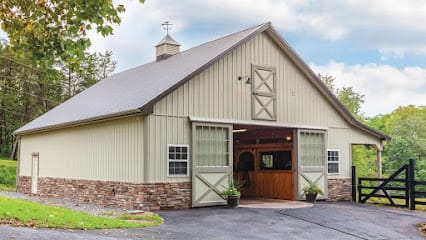
Photo: Conestoga Buildings
The photo is a horse barn, not a home, but it shows the post-frame shell, stone wainscot and trim work this builder lists. It shares a name with a Conestoga Buildings listing in Ephrata, Pennsylvania. With one in-state listing, most New Jersey owners will also look across the Delaware River: our Pennsylvania builders page lists nine more post-frame firms, and Fetterville publishes a building guide for New York and New Jersey. Whoever you hire, confirm they appear on the state's registered new home builder list before you sign.
Ready to price your build? Request quotes from builders who serve your county, and compare every number to our cost table.
Updated October 2026 · Barndo Finder research
Building in New Jersey: common questions
Do you need a permit to build a barndominium in New Jersey?
Yes. New Jersey's Uniform Construction Code applies in every municipality, and the local construction official issues the permit and runs inspections. The builder must also be registered with the Department of Community Affairs before a permit for a new home can be issued. Septic approval comes from the local board of health, and Pinelands or Highlands parcels need a state review as well.
How much does a barndominium cost in New Jersey?
Our directory estimate for New Jersey is $175 to $260 per square foot turnkey and $55 to $95 per square foot for a shell, the highest of the mid-Atlantic states in our data. A 2,400 square foot turnkey build works out to about $420,000 to $624,000 before land, well, septic, driveway and site work. These are estimates, not quotes.
Does a New Jersey barndominium builder need to be registered?
Yes. The New Home Warranty and Builders' Registration Act requires a builder to register with the state before starting construction of any new home, and to back each home with a limited ten-year warranty through the state plan or an approved private plan. The Department of Community Affairs publishes a list of registered builders you can check.
Can you build a barndominium in the New Jersey Pinelands?
Possibly, but anyone developing land in the Pinelands Area must file with both the Pinelands Commission and the municipality, and the Commission reviews local approvals for consistency with its management plan. Density and septic rules there are stricter than in most of the state, so check the parcel's Pinelands management area before you buy.
How do New Jersey's new flood rules affect a barndominium?
The state's REAL rules, adopted January 20, 2026, set a Climate-Adjusted Flood Elevation four feet above FEMA's base flood elevation in tidal flood hazard areas. A slab-on-grade barndominium in those areas may need fill, a raised foundation or a different site. Check the parcel against FEMA and state flood maps before you design anything.